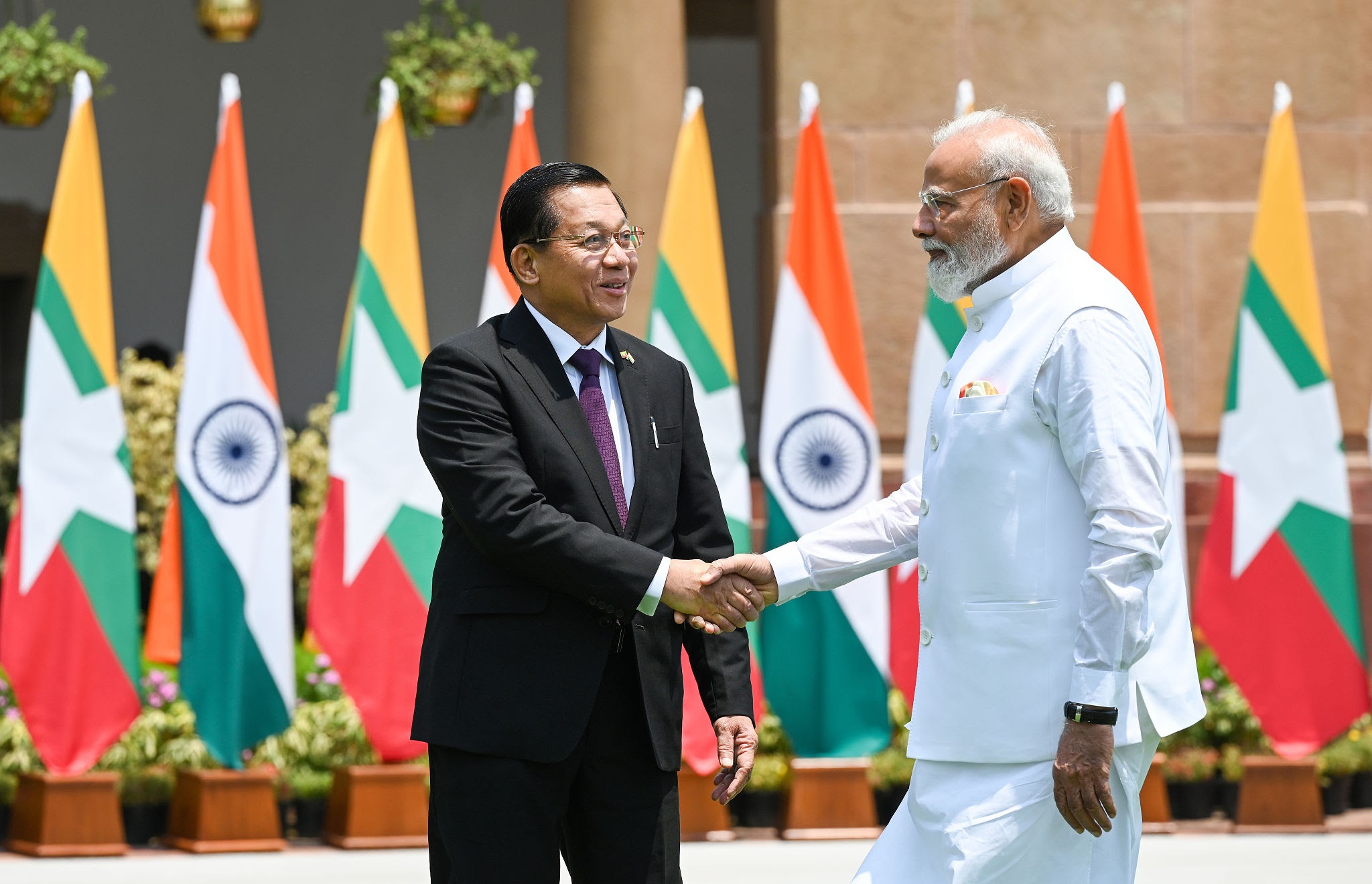
NEW DELHI — Indian Prime Minister Narendra Modi and visiting Myanmar President U Min Aung Hlaing held extensive bilateral discussions at Hyderabad House on Monday, June 1, 2026. The high-profile five-day official visit, running from May 30 to June 3, marks the Myanmar leader’s first foreign trip since being sworn in as president in April 2026 following highly scrutinized general elections. This diplomatic encounter arrives at a critical moment for both nations as they confront escalating security concerns along their shared perimeter, sluggish progress on joint economic infrastructure, and complex geopolitical shifts across South and Southeast Asia.
NEW DELHI - Indian Prime Minister Narendra Modi and visiting Myanmar President U Min Aung Hlaing held extensive bilateral discussions at Hyderabad House on Monday, June 1, 2026. The high-profile five-day official visit, running from May 30 to June 3, marks the Myanmar leader’s first foreign trip since being sworn in as president in April 2026 following highly scrutinized general elections. This diplomatic encounter arrives at a critical moment for both nations as they confront escalating security concerns along their shared perimeter, sluggish progress on joint economic infrastructure, and complex geopolitical shifts across South and Southeast Asia.
Strategic Security and Border Management Commitments
The primary focus of Monday's high-level dialogue centered on the management of the 1,643-kilometer (1,020-mile) international boundary separating India and Myanmar. According to official briefings from the Indian Ministry of External Affairs (MEA), Prime Minister Modi strongly reaffirmed India’s unwavering support for the sovereignty and territorial integrity of the Republic of the Union of Myanmar.
Central to India's domestic security interests is the activity of various Northeast insurgent groups that have historically utilized the dense, forested terrain of western Myanmar to establish sanctuary bases. During the closed-door meetings, the Indian delegation raised serious concerns regarding these insurgent factions and their potential to destabilize India's frontier states.
In response, President Min Aung Hlaing provided a firm diplomatic assurance to the Indian leadership. Official statements confirm that the Myanmar head of state reiterated that his country's sovereign territory would not be permitted under any circumstances to be utilized for activities inimical to India’s core security interests. Both sides underscored the vital importance of real-time intelligence sharing and coordinated border management to neutralize armed rebel movements and ensure long-term stability along the frontier.
Infrastructure and Regional Connectivity Projects Re-examined
The ongoing civil conflict within Myanmar has severely hampered several landmark infrastructure initiatives backed by New Delhi. The bilateral talks heavily focused on reviving and accelerating these lagging connectivity corridors, which form the bedrock of India's "Act East" and "Neighbourhood First" policies.
Chief among these projects is the Kaladan Multi-Modal Transit Transport project and the India-Myanmar-Thailand Trilateral Highway. Large sections of these routes traverse highly volatile regions where Myanmar’s military forces are actively engaged in hostilities with ethnic armed organizations and civilian People’s Defence Forces (PDFs).
Indian Foreign Secretary Vikram Misri acknowledged the operational difficulties during a special media briefing, noting that active conflict makes it exceedingly difficult to meet preset timelines. However, the MEA confirmed that India remains committed to utilizing operational lulls to advance construction safely. President Min Aung Hlaing assured Prime Minister Modi that the Myanmar government would extend all necessary administrative and security guarantees to ensure these strategic connectivity projects move toward rapid completion.
The Diplomacy of Engagement Amid Democratic Transition
The visit has drawn sharp criticism from international human rights organizations and Myanmar’s parallel opposition government, the National Unity Government (NUG). Ahead of the summit, NUG Foreign Minister Zin Mar Aung sent an official communication to India’s External Affairs Minister, Subrahmanyam Jaishankar, warning that formal diplomatic hosting risks legitimizing military-backed rule in Naypyidaw.
The Indian government, however, strongly defended its policy of continuous pragmatic engagement with its immediate neighbor. Officials argued that isolating Myanmar remains counterproductive to regional security and democratic progression.
"History has shown that disengagement does not give us any results that are better than engagement, and it certainly does not produce democratic change," stated Indian Foreign Secretary Vikram Misri. "Disengagement only produces a vacuum that others go on to fill to our detriment. And those others have no interest in democracy, I can assure you about that."
While defending the meeting as an absolute necessity, Prime Minister Modi explicitly raised the issue of Myanmar’s stalled democratic transition. Indian officials confirmed that Modi highlighted the status of deposed leader Aung San Suu Kyi, who remains under house arrest following the 2021 political upheaval. Modi emphasized that any durable resolution to Myanmar’s internal instability must be a "Myanmar-led and Myanmar-owned solution," driven by inclusive dialogue that brings all major political stakeholders back to the negotiating table.
Bilateral Trade, Technology, and Cybercrime Cooperation
Beyond hard security, the two leaders reviewed the economic portfolio connecting the neighboring economies. Bilateral trade between India and Myanmar reached an estimated $1.95 billion to $2 billion over the 2025–2026 financial period, characterized by a trade asymmetry where India’s exports stand at approximately $600 million against $1.5 billion in imports from Myanmar.
To ease transactional friction, the leaders praised the steady growth of the Rupee-Kyat settlement mechanism, which has been operational since May 2024. Looking forward, the bilateral agenda is expanding into advanced technical sectors. The two states agreed to foster deeper commercial and regulatory collaborations in:
Agro-processing and trade logistics
Petroleum refining and energy supply chains
Critical minerals exploration and rare earths extraction
Emerging technologies, including Artificial Intelligence (AI) and joint space sector initiatives
Furthermore, the leaders confronted the growing transnational threat of organized cybercrime. Transnational syndicates operating out of lawless zones in Southeast Asia have systematically trafficked foreign nationals into specialized scam compounds. The MEA reported that through close bilateral collaboration, over 2,411 Indian citizens have been successfully rescued and repatriated. Officials are currently working to secure the release of an estimated 150 remaining Indian nationals still trapped inside these illegal facilities.
To reinforce educational and cultural exchange amidst the ongoing crisis, India announced that the prestigious Mekong Ganga ICCR scholarships allotted to Myanmarese students will be substantially expanded from 36 to 100 annual seats starting in 2026. Following his high-level meetings with President Droupadi Murmu, NSA Ajit Doval, and Minister S. Jaishankar in New Delhi, President Min Aung Hlaing departed for Mumbai to conclude his tour with targeted corporate interactions at major industrial hubs, including the Jawaharlal Nehru Port Trust.
Official Sources Section
Information in this report is compiled directly from official government releases, diplomatic readouts, and press briefings provided by the Ministry of External Affairs, India and the State Administration Council of Myanmar.
Quote Section
"The Prime Minister reaffirmed India's support for the sovereignty and territorial integrity of the Republic of the Union of Myanmar... The President of Myanmar, in particular, reiterated the assurance that Myanmar's territory would not be permitted to be used against India's security interests."
-Official Transcript, Ministry of External Affairs Briefing
Why It Matters
For citizens and regional investors, stability in Myanmar directly dictates the security of Northeast India and determines the success of trans-Asian trade routes. Continued volatility threatens regional supply chains, drives refugee cross-migration into Indian border states, and creates geopolitical vacuums that competing regional superpowers can exploit to the detriment of South Asian security architecture.
Key Facts at a Glance
Historical Milestone: This five-day state visit marks President U Min Aung Hlaing’s very first foreign trip since his formal inauguration in April 2026.
Border Dimensions: India and Myanmar share a vast 1,643-kilometer land border alongside a vital maritime boundary within the Bay of Bengal.
Trade Volume: Total bilateral trade is hovering just above $2 billion, supported increasingly by the direct Rupee-Kyat currency settlement framework.
Humanitarian Rescue: Joint law enforcement operations have successfully repatriated 2,411 Indian nationals trafficked into illicit regional cyber-scam operations.
FAQ Section
Q1: Why is Myanmar President Min Aung Hlaing’s visit to India legally and politically significant?
A1: This marks his first diplomatic trip abroad since transitioning to the official role of civilian president in April 2026. The visit highlights India's conscious decision to maintain regular working relations with the Naypyidaw administration despite pushback from Western nations and domestic resistance groups.
Q2: What did the two nations decide regarding border security?
A2: Myanmar provided a renewed, firm commitment that its territory would not be used by insurgent groups to launch hostile operations against India. In return, India reaffirmed its strict respect for Myanmar's sovereign borders and territorial integrity.
Q3: How are the ongoing conflicts in Myanmar affecting Indian infrastructure projects?
A3: Intense fighting between the military and anti-junta coalition forces near construction zones has caused severe delays to the India-Myanmar-Thailand Trilateral Highway and the Kaladan Multi-Modal project. Both countries have agreed to utilize localized pauses in fighting to resume construction.
Q4: Did India address the democratic situation and opposition concerns during the talks?
A4: Yes. Prime Minister Modi explicitly advocated for a peaceful, inclusive path back toward full democracy, raising the status of detained leader Aung San Suu Kyi and calling for a solution that incorporates all primary national stakeholders.
Source: