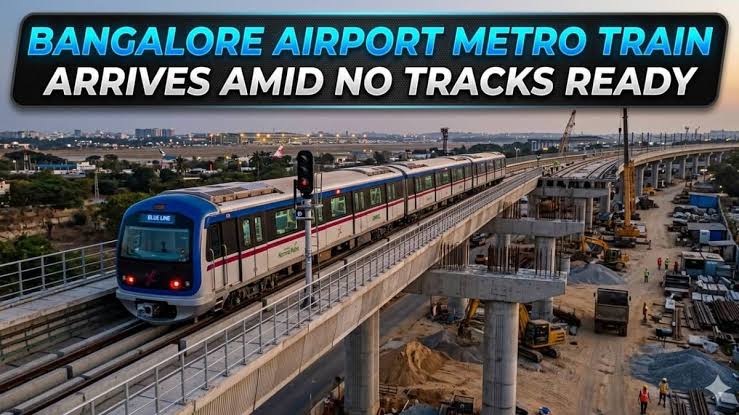
An independent study by the Indian Institute of Science (IISc) has labeled the double-decker road-cum-rail design for Namma Metro Phase 3 "economically unsound." Researchers warn the plan increases costs by ₹2,863.53 crore, drops economic returns below mandatory benchmarks, and worsens air pollution by promoting private vehicle use.
BENGALURU — A new comprehensive technical assessment by the Indian Institute of Science (IISc) has challenged the viability of Bengaluru’s proposed integrated double-decker metro corridors under Namma Metro Phase 3, declaring the projects "economically unsound" and counterproductive to urban mobility. The study, presented on June 28, 2026, details severe long-term financial, operational, and environmental consequences if the Bangalore Metro Rail Corporation Limited (BMRCL) proceeds with combining elevated road corridors alongside mass transit lines.
Led by Professor Ashish Verma of the IISc Sustainable Transportation Lab (IST Lab), the rigorous independent study concluded that building multi-layered road infrastructure directly above or below metro lines actively undermines the public transit system. According to the data, the dual structures will inadvertently encourage private vehicle reliance, causing an increase in overall traffic congestion, fuel consumption, and air pollution while significantly raising project capital costs.
Economic Rates of Return Plunge Well Below Benchmarks
The core of the controversy lies in the recalculated Economic Internal Rate of Return (EIRR), a critical financial index used by governments and international lenders to assess whether infrastructure benefits outweigh taxpayer investments. For public infrastructure projects in India, the standard accepted benchmark for a viable investment is an EIRR of 14%.
According to the IISc technical report submitted to the Union Ministry of Housing and Urban Affairs (MoHUA), incorporating the double-decker road infrastructure into Namma Metro Phase 3 drops the EIRR for BMRCL’s investment to just 9.07%. When assessing the overall double-decker project as a whole, the EIRR plummets further to a mere 5.43%.
In stark contrast, Professor Verma’s team demonstrated that if the elevated road component is completely removed—leaving an exclusive, standalone elevated metro rail corridor—the EIRR jumps substantially to 18%. This places a purely transit-oriented investment far above required developmental benchmarks.
The report highlights that adding the double-decker road infrastructure adds an immediate capital expenditure burden of ₹2,863.53 crore onto the Phase 3 budget. These escalated costs stem from the requirement for larger structural components, significantly deeper foundations, elevated station modifications, and complex multimodal integration.
Environmental and Traffic Complications Revealed
Beyond the fiscal strain, researchers mapped out travel behaviors up to the year 2041, uncovering severe systemic flaws. The study noted that while double-decker corridors may initially give the illusion of easing traffic, they ultimately induce more private vehicle usage. By 2041, the bus mode share in Bengaluru is projected to fall by 6.4%, and the metro mode share itself would contract by 1.4% due to the parallel facilitation of private vehicle corridors.
This projected shift back to personal cars and two-wheelers translates to an increased environmental toll. The assessment estimates that the proposed double-decker corridors would generate:
17,012 kg of additional carbon dioxide ($\text{CO}_2$) daily
85.9 kg of carbon monoxide ($\text{CO}$) daily
12.6 kg of nitrogen oxides ($\text{NO}_x$) daily
1.1 kg of dangerous $\text{PM}_{2.5}$ particulate emissions daily
Furthermore, fuel consumption across the city is projected to rise by more than 7,000 liters per day, translating directly into a daily financial loss exceeding ₹6.45 lakh for commuters in wasted fuel expenditure.
Official Sources Section
The data points, environmental metrics, and economic calculations cited in this report originate directly from the technical report 'Implications of Metro Double-Decker & Elevated Corridors on Bengaluru's Mobility & Environment' published by the Sustainable Transportation Lab at the Indian Institute of Science (IISc), alongside statutory filings from the Bangalore Metro Rail Corporation Limited (BMRCL).
Quote Section
Mobility experts argue that structural interventions must align with modern sustainability policies rather than outdated vehicle-first planning paradigms.
"Fundamentally, this project is incompatible with metro rail objectives and, at large, with sustainable mobility and livability goals of Bengaluru," Professor Ashish Verma stated during the interactive session on Sunday.
According to officials familiar with central planning reviews, the project faces institutional hurdles as well. The IISc study explicitly noted:
"The proposed double-decker infrastructure does not form part of Bengaluru's approved Comprehensive Mobility Plan (CMP), and proceeding without fresh clearances could expose the multi-crore project to severe legal and procedural challenges."
Why It Matters
For citizens, daily commuters, and taxpayers in Bengaluru, the IISc study indicates that massive double-decker road allocations may worsen local gridlock rather than solve it. The findings imply that pouring thousands of crores into elevated roads shifts bottlenecks down the line while draining funds that could otherwise expand public bus fleets or fast-track the delayed metro network. For international and domestic investors, these findings introduce significant regulatory and funding risks for Phase 3 approvals moving forward.
Key Facts at a Glance
Benchmark Failure: The double-decker layout reduces the project's Economic Internal Rate of Return (EIRR) to 9.07%, far below the mandatory 14% benchmark.
Transit Subversion: The integrated road design is projected to decrease Bengaluru's metro ridership share by 1.4% and bus share by 6.4% by 2041.
Financial Burden: Adding the elevated road components spikes the BMRCL capital expenditure by ₹2,863.53 crore.
Environmental Damage: Increased private vehicle travel will dump an estimated 17,012 kg of extra $\text{CO}_2$ into Bengaluru's atmosphere every day.
FAQ Section
Q: Why did the IISc declare Namma Metro Phase 3 double-decker plans economically unsound?
A: The IISc study calculated the project's Economic Internal Rate of Return (EIRR) at just 9.07% with the double-decker road added, which is well below the standard 14% requirement for public infrastructure. Without the road component, the metro's EIRR rises to a healthy 18%.
Q: How does building a double-decker flyover hurt metro ridership?
A: By providing expanded lanes for private cars and two-wheelers directly alongside mass transit, it incentivizes commuters to continue using private vehicles rather than shifting to public transit, thereby reducing overall metro and bus ridership.
Q: What is the extra financial cost of adding the double-decker road network?
A: Incorporating the double-decker road infrastructure increases capital expenditure by ₹2,863.53 crore due to the need for deeper foundations, heavier structural pillars, and elevated stations.
Source: IISc Sustainable Transportation Lab (IST Lab) Technical Assessment Report, June 2026; Ministry of Housing and Urban Affairs (MoHUA) Infrastructure Project Repository; Bangalore Metro Rail Corporation Limited (BMRCL) Phase 3 Project Proposals.