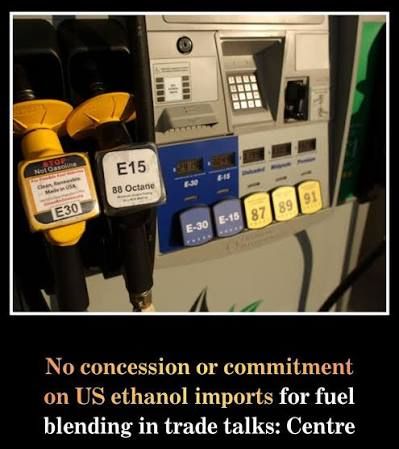
The Indian government has dismissed media reports suggesting it has agreed to import large quantities of ethanol from the United States under ongoing trade pact talks. The Ministry of Commerce and Industry clarified that the Ethanol Blended with Petrol Programme relies entirely on domestic production without foreign concessions
Amid ongoing bilateral trade discussions in New Delhi, federal authorities clarify that national fuel blending policies rely exclusively on domestic producers.
Addressing intense public debate and speculative media reports, the Indian government formally clarified on Thursday, August 6, 2026, that it has made no commitments or concessions regarding the import of ethanol from the United States. Issuing a definitive statement in New Delhi, the Ministry of Commerce and Industry dismissed claims suggesting that India intends to import large volumes of foreign biofuel for its national fuel blending initiatives as entirely baseless. The official pushback arrives as bilateral trade negotiations continue between Washington and New Delhi, setting strict boundaries to protect domestic agricultural interests and energy frameworks.
Deconstructing the Domestic Ethanol Framework
India’s broader energy transition strategy heavily relies on the Ethanol Blended with Petrol (EBP) Programme, which mandates mixing ethanol with petroleum to curb carbon emissions and reduce foreign exchange outflows. However, the administration emphasized that these operational requirements are insulated from international trade compromises.
Key structural aspects of India's current ethanol policy include:
Exclusive Domestic Sourcing: All ethanol utilized for fuel blending across domestic retail networks is procured entirely from local sugarcane, grain, and agricultural producers.
Exclusion from Trade Pacts: Ministry officials confirmed that US ethanol imports were not part of any concessions or commitments finalized during ongoing bilateral trade negotiations.
Macroeconomic Impact: Government data indicates that the domestic blending initiative has saved over ₹1.90 lakh crore in foreign exchange and redirected substantial supplementary revenue to Indian farmers since its inception.
Rebuttal of Policy Shift Rumors: Officials reiterated that suggestions of a sudden regulatory pivot allowing large-scale foreign fuel imports are misleading and factually inaccurate.
Impact on Domestic Farmers, Consumers, and Energy Markets
The categorical rejection of foreign ethanol imports carries significant practical implications for domestic agricultural stakeholders, sugar mills, and commercial investors. By restricting procurement to domestic feedstock providers, the policy safeguards millions of Indian farmers who depend on steady ethanol purchase quotas. For consumers and automotive investors, maintaining domestic supply chains ensures insulation from international commodity price shocks, even as retail fuel standards evolve under higher blending targets like E20. Industry analysts note that maintaining this boundary provides market stability while allowing bilateral trade talks to focus on non-sensitive industrial sectors.
Why It Matters
Ensuring absolute clarity on biofuel sourcing prevents market distortion and protects domestic agricultural supply chains. By establishing that national energy blending programs rely strictly on local production, the government preserves vital economic incentives for domestic farming communities.
Key Facts at a Glance
Core Policy Stance: Zero import of ethanol from the US for fuel blending purposes.
Governing Program: Ethanol Blended with Petrol (EBP) Programme managed through domestic agricultural procurement.
Trade Status: No concessions or trade pact commitments made regarding foreign ethanol.
Economic Benefit: Cumulative foreign exchange savings exceed ₹1.90 lakh crore through domestic biofuel substitution.
FAQ Section
Has India agreed to import US ethanol under the ongoing trade talks?
No. The Ministry of Commerce and Industry clarified that no concessions or commitments regarding ethanol imports from the US have been made in bilateral trade discussions.
Where does India source ethanol for its fuel blending program?
Ethanol used under the Ethanol Blended with Petrol Programme is sourced entirely from domestic agricultural producers within India.
Why are domestic ethanol sourcing rules important for farmers?
Restricting procurement to local producers guarantees a steady market and supplemental income for millions of Indian sugarcane and grain farmers.
Where can citizens track official updates regarding India's trade and energy policies?
Verified government announcements and policy clarifications are accessible via the Ministry of Commerce and Industry Portal and Newsonair.
Source: Ministry of Commerce and Industry, Newsonair, The Economic Times, Business Today