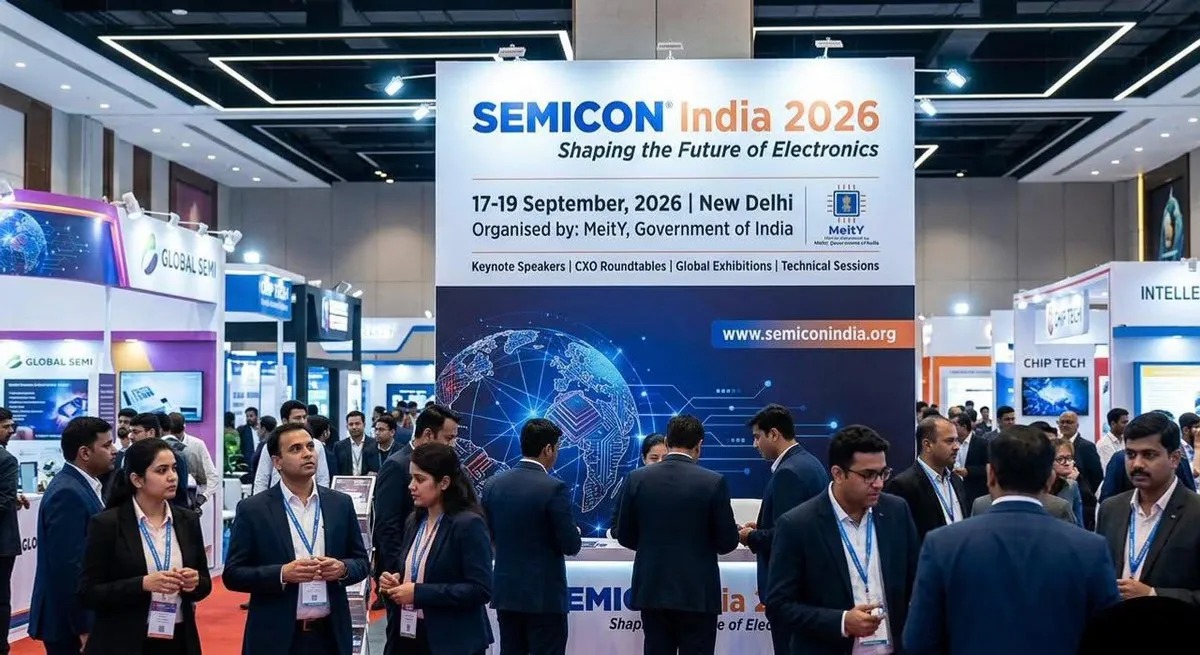
India will host the flagship SEMICON India 2026 exhibition in New Delhi from September 17–19, 2026. Organized by the India Semiconductor Mission and SEMI, the 18,000 sqm event will bring together over 400 global companies and six country pavilions to foster resilient, trusted electronics and hardware supply chains.
NEW DELHI — India will officially host the SEMICON India 2026 international convention over a three-day schedule running from September 17 to September 19, 2026. Organized jointly by the India Semiconductor Mission (ISM) under the Ministry of Electronics & IT (MeitY) and global industry association SEMI, the flagship summit will be staged at the Yashobhoomi India International Convention & Expo Centre in the national capital. The 2026 edition centers formally on the theme "Building Trusted and Resilient Semiconductor Ecosystems," focusing on deep supply chain collaborations and localized manufacturing partnerships as western electronics brands actively diversify beyond traditional East Asian foundry hubs.
Expanding Scale and Country Pavilions at Yashobhoomi
According to administrative project briefings released by MeitY on June 16, 2026, the microelectronics expo is structurally expanding to cover 18,000 square meters of exhibition space. The event organizers project active representation from more than 300 domestic enterprise suppliers alongside 100-plus major international equipment and chemical fabricators. A major operational feature of the 2026 convention layout includes the deployment of six dedicated Country Pavilions representing crucial technical corridors:
Japan and South Korea: Displaying advanced raw silicon crystal growth and chemical vapor deposition systems.
The Netherlands: Presenting lithography optimization frameworks and extreme ultraviolet (EUV) research partnerships.
Singapore and Malaysia: Highlighting regional assembly, testing, and outsourced semiconductor packaging methodologies.
Sweden: Showcasing specialized industrial automation engineering and cleanroom safety technologies.
To broaden the geographical spread of advanced tech beyond standard tech hubs, ten Indian state pavilions will also feature at the summit. State teams from Gujarat, Odisha, Uttar Pradesh, and Assam will pitch localized infrastructure incentives, power connectivity matrices, and land grants to multi-national foundry consortiums looking to lock in localized factories.
Strategic Shift Toward Equipment, Materials, and ISM 2.0
The focus of the upcoming SEMICON event represents an intentional policy pivot from pure capacity building toward manufacturing resilience and technology sovereignty. Following the rollout of the enhanced India Semiconductor Mission (ISM) 2.0 framework during the Union Budget cycle backed by a revised ₹8,000 crore spending outlay for the 2026–27 fiscal year the nation is prioritizing deeper manufacturing capabilities.
While ISM 1.0 successfully triggered construction on early packaging and compound fabs across Sanand and Dholera, the next stage shifts parameters toward producing semiconductor manufacturing equipment, specialized gases, and domestic intellectual property (IP) blocks. According to statements from Union Electronics and IT Minister Ashwini Vaishnaw, two major domestic semiconductor fabrication facilities have reached full commercial production scaling this quarter, with a third advanced assembly plant scheduled for inauguration in July.
Addressing the Global Engineering Talent and Workforce Gap
For semiconductor industry executives, academic institutions, and young engineering professionals, a core focal point of SEMICON India 2026 remains bridging the critical global talent shortage. The microelectronics value chain requires highly specialized engineering expertise to maintain yield consistency within sub-nanometer fabrication lines.
To systematically address this bottleneck, the upcoming exhibition features a 360-square-meter Workforce Development Pavilion alongside a national university hackathon. The platform allows global logic designers and tool manufacturers to recruit directly from elite Indian technological institutes, linking academic curricula with specialized engineering needs.
Official Sources Section
The summit timelines, layout dimensions, and state allocation metrics mapped in this news brief are derived from official press releases issued by the Ministry of Electronics and Information Technology (MeitY) and the regulatory event platform organized by the India Semiconductor Mission. National industrial policy data and budget outlays are compiled from statutory updates published by the Press Information Bureau (PIB).
Quote Section
"According to officials from the India Semiconductor Mission's steering council, the scheduling of SEMICON India 2026 between September 17 and 19 establishes a key marker on the global electronics calendar. Organizers stated that the focus of this edition shifts directly away from general interest-building to technical execution, seeking to lock in deep supply commitments for chemical gas refinement and complex tooling plants right on Indian soil."
Why It Matters
Securing a reliable microelectronics pipeline is crucial to stabilizing consumer electronics, vehicle manufacturing, and national defense platforms from sudden geopolitical blockades. As advanced chips form the structural backbone of 5G infrastructure, electric vehicle powertrains, and artificial intelligence networks, reliance on concentrated geographical hubs introduces severe supply chain vulnerabilities. By building domestic ecosystems spanning chemical supplies, logic design, and advanced packaging, India aims to establish a reliable secondary supply node for global technology brands.
Key Facts at a Glance
Event Parameters: SEMICON India 2026 will run for three consecutive days from September 17 to September 19, 2026, in New Delhi.
Exhibition Dimensions: The convention floor will span 18,000 square meters, featuring six specialized international country pavilions.
Policy Integration: The assembly directly supports India’s newly expanded ISM 2.0 initiative, which targets equipment localization and domestic Design IP creation.
Talent Initiative: A dedicated workforce development pavilion will connect over 400 exhibiting technology firms with regional engineering talent pools.
FAQ Section
Which global countries are setting up official pavilions at the 2026 tech expo?
The Ministry of Electronics & IT has confirmed dedicated country pavilions from Japan, South Korea, the Netherlands, Singapore, Malaysia, and Sweden.
How does ISM 2.0 differ from the original India Semiconductor Mission framework?
While the original mission focused heavily on funding assembly plants and testing labs, ISM 2.0 zeroes in on localizing complex fabrication equipment, refining chemical materials, and creating Indian design patents.
Can retail technology startups and engineering students attend the main event?
Yes. The 2026 layout includes a dedicated Start-Up Pavilion highlighting 40 disruptive tech companies, alongside organized workforce zones and technical hackathons for student developers.
Source: Official press circulars, event overviews, and statutory budget summaries distributed by the Ministry of Electronics and IT, India Semiconductor Mission, and SEMI Corporation.