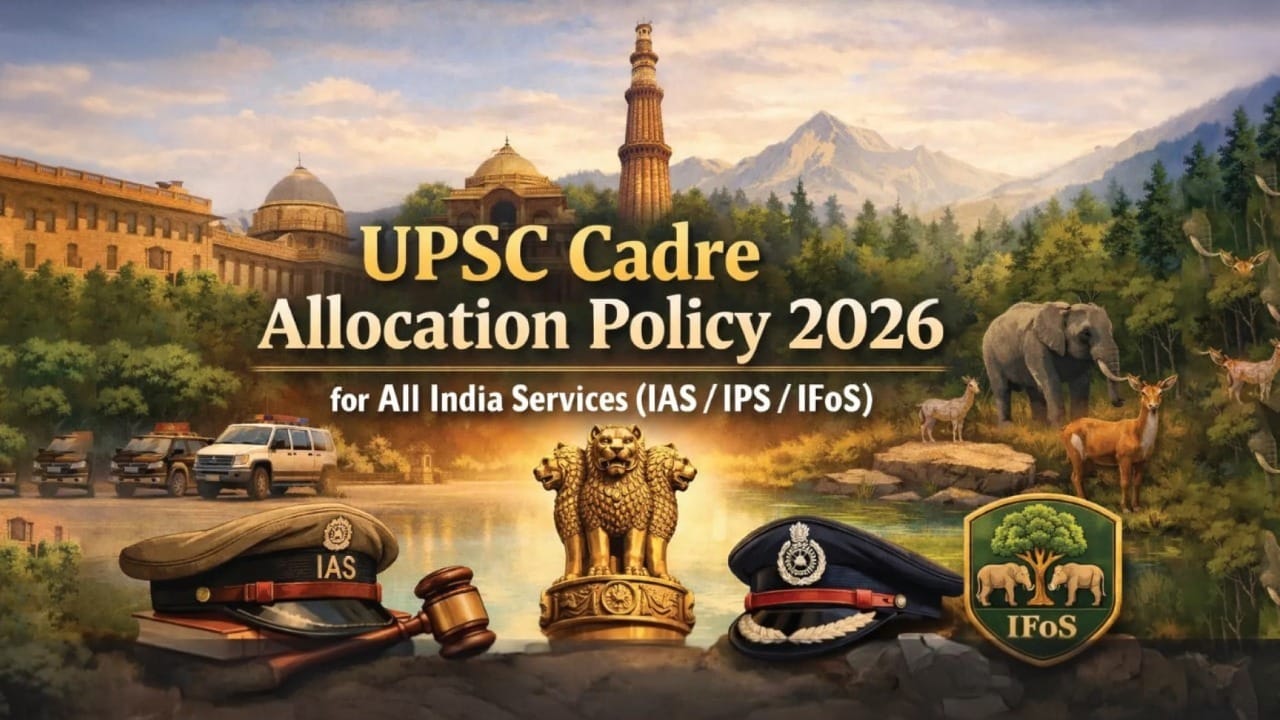

The UPSC Cadre Allocation Policy 2026 introduces a group-based system replacing the zonal framework. Cadres are now divided alphabetically into four groups, with insider vacancies prioritized over outsider ones. The revised rules aim to ensure fairness, transparency, and balanced officer distribution across states for IAS, IPS, and IFoS aspirants.
The Department of Personnel and Training (DoPT) has unveiled the UPSC New Cadre Allocation Policy 2026, marking a significant shift in how IAS, IPS, and Indian Forest Service officers will be assigned their state cadres. This policy, effective from the Civil Services Examination 2026, replaces the zonal system introduced in 2017.
Key Highlights
-
The five-zone system has been scrapped, and cadres are now grouped alphabetically into four broad categories. This restructuring is designed to ensure a more balanced spread of officers across states.
-
Insider vacancies will be filled before outsider vacancies, strictly on the basis of merit and category. This change emphasizes transparency and fairness in the allocation process.
-
Cadre allocation will follow cycles of 25 cadres, ensuring systematic distribution. The new grouping system simplifies cadre preferences for aspirants, reducing complexity compared to the earlier zonal arrangement.
-
The revised framework integrates provisions for Economically Weaker Sections (EWS), ensuring inclusivity in the allocation process.
-
The government consulted extensively with state administrations before finalizing the policy, aiming to balance national integration with regional representation.
-
The allocation process continues to be governed by rank, category, and vacancy availability, but the new grouping system is expected to minimize disparities and enhance efficiency.
This policy is a landmark reform in cadre allocation, reflecting the government’s intent to create a transparent and equitable system for future civil servants. Aspirants preparing for UPSC 2026 should carefully study the new framework to understand how their preferences and ranks will interact with the revised rules.
Sources: The Indian Express, Hindustan Times, Vajiram & Ravi