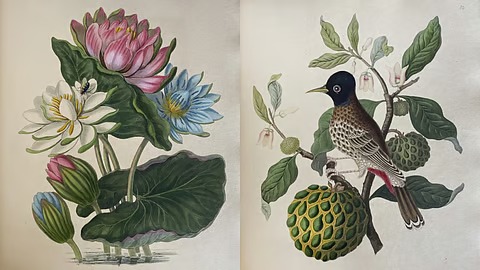
Colonial India’s botanical paintings, celebrated for their scientific precision and artistic beauty, were largely created by anonymous Indian artists working under East India Company officials. Recent research by historian H.J. Noltie and others reveals how these “Company School” painters blended indigenous artistry with European science, leaving behind a legacy long overshadowed by colonial narratives.
Key Highlights
-
Anonymous Genius: Most colonial botanical paintings were produced by Indian artists whose names were erased from records, overshadowed by British patrons and taxonomists.
-
Company School Painters: These artists, often trained in traditional miniature styles, adapted their skills to meet the scientific demands of the East India Company.
-
Art Meets Science: Paintings combined aesthetic detail with taxonomic precision, sometimes left partially colored to aid botanists in classification.
-
Recent Recognition: Historian H.J. Noltie’s work at the Royal Botanic Gardens, Kew has brought renewed attention to these forgotten figures.
-
Regional Traditions: Schools like Patnakalam in Bihar exemplified the fusion of indigenous art with European scientific documentation.
The Story Behind the Paintings
During the 18th and 19th centuries, the East India Company commissioned thousands of botanical illustrations to catalog India’s rich flora. While British officers and naturalists often took credit, the actual artistry came from local painters who meticulously documented plants, flowers, and fruits. These works were not mere art — they were scientific records, essential for identifying species and studying biodiversity.
The painters, many trained in Mughal and regional miniature traditions, adapted their techniques to meet European expectations. They emphasized accuracy of form, structure, and color, ensuring botanists could classify species correctly. Some paintings were deliberately left unfinished, with outlines or partial coloring, so scientists could focus on specific morphological details.
Unsung Artists and Their Legacy
The anonymity of these artists reflects the colonial erasure of indigenous contributions. While British patrons like William Roxburgh or Joseph Hooker are remembered, the painters remain nameless. Yet their work was foundational — bridging art and science, and creating a visual archive of India’s biodiversity.
The Patnakalam school in Bihar is a striking example. Emerging in the 19th century, it blended local artistic traditions with European scientific needs. These painters produced detailed botanical drawings that were both scientifically useful and aesthetically captivating.
Why It Matters Today
-
Cultural Recognition: Acknowledging these artists restores dignity to their contributions and highlights India’s role in global scientific history.
-
Scientific Value: The paintings remain valuable references for botanists, offering insights into species that may have changed or disappeared.
-
Artistic Heritage: They showcase the adaptability of Indian art traditions, merging miniature painting techniques with natural history illustration.
Outlook
As scholars like H.J. Noltie continue to uncover the identities and stories of these painters, India’s colonial botanical art is being reframed not just as a product of imperial science, but as a testament to indigenous skill, creativity, and resilience. These works remind us that behind every scientific breakthrough lies the artistry of human hands.
Sources: The Hindu, The Wire Science, Rupkatha Journal, Royal Botanic Gardens Kew