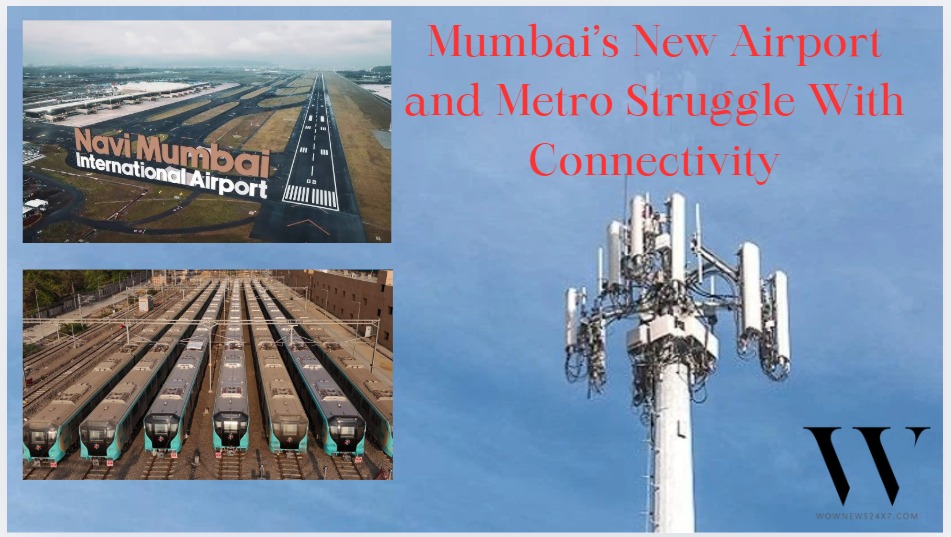

Mumbai’s new Navi Mumbai International Airport and Aqua Metro Line 3 face severe mobile signal issues due to disputes over high access fees between telecom operators and authorities. With only BSNL and Vi offering partial coverage, commuters rely on patchy networks or free Wi-Fi, raising concerns about convenience and safety.
Mumbai’s glittering new infrastructure projects the Navi Mumbai International Airport (NMIA) and the Aqua Metro Line 3 (Colaba-Bandra-SEEPZ) are making headlines not just for their scale but for a surprising shortfall: signal starvation. Despite being equipped with advanced in-building solutions (IBS) designed to boost mobile signals indoors, both facilities remain plagued by poor connectivity.
Airport Connectivity Crisis
At NMIA, telecom operators have refused to provide services after authorities demanded ₹92 lakh per month for access to IBS systems. This fee is significantly higher than what operators pay at other airports, leading to a standoff. As a result, passengers currently rely on BSNL’s limited coverage or the airport’s free Wi-Fi, leaving most users of Jio and Airtel disconnected.
Metro Line 3 Blackout
The situation is equally dire underground. Since its launch in October 2025, the Aqua Metro Line 3 has struggled with mobile network blackouts. Stations between Worli and Colaba remain without connectivity, as telecom firms and the Mumbai Metro Rail Corporation Ltd (MMRCL) clash over infrastructure charges. Only Vodafone Idea (Vi) and BSNL provide partial service, while Jio and Airtel users face complete outages.
Impact on Commuters
For passengers, the lack of connectivity is more than an inconvenience. Dropped calls, inability to access navigation apps, and safety concerns during emergencies have sparked frustration. Critics argue that projects marketed as “world-class” infrastructure cannot afford to overlook basic digital connectivity.
The Bigger Picture
The disputes highlight a broader challenge in India’s infrastructure rollout: balancing commercial interests with public utility. Until pricing disagreements are resolved, commuters at Mumbai’s newest airport and metro line will continue to face a digital blackout.
Conclusion
Mumbai’s signal-starved airport and metro underscore the importance of seamless connectivity in modern infrastructure. While disputes over fees persist, the absence of reliable mobile networks risks undermining the city’s promise of world-class commuting experiences.
Sources: Indian Express, NewsBytes, Times Now