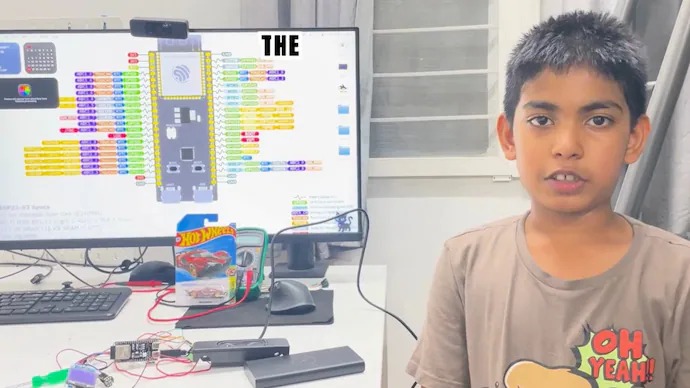
Eight-year-old developer Laksh, co-founder of Projects by Laksh, has built a voice-controlled AI storytelling device that operates completely offline. Powered by an $8 (₹760) ESP32-S3 microcontroller, the device uses open-source language models to generate stories, read them aloud, and display animations without internet connectivity.
NEW DELHI — Eight-year-old developer Laksh, co-founder of the educational initiative Projects by Laksh, has built a standalone, voice-controlled artificial intelligence storytelling device that functions without an internet connection. Disclosed on July 29, 2026, the project utilizes a low-cost ESP32-S3 microcontroller priced at approximately $8 (₹760), demonstrating that small-scale large language models (LLMs) can run locally on low-power hardware. The innovation eliminates reliance on cloud computing infrastructure, Wi-Fi connectivity, or third-party application programming interfaces (APIs), opening practical applications for digital learning tools in remote or internet-restricted environments.
Technical Architecture and Hardware Components
The compact device operates on edge-computing principles, processing all computational tasks locally on the silicon chip. To achieve offline functionality, Laksh modified an open-source lightweight language model, TinyStories LLM for ESP32, originally created by developer slvDev.
The system integrates four primary hardware components:
Processing Unit: An ESP32-S3 microcontroller executing local model inference.
Audio Input: An INMP441 omnidirectional microphone capturing spoken user prompts.
Amplification & Output: A MAX98357A digital audio amplifier paired with an I2S speaker for voice synthesis.
Visual Display: An integrated mini-display showing real-time simple animations alongside story generation.
During a technical demonstration, the device successfully received the voice prompt "Make a funny story," generated a original short narrative on-chip, read the text aloud, and responded to verbal playback commands including "play," "pause," "resume," and "next story".
Edge AI and Offline Learning Implications
The development highlights a growing trend toward Edge AI—running artificial intelligence algorithms directly on local physical hardware rather than relying on centralized data centers. Operating AI locally provides distinct advantages regarding data privacy, zero latency from network traffic, and zero ongoing cloud subscription costs.
For educational institutions and rural development agencies, offline AI devices offer a practical method for deploying interactive learning tools in regions with inconsistent power grids or limited telecommunications coverage. While current text-to-speech (TTS) output on basic microcontrollers remains robotic, Laksh noted that improving speech synthesis quality on low-memory microchips represents the next development phase for the project.
Official Sources Section
Technical schematics, open-source repository modifications, and hardware demonstrations cited in this report reflect disclosures published by Projects by Laksh on public software development repositories and reported by the India Today Education Desk. Open-source model parameters comply with developer documentation for slvDev's TinyStories ESP32 implementation.
Quote Section
"According to developer disclosures, the AI storytelling system performs all natural language processing and text-to-speech conversion locally on the ESP32 chip without transmitting data to external cloud servers."
"Technology analysts stated that combining lightweight open-source models with sub-$10 microcontrollers demonstrates the potential for accessible, privacy-focused educational hardware in underserved markets."
Why It Matters
Most commercial AI tools depend on continuous internet access, high-bandwidth connections, and expensive cloud server processing. By demonstrating that a functional voice-interactive AI storyteller can run on a $8 microcontroller, this project proves that interactive educational technology can be produced at a fraction of standard commercial costs. This approach reduces barrier-to-entry costs for schools and families in low-connectivity regions while eliminating data privacy concerns associated with cloud-connected microphones.
Key Facts at a Glance
Developer: Built by 8-year-old innovator Laksh, co-founder of Projects by Laksh.
Core Hardware: Operates on an $8 (₹760) ESP32-S3 microcontroller with an INMP441 microphone and MAX98357A amplifier.
Offline Operation: Requires zero Wi-Fi, cellular data, cloud APIs, or external server connections.
Functionality: Accepts voice commands to generate, animate, and read original short stories aloud.
Frequently Asked Questions (FAQ)
How does the offline AI storyteller work without the internet?
The device uses a compressed, lightweight large language model (TinyStories LLM) loaded directly onto the flash memory of the ESP32-S3 microcontroller, allowing it to process text and speech locally on the chip.
What hardware components were used to build the device?
The setup includes an ESP32-S3 microcontroller, an INMP441 microphone module, an I2S speaker, a MAX98357A audio amplifier, and a small display screen for animations.
What commands can the offline AI storyteller understand?
The device responds to voice commands such as "make a funny story," "play," "pause," "resume," and "next story".
Why is offline AI technology important for education?
Offline AI allows interactive, responsive learning devices to operate in remote areas without internet infrastructure, while protecting child user privacy by keeping voice recordings off cloud servers.
Source: Technical dispatches and project releases published via India Today Education and open-source project documentation on GitHub.