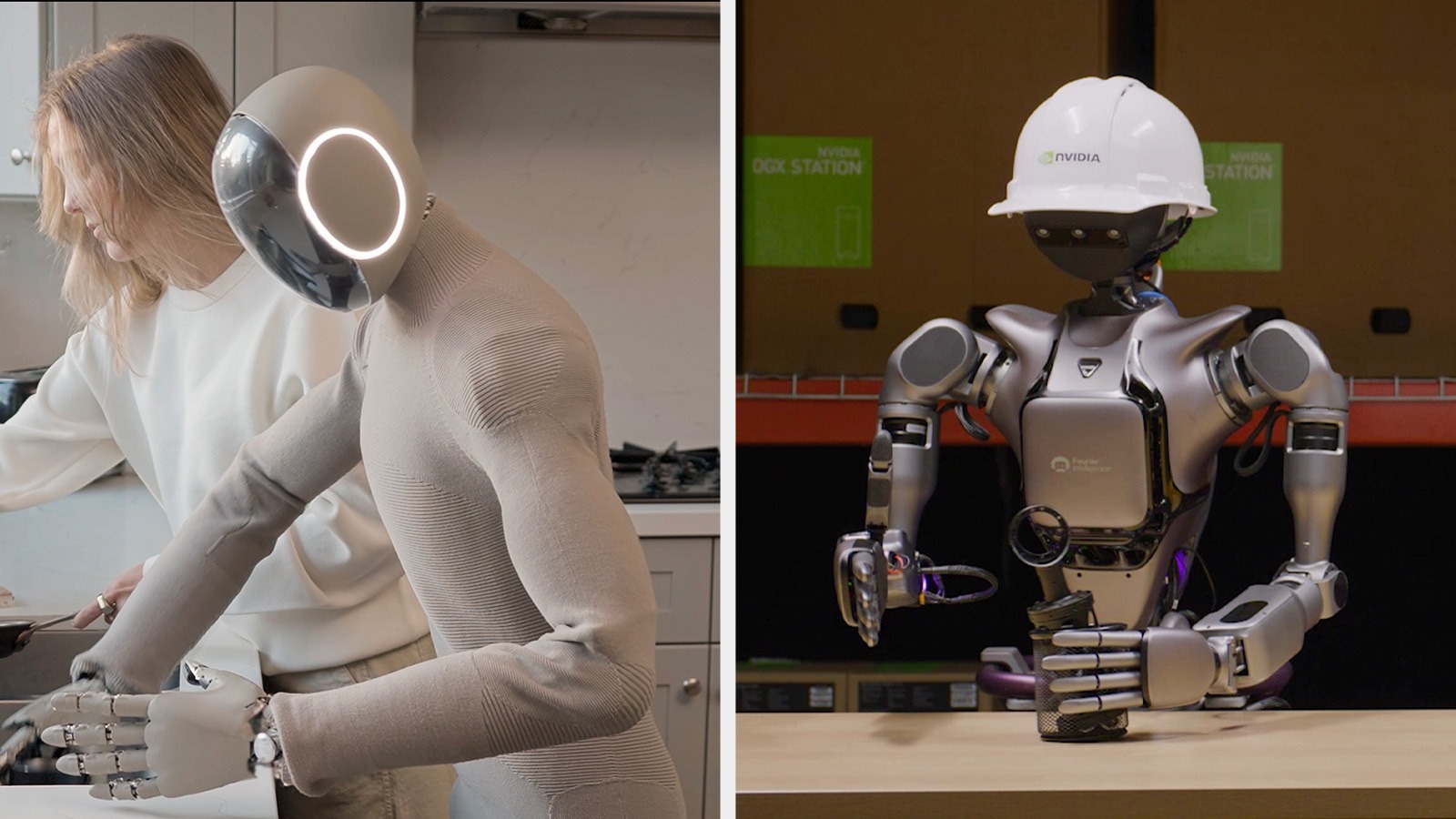
Nvidia has partnered with Chinese robotics startup Unitree to launch its first publicly available humanoid robot system targeting universities and research labs worldwide. The system pairs Unitree's nearly six-foot-tall H2 robot with Nvidia's Jetson Thor chip powered by Blackwell GPU technology, including the full Isaac GR00T AI model stack and simulation tools all in one ready-to-research package.
While the world's attention has long been fixed on Tesla's Optimus as the face of humanoid robotics, Nvidia just quietly made a far more disruptive move. The chipmaker has chosen Chinese startup Unitree to power its first integrated humanoid robot platform built specifically for the research community, unveiled by CEO Jensen Huang during a Taipei keynote on June 2, 2026. The announcement signals Nvidia's growing ambition to become the operating system of the physical AI era and it isn't waiting for Big Tech to lead the way.
Not Tesla, Not Boston Dynamics Unitree
The Nvidia-Unitree partnership is a deliberate, strategic pivot toward accessibility over spectacle. The system bundles Unitree's H2 humanoid standing six feet tall and weighing 150 pounds with Nvidia's Jetson Thor hardware and Blackwell GPU, delivering on-device AI at a level previously unavailable to most research institutions. Mechanical hands are supplied by Singapore-based Sharpa, adding another layer of precision engineering to the integrated package.
The Brain Behind The Robot
At the heart of the system sits Isaac GR00T, Nvidia's suite of humanoid AI models, designed to enable reasoning, full-body motion control, and real-world task generalization. Robots trained entirely in virtual simulation environments can now be deployed in the real world without the need for expensive, specialized hardware infrastructure. Jensen Huang described the platform as running the "entire software stack, data generation stack, simulation stack, and runtime — all integrated into one robot designed for everyone to use."
Opening Robotics To The World
The upgraded H2 Plus variant is set for an October 2026 launch and will be available for public purchase, a move Nvidia's VP of Physical AI Simulation Rev Lebaredian said is aimed explicitly at democratizing humanoid robotics beyond large tech firms. At least four research institutions including Stanford Robotics Center, ETH Zurich, UC San Diego's Advanced Robotics and Controls Laboratory, and Ai2 in Seattle are among the first adopters. No China-based institutions were included in the initial rollout.
Key Highlights
- Nvidia picks Unitree's H2 humanoid robot for its first publicly available humanoid research platform
- System integrates Nvidia's Jetson Thor chip, Blackwell GPU, Isaac GR00T AI models, and virtual simulation tools
- Mechanical hands developed by Singapore-based Sharpa offer 25 degrees of freedom per hand
- Upgraded H2 Plus variant launching in October 2026, open for public purchase
- Initial rollout targets Stanford, ETH Zurich, UC San Diego, and Ai2 in Seattle
- No Chinese research institutions included in the first deployment wave
- Nvidia's broader robotics ecosystem already includes partners like Boston Dynamics, ABB, Caterpillar, and NEURA Robotics
Sources: CNBC, NDTV, TechCrunch, Nvidia Newsroom (June 2026)