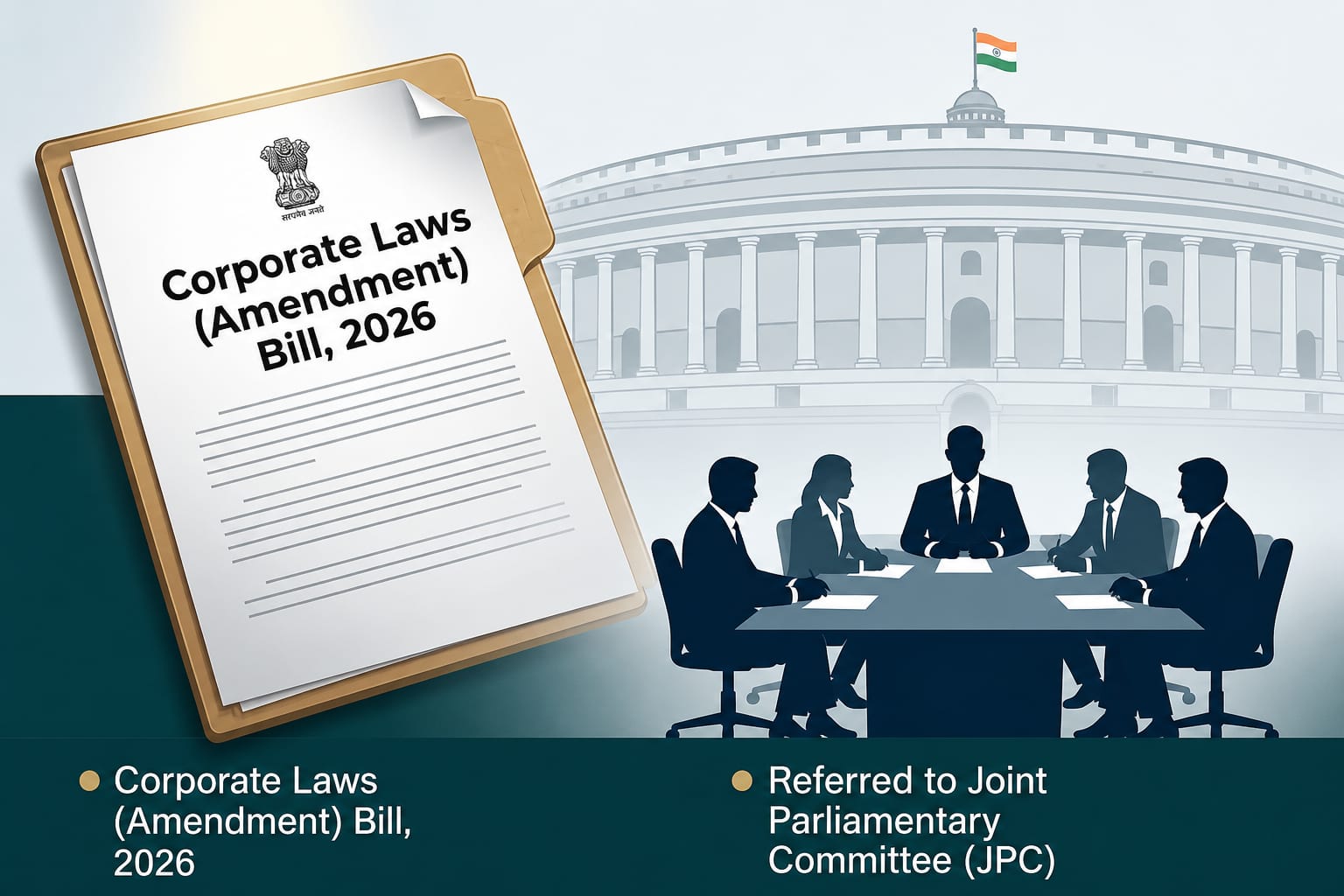
The Joint Parliamentary Committee evaluating the Corporate Laws (Amendment) Bill, 2026, met with Ministry of Finance and NFRA officials on Wednesday. The consultations focused on reclassifying minor procedural corporate lapses into civil penalties while augmenting the NFRA's powers to supervise independent audit quality and corporate compliance.
NEW DELHI, India — The Joint Committee of Parliament examining the Corporate Laws (Amendment) Bill, 2026, officially convened on Wednesday, June 24, 2026, to evaluate testimonies and strategic inputs from top officials of the National Financial Reporting Authority (NFRA) and the Ministry of Finance. This high-level consultation marks a pivotal phase in the legislative review of the sweeping bill, which seeks to fundamentally restructure India's corporate governance architecture.
The parliamentary panel, chaired by Bharatiya Janata Party (BJP) Member of Parliament (MP) Sudheer Gupta, is systematically vetting the draft legislation before submitting its final recommendations to Parliament. Introduced in the Lok Sabha on March 23, 2026, by Union Minister for Finance and Corporate Affairs Nirmala Sitharaman, the bill proposes comprehensive amendments to both the Companies Act, 2013, and the Limited Liability Partnership (LLP) Act, 2008. The central objective of the review is to strike a precise statutory balance between expanding the "ease of doing business" for law-abiding businesses and reinforcing institutional accountability across the financial ecosystem.
Decriminalization of Minor Defaults and Rationalizing Penalties
A core pillar of the Corporate Laws (Amendment) Bill, 2026, presented before the panel involves the extensive decriminalization of minor, technical, and procedural defaults. Under current statutory frameworks, simple compliance lapses—such as administrative delays in filing corporate returns or minor disclosure omissions—can technically expose company directors and partners to criminal liability, including lengthy court litigation and potential imprisonment.
The proposed amendments intend to shift these routine procedural infractions out of the criminal ambit, replacing them with a rationalized matrix of civil monetary penalties. According to Ministry of Finance representations submitted to the committee, this transition is projected to sharply reduce the commercial litigation burden on Indian courts while simultaneously lowering operational risks for corporate entities and LLPs. By eliminating the threat of criminal prosecution for non-fraudulent clerical errors, the government aims to establish a more facilitative, less adversarial environment for domestic and international investors.
Expanding NFRA Jurisdiction and Audit Quality Oversight
While the bill eases pressures on minor procedural items, it conversely introduces significantly stricter accountability guidelines for corporate auditing and accounting practices. NFRA Chairperson Nitin Gupta, accompanied by Full-Time Member Smita Jhingran and other regulatory officials, briefed the parliamentary panel on provisions designed to elevate the independent watchdog’s statutory capabilities.
The Corporate Laws (Amendment) Bill, 2026, seeks to formally reconstitute the NFRA as a fully autonomous body corporate under Section 132 of the Companies Act, bringing its regulatory and regulation-making powers on par with apex watchdogs like the Securities and Exchange Board of India (SEBI) and the Competition Commission of India (CCI).
Key structural transformations evaluated by the panel include:
Autonomy to Regulate: Empowering the NFRA to directly draft internal regulations governing its investigative operations, staff management, and fee structures.
Graduated Sanctions Framework: Introducing a tiered disciplinary system allowing the regulator to issue mild advisories, censures, or formal warnings, alongside existing powers of severe financial debarment.
Prohibition on Non-Audit Services: Banning statutory auditors of prescribed classes of companies from providing any secondary non-audit services to the client, its holding company, or its subsidiaries—with a mandatory three-year post-tenure cooling-off period.
Criminal Backing for Enforcement: Establishing explicit criminal sanctions (including up to six months of imprisonment or substantial fines) for individuals or audit firms that intentionally fail to comply with NFRA compliance orders or default on penal recoveries.
Easing Compliance for Small and Mid-Sized Enterprises
Beyond regulatory enforcement, the joint committee reviewed several developmental components included in the draft text to support the growth of smaller business structures. Notably, the bill proposes to double the statutory upper limits governing the legal definition of a "small company." Under the revised guidelines, the paid-up share capital cap will scale from INR 10 crore to INR 20 crore, while the annual turnover ceiling will expand from INR 100 crore to INR 200 crore.
This threshold expansion will legally reclassify a significant universe of mid-sized private companies as small companies, granting them access to various simplified compliance frameworks, relaxed board meeting frequencies, and lower statutory penalty rates. Furthermore, the bill updates Corporate Social Responsibility (CSR) compliance mandates, exempting companies with moderate profitability from mandatory CSR committee structures by raising the committee exemption threshold from INR 50 lakh to INR 1 crore.
Official Sources Section
The ongoing consultative proceedings and legislative benchmarks are monitored in accordance with official announcements from the Joint Committee of Parliament and administrative briefings distributed by the Ministry of Corporate Affairs. Regulatory viewpoints and presentation timelines remain anchored to the official gazetted text of the Corporate Laws (Amendment) Bill, 2026.
Quote Section
"Organizers stated that the Joint Committee of Parliament will continue its systematic series of consultations, engaging with prominent industry chambers, legal experts, and financial market professionals before finalizing its comprehensive review report for parliamentary presentation."
Why It Matters
The outcome of the parliamentary panel's evaluation will directly shape the legal landscape governing Indian commerce. For international investors and corporate executives, the bill's passage will simplify operational setups and eliminate systemic litigation risks tied to routine documentation. Simultaneously, for public shareholders and institutional fund managers, the enhanced powers granted to the NFRA provide a robust layer of protection against accounting malpractice, reinforcing the overall credibility of corporate financial reporting in India.
Key Facts at a Glance
Targeted Legislation: The Corporate Laws (Amendment) Bill, 2026, modifies key sections of the Companies Act, 2013, and the Limited Liability Partnership Act, 2008.
Regulatory Upgrade: The bill transforms the NFRA into an autonomous body corporate with independent regulation-making and enforcement frameworks.
Decriminalization Drive: Minor clerical and procedural errors are reclassified from criminal offenses to civil defaults backed by financial penalties.
Small Business Relief: Threshold boundaries for "small companies" are doubled, exempting thousands of mid-market enterprises from intense compliance burdens.
Audit Safeguards: A statutory three-year cooling-off period is introduced to strictly prevent auditors from offering non-audit services to their corporate clients.
Frequently Asked Questions
What is the main purpose of the Corporate Laws (Amendment) Bill, 2026?
The bill aims to modernize India’s corporate architecture by easing compliance burdens, decriminalizing routine administrative filing errors, and substantially strengthening independent audit oversight to protect investors.
How does this bill change the role of the NFRA?
It upgrades the NFRA into a fully autonomous corporate regulator on par with SEBI. It grants the authority to issue regulations, utilize a graduated disciplinary framework (such as warnings and censures), and enforces strict criminal penalties for non-compliance with its orders.
Will small businesses benefit from these amendments?
Yes. By doubling the capital and turnover limits that define a "small company," a significantly larger number of mid-sized businesses can legally qualify for reduced regulatory filings and lower penalty scales.
Source: Ministry of Corporate Affairs Legislative Vault, Lok Sabha Joint Parliamentary Committee Records, National Financial Reporting Authority Executive Board Announcements.