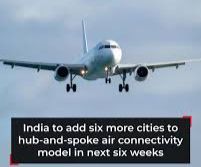
The hub-and-spoke aviation model, launched by the Civil Aviation Ministry in Varanasi on June 25, 2026, enables passengers from Tier-2 and Tier-3 cities to complete immigration and baggage check-in at their home airport. This seamless transit through major hubs like Delhi aims to boost international connectivity and drive regional economic growth.
VARANASI — The landscape of Indian aviation underwent a strategic transformation on Thursday, June 25, 2026, as Civil Aviation Minister K. Ram Mohan Naidu inaugurated the first "hub-and-spoke" flight service from Varanasi. The new initiative, branded as the "Easy Connect" service, allows passengers from Tier-2 and Tier-3 cities to complete immigration and baggage check-in procedures at their home airport, facilitating seamless international transit via major hubs like New Delhi.
This milestone project is part of a broader government roadmap to position India as a global aviation powerhouse by 2047. By redirecting international traffic—previously routed through foreign hubs like Dubai or Singapore—through domestic airports, the initiative aims to enhance the efficiency of the national aviation network and stimulate economic growth in smaller urban centers.
Transforming the Passenger Experience
Under the traditional point-to-point model, travelers from smaller cities often faced the logistical burden of collecting baggage and clearing repeated customs and immigration checks at large transit hubs. The hub-and-spoke model eliminates these hurdles.
According to Air India, which is the first carrier to operationalize this service, passengers boarding from Varanasi can now check their luggage directly to their final international destination. Immigration formalities are completed at the origin airport, allowing transit through Delhi Airport—the country’s largest aviation gateway—as international passengers. The model is initially being used to connect travelers to over a dozen overseas destinations, including London, Frankfurt, Singapore, Dubai, and Riyadh.
Strategic Expansion Plans
The government has set an ambitious timeline for scaling this infrastructure. Minister K. Ram Mohan Naidu confirmed that six additional cities will be integrated into the hub-and-spoke model within the next six weeks. While the specific list of upcoming cities may evolve, the airline and ministry have identified Amritsar, Vadodara, Mumbai, Hyderabad, Chennai, and Visakhapatnam as primary candidates for the program's next phase.
To support this surge in international connectivity, the Civil Aviation Ministry has also announced a major infrastructure overhaul for Varanasi Airport. Within the next 13 months, the facility is slated to receive a runway extension, a new terminal building, and multi-level car parking, bringing its capacity and amenities in line with Delhi’s world-class standards.
Why It Matters
For travelers, the practical implication is a significant reduction in transit stress and travel time. For the national economy, the model is expected to optimize airport utilization and support the growth of local industries—such as agriculture, handlooms, and crafts—by providing them with faster, more efficient links to global export markets. Furthermore, the government estimates that successful implementation of this strategy could contribute significantly to India's GDP and job market by 2047.
Key Facts at a Glance
The Launch: First hub-and-spoke flight inaugurated in Varanasi on June 25, 2026.
The Model: Passengers clear immigration and check bags at the origin airport for the entire journey.
Scaling: Six more cities are scheduled to join the network in the next six weeks.
Infrastructure: Varanasi Airport will undergo modernization, including a new terminal and runway expansion, within 13 months.
Objectives: Reduce reliance on foreign transit hubs and improve international connectivity for smaller Indian cities.
FAQ
What is the hub-and-spoke aviation model?
It is an operational strategy where smaller "spoke" airports connect to a large "hub" (like Delhi), allowing passengers to seamlessly transit to international flights without re-checking bags or clearing immigration twice.
Which cities are next in line for this model?
Minister K. Ram Mohan Naidu announced that six more cities will be added in the next six weeks, with Amritsar, Vadodara, Mumbai, Hyderabad, Chennai, and Visakhapatnam being highlighted as potential additions.
How does this model benefit the average traveler?
It simplifies international travel by centralizing check-in and immigration at the origin, effectively turning domestic flights into seamless feeders for international long-haul routes.
Source: Ministry of Civil Aviation, Airports Authority of India, Air India
Varanasi Hub-and-Spoke Launch