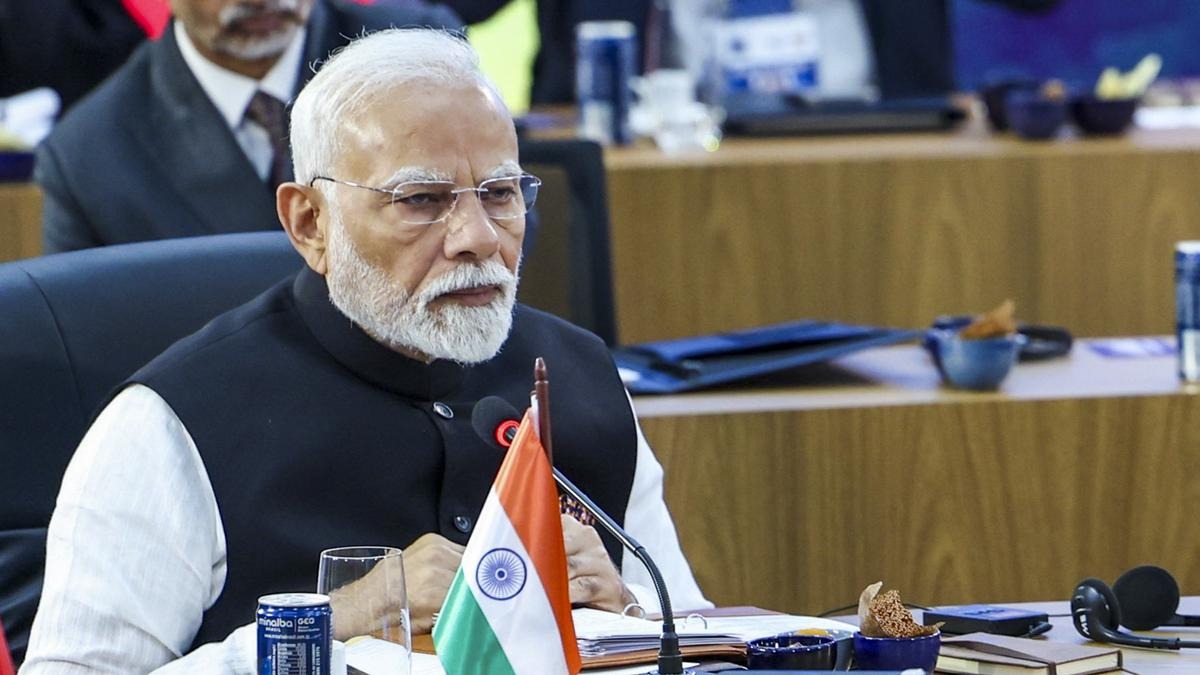
Prime Minister Narendra Modi attended the 26th SCO Summit in Bishkek on September 1, 2026, marking the bloc's 25th anniversary. He emphasized regional security, zero tolerance for terrorism, and sovereign-respecting connectivity, while holding critical bilateral meetings with global leaders on the sidelines.
Prime Minister Narendra Modi attended the 26th Shanghai Cooperation Organisation (SCO) Summit in Bishkek, emphasizing regional security, transparent connectivity, and a united front against cross-border terrorism.
BISHKEK — Prime Minister Narendra Modi addressed the 26th Shanghai Cooperation Organisation (SCO) Council of Heads of State meeting in Kyrgyzstan’s capital on Tuesday, September 1, 2026. Marking the 25th anniversary of the Eurasian bloc, the two-day summit brought together leaders from ten member states, including Russian President Vladimir Putin and Chinese President Xi Jinping. Prime Minister Modi used the international platform to advance India's core governance vision for the region, anchored around the pillars of security, connectivity, and opportunity (SCO), while issuing a firm call for zero tolerance toward cross-border terrorism and extremism.
Zero Tolerance Against Terrorism and Transnational Threats
Addressing the plenary session, Prime Minister Modi stressed that eradicating the "three evils" of terrorism, separatism, and extremism remains foundational to the SCO's original mandate. Without explicitly naming specific jurisdictions, he underscored that regional stability requires member states to reject double standards and combat terror financing networks unequivocally.
Indian diplomatic delegations have consistently advocated for stringent enforcement of international counter-terrorism standards. The discussions in Bishkek also encompassed broader geopolitical pressures, including regional security spillovers from West Asia and supply chain resilience amid shifting global trade dynamics.
Promoting Rules-Based Connectivity and Digital Integration
Beyond security cooperation, Prime Minister Modi outlined India's framework for sustainable regional connectivity. Reiterating India's stance on infrastructure initiatives, he emphasized that trans-national connectivity projects must respect the sovereignty and territorial integrity of all member states, remaining transparent and financially viable.
As an alternative to exclusive corridors, New Delhi pressed for accelerated integration through the International North-South Transport Corridor (INSTC) and the Chabahar port framework. Furthermore, the Prime Minister highlighted India's Digital Public Infrastructure (DPI) as an open model for driving financial inclusion, emerging technology collaboration, and artificial intelligence innovation across member countries.
Bilateral Engagements on the Sidelines
The multilateral summit served as a focal point for high-level bilateral diplomacy. On the margins of the event, Prime Minister Modi held structured discussions with Kyrgyz President Sadyr Zhaparov, Russian President Vladimir Putin, and Iranian President Masoud Pezeshkian to review bilateral economic cooperation, energy partnerships, and regional stability. Following formal deliberations, leaders attended the opening ceremony of the 6th World Nomad Games, highlighting the shared cultural heritage of Central Asian and Eurasian nations.
Official Sources Section
Official statements, policy outlines, and summit declarations were compiled from briefings issued by the Ministry of External Affairs (MEA), Government of India, official dispatches from the Shanghai Cooperation Organisation (SCO), and regional reporting via Reuters.
Quote Section
"According to officials, Prime Minister Modi reiterated that lasting regional integration requires a collective, unambiguous stand against cross-border terrorism and strict adherence to sovereign-respecting connectivity frameworks."
Why It Matters
Active participation in the SCO allows India to project strategic influence across its extended Central Asian neighborhood, secure critical energy corridors, and safeguard national security interests. For regional investors and businesses, collaborative digital and transport frameworks help diversify trade routes and mitigate geopolitical supply vulnerabilities.
Key Facts at a Glance
Prime Minister Narendra Modi attended the 26th SCO Summit in Bishkek, Kyrgyzstan, marking the bloc's 25th anniversary.
The leader championed India's tripartite vision of Security, Connectivity, and Opportunity.
Discussions prioritized a unified regional fight against terrorism, separatism, and extremism.
Bilateral meetings were held with key Eurasian leaders, including Presidents Vladimir Putin and Sadyr Zhaparov.
Frequently Asked Questions
What were the primary themes of PM Modi's address at the SCO Summit?
Prime Minister Modi focused on regional security, fighting cross-border terrorism, fostering transparent rules-based connectivity, and expanding digital public infrastructure cooperation.
Which countries are members of the Shanghai Cooperation Organisation?
The 10-member bloc includes India, Russia, China, Pakistan, Iran, Belarus, Kazakhstan, Kyrgyzstan, Tajikistan, and Uzbekistan.
What is India's stance on regional connectivity within the SCO?
India supports open, financially sustainable connectivity projects that strictly respect the national sovereignty and territorial integrity of all participating states.
What bilateral meetings did PM Modi hold in Bishkek?
On the sidelines of the summit, PM Modi held bilateral talks with Kyrgyz President Sadyr Zhaparov, Russian President Vladimir Putin, and Iranian President Masoud Pezeshkian.
Source: Ministry of External Affairs (MEA), Shanghai Cooperation Organisation (SCO), Reuters