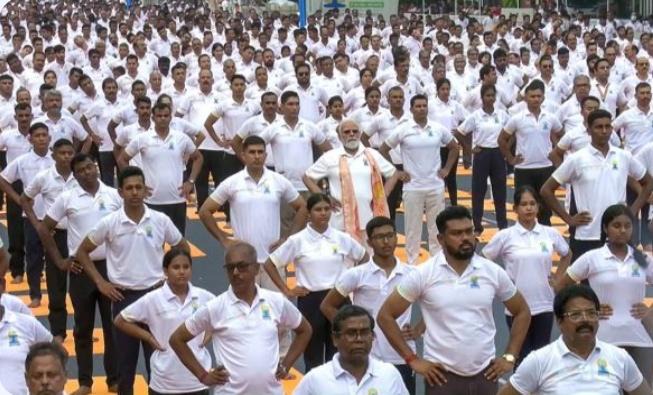
Prime Minister Narendra Modi led India's 12th International Day of Yoga celebrations from Kolkata’s Red Road under the theme "Yoga for Healthy Ageing." The event catalyzed mass community sessions across 100 iconic heritage sites domestically and reached thousands of international locations through 210 diplomatic missions worldwide.
KOLKATA — Indian Prime Minister Narendra Modi led a mass public gathering at Kolkata’s historic Red Road on Sunday, June 21, 2026, to celebrate the 12th International Day of Yoga. The high-profile physical assembly drew an estimated 35,000 active practitioners on-site, anchoring a broader synchronized framework where nearly 10 lakh (1 million) citizens participated across the metropolitan area. Speaking at the national flagship venue, Modi framed the ancient Indian discipline not merely as a system of physical exercise, but as an essential modern mechanism for public health, preventative care, and mental wellness. The event highlights India’s continued diplomatic leveraging of its heritage to foster global public health solutions.
Technical Focus on 'Yoga for Healthy Ageing'
According to a formal directive issued by the Union Ministry of Ayush, the central theme chosen for the 2026 global observance is "Yoga for Healthy Ageing." The protocol implemented during the 40-minute mass session on Red Road specifically emphasized postures, breathing techniques, and meditative practices engineered to preserve joint mobility, balance cardiovascular stress, and maintain cognitive acuity across older demographics.
The Prime Minister explicitly addressed how regular adherence to the Common Yoga Protocol could serve as a low-cost buffer against the burgeoning global burden of non-communicable lifestyle illnesses.
"When we speak of Yoga for healthy ageing, it means that we can work to ensure that age doesn't reduce human potential," Modi stated during his address to the assembled participants. "Our target must be to be more flexible at 40 than we were at 20. Our target must be more energetic at 50 than we were at 30."
Nationwide Mobilization and Cross-Border Coordination
The celebrations extended far beyond West Bengal. Data released by the Press Information Bureau (PIB) confirmed that the Archaeological Survey of India (ASI) organized concurrent commemorative sessions at 100 iconic heritage structures nationwide. Key historical locations included the Red Fort in New Delhi, Sarnath in Uttar Pradesh, Nalanda in Bihar, and Hampi in Karnataka, intertwining architectural conservation with the preservation of cultural practices.
Concurrently, the Indian Armed Forces executed high-altitude and maritime displays to emphasize structural physical resilience. Units deployed at the Siachen Glacier observed the day in sub-zero conditions, while naval personnel organized group practices on active aviation decks across Indian Navy platforms in the Indian Ocean.
On an international level, the Indian Council for Cultural Relations (ICCR) coordinated with more than 210 Indian diplomatic missions abroad. These missions facilitated localized public yoga demonstrations spanning approximately 2,500 cities worldwide, ensuring visibility across diverse geopolitical hubs in Europe, the Americas, and the Middle East.
Societal and Economic Implications for Wellness Tourism
The annual global scale of the event carries clear economic implications for India’s domestic wellness and traditional medicine markets. Ayush industry tracking reports indicate that institutional backing of Yoga Day has driven consistent annual growth in wellness tourism, physical therapy centers, and traditional lifestyle product exports.
For consumers and health insurance providers, the national emphasis on alternative wellness protocols supports preventive medicine paradigms designed to alleviate the financial strain on crowded clinical infrastructures. For the hospitality and tourism sectors, especially in ancient cultural clusters, the international integration of heritage sites directly translates into multi-season bookings and heightened demand for accredited wellness instructors.
Official Sources Section
Statistical tracking, localized participation figures, and logistical operational data within this report are drawn from official corporate and ministerial channels, including the Ministry of Ayush and detailed scheduling parameters published by the Press Information Bureau. Cultural site implementation vectors align with registries held by the Ministry of Culture.
Quote Section
"According to officials from the Ministry of Ayush, the launch of the 'Yoga 365' infrastructure initiative ahead of this year's observance provided a 100-day structured digital training protocol to ensure that public participation remains active throughout the year rather than concluding with the single-day annual event."
Why It Matters
The global institutionalization of the International Day of Yoga represents a significant soft-power milestone for Indian foreign policy while serving as a baseline template for universal, low-cost community healthcare. By promoting a standardized health protocol that cuts across language and economic barriers, the initiative supports public wellness frameworks addressing anxiety, physical degeneration, and industrial stress globally.
Key Facts at a Glance
Flagship Assembly Location: Prime Minister Narendra Modi led the main national session from Red Road in Kolkata, West Bengal.
Global Observance Theme: The 2026 iteration targeted "Yoga for Healthy Ageing" to emphasize physical and cognitive durability.
Cultural Integration: The Archaeological Survey of India hosted matching commemorative protocols across 100 designated heritage landmarks.
International Footprint: Over 210 Indian diplomatic missions organized public exercises across roughly 2,500 cities worldwide.
Technological Component: The deployment included the "Yoga 365" digital education module to foster sustained daily practice.
FAQ Section
Q: Why was June 21 selected as the International Day of Yoga? A: June 21 coincides with the summer solstice, making it the longest day of the year in the Northern Hemisphere. The date holds historical and cultural significance in various ancient traditions regarding energy and vitality.
Q: What is the main purpose of the "Yoga for Healthy Ageing" theme? A: The 2026 theme focuses on utilizing regular yoga practice to enhance flexibility, maintain stamina, and lower the vulnerability to chronic lifestyle conditions like hypertension and arthritis as populations age.
Q: Do people need specific equipment or a gym membership to participate? A: No. The Common Yoga Protocol is specifically designed by international experts to require minimal equipment, consisting primarily of a standard floor mat, making it completely accessible to individuals across all socioeconomic levels.
Source: Press Information Bureau India, Ministry of Ayush Official Portal, Ministry of Culture Heritage Registry