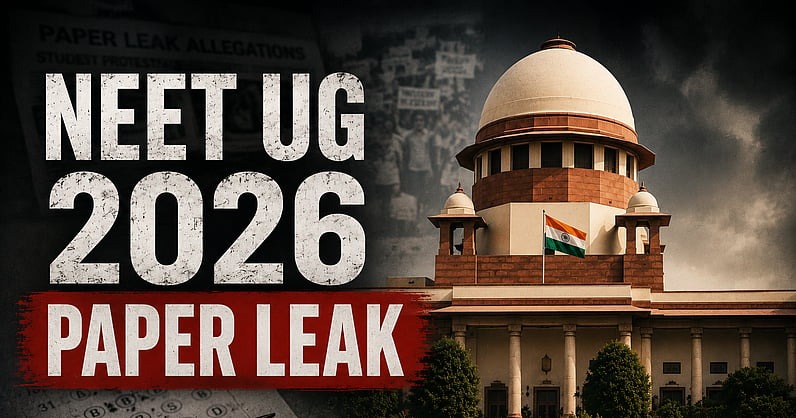
Prime Minister Narendra Modi has directed central and state authorities to establish specialized fast-track courts to ensure swift, stringent punishment for those involved in competitive examination paper leaks. Terming exam irregularities a "grave sin" (ghor paap), the Prime Minister confirmed that top legal teams are being deployed to secure maximum penalties for organized syndicates.
NEW DELHI — Prime Minister Narendra Modi has issued a firm directive to Union authorities and state governments to institute fast-track courts specifically designated for the rapid trial and conviction of individuals involved in examination paper leaks.
Addressing lawmakers during the National Democratic Alliance (NDA) Parliamentary Party meeting in New Delhi, the Prime Minister emphasized that safeguarding the aspirations and academic security of India's youth remains a paramount national priority. The directive follows recent investigative actions by central agencies into competitive testing breaches, including the NEET-UG examination irregularities.
Fast-Track Courts and Enhanced Prosecution Framework
Under the newly mandated judicial directives, the central government is coordinating with state administrative and legal authorities to set up dedicated fast-track court benches. These tribunals will hear cases registered under the Public Examinations (Prevention of Unfair Means) Act, 2024, on a day-to-day basis.
Key structural measures outlined in the executive strategy include:
Fast-Track Trial Acceleration: Establishing dedicated judicial mechanisms to resolve paper leak prosecutions without procedural delays.
Deployment of Top Prosecution: Engaging senior government advocates (dhurandhar lawyers) to ensure watertight legal cases against organized criminal syndicates.
Maximum Statutory Sentences: Enforcing strict statutory prison terms, heavy financial penalties, and asset seizure orders against perpetrators.
Inter-Agency Data Sharing: Integrating evidence from the Central Bureau of Investigation (CBI) and state police task forces to establish organized crime charges.
The Prime Minister stressed that examination leaks must be treated as a non-partisan national concern requiring a unified, zero-tolerance approach across all states.
Executive Actions and Probe Progress
Briefing reporters on the executive meeting, Union Minister for Parliamentary Affairs Kiren Rijiju confirmed that central law enforcement agencies moved swiftly once irregularities came to light. Thirteen key accused individuals were arrested immediately and placed in judicial custody.
To protect student timelines, the central government ordered a rapid re-examination, successfully conducting the test and declaring results without extended delays. Central agencies, including the CBI, continue to map cross-state syndicates to dismantle commercial paper-leak networks permanently.
Impact on Students and National Exam Security
The establishment of fast-track courts addresses long-standing concerns among millions of competitive exam candidates. Historically, prolonged legal trials allowed primary operatives to secure bail, creating uncertainty for aspirants.
Legal analysts note that combining fast-track judicial mechanisms with modern technology such as encrypted digital question paper distribution, biometric verification, and computer-based testing models provides both structural deterrence and faster justice.
Official Sources Section
The details in this news report are drawn from official briefings, parliamentary statements, and government disclosures issued by:
Quote Section
According to statements delivered by Union Minister Kiren Rijiju quoting Prime Minister Narendra Modi:
"The Prime Minister termed the paper leak a 'ghor paap' (grave sin) and assured that those who try to harm the future of our youth will not be spared. The government has decided to set up fast-track courts supported by top legal teams to ensure the strictest possible punishment for perpetrators and eliminate this menace."
Why It Matters
For Exam Aspirants: Guarantees faster judicial outcomes and protects merit-based entry into higher education and public sector careers.
For Law Enforcement: Establishes dedicated judicial channels to try organized paper leak gangs without general court backlogs.
For Educational Governance: Standardizes strict anti-leak protocols and fast-track prosecution across central and state testing bodies.
Key Facts at a Glance
Judicial Action: Mandates fast-track courts to expedite paper leak trials.
Prime Minister Statement: PM Modi labels paper leaks a "grave sin" and vows zero leniency.
Legal Support: Top government lawyers engaged to secure maximum statutory penalties against offenders.
Central Investigation: CBI and state police agencies actively arresting members of interstate syndicates.
Frequently Asked Questions (FAQs)
What new step has PM Modi ordered against paper leaks?
Prime Minister Narendra Modi ordered the establishment of fast-track courts to ensure accelerated trials and severe punishment for anyone involved in competitive exam paper leaks.
What central law governs paper leak prosecutions?
Paper leak offences are prosecuted under the Public Examinations (Prevention of Unfair Means) Act, 2024, alongside applicable sections of the Bharatiya Nyaya Sanhita (BNS).
Which agency is investigating major national paper leak cases?
The Central Bureau of Investigation (CBI), working alongside specialized state police units, leads investigations into paper leak syndicates.
Where can students access official updates on national exams?
Official updates regarding national entrance examinations are available through the Ministry of Education and the National Testing Agency (NTA).
Source: Official briefings from the Prime Minister's Office, parliamentary releases from the Ministry of Parliamentary Affairs, statutory updates from the Ministry of Law and Justice, and press reports from the Central Bureau of Investigation.