Prime Minister Narendra Modi chaired the 11th NITI Aayog Governing Council meeting in New Delhi, declaring youth empowerment and demand-driven skill creation as foundational pillars for achieving a developed India by 2047. The policy framework emphasizes leveraging Free Trade Agreements to integrate domestic MSMEs into international supply chains through state-level collaboration.
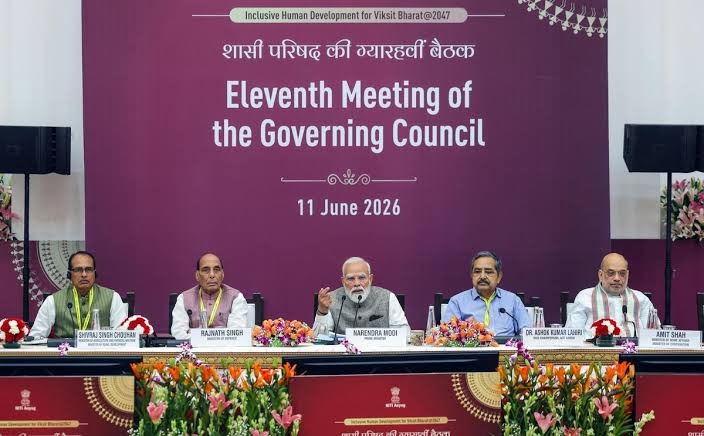
NEW DELHI — Prime Minister Narendra Modi declared on Thursday that empowering India's youth remains an absolute national priority, describing the country's demographic dividend as a historic opportunity that cannot be squandered. Speaking at the 11th Governing Council meeting of NITI Aayog held at Rashtrapati Bhavan in New Delhi on June 11, 2026, the Prime Minister outlined a comprehensive framework focused on skill development, quality education, and cooperative federalism to transform India into a developed nation ("Viksit Bharat") by the year 2047.
The high-level session convened State Chief Ministers, Lieutenant Governors of Union Territories, and Union Cabinet Ministers to align regional development strategies with macroeconomic objectives. As global markets experience volatile trade conditions, the Indian government seeks to accelerate internal economic structural changes. This includes leveraging international trade pacts and strengthening grassroots entrepreneurship to secure job creation for millions entering the domestic workforce.
National Strategy for the Demographic Dividend
Addressing the administrative assembly, Prime Minister Modi emphasized that the country's unique population structure provides an unprecedented macroeconomic edge that requires active policy support. Official data underscores that India possesses one of the world's youngest populations, a factor the administration plans to turn into the core engine of industrial and technological advancement.
According to a formal statement released by the press desk of the NITI Aayog, the administrative theme for this session focused explicitly on "Inclusive Human Development for Viksit Bharat @2047." The Prime Minister directed state governments to systematically map their local educational pipelines to match emerging market demands, aiming to eliminate structural friction within the domestic labor market.
Expanding MSME Access Through Global Trade
A significant segment of the policy address focused on enhancing the integration of Micro, Small, and Medium Enterprises (MSMEs) into international value chains. The Prime Minister pointed out that India's recent signings of Free Trade Agreements (FTAs) with multiple bilateral partners are designed to act as conduits for small-scale domestic manufacturers.
The administration highlighted that international trade pacts provide an immediate operational framework for localized industries to expand their operations. However, capitalizing on these agreements demands strict adherence to global production benchmarks. The central government expects state administrations to establish localized compliance centers, helping regional businesses transition to high-grade manufacturing standards.
Cooperative Federalism and Trillion-Dollar Ambitions
The policy roadmap presented at Rashtrapati Bhavan heavily relies on functional alignment between central and state ministries. The Prime Minister noted that national economic resilience relies on regional competition, urging state heads to establish aggressive development milestones.
The central government has proposed a framework of "healthy competition" among states, urging regional leaders to accelerate plans to expand their local economies. Central planning models indicate that achieving a developed nation status by 2047 will require multiple states to scale their individual gross state domestic products (GSDP) past the one-trillion-dollar threshold through targeted industrial policies and institutional updates.
Official Sources Section
The information detailed in this report is based on formal statements issued by the Press Information Bureau (PIB), regulatory briefings from the NITI Aayog Governing Council, and official communications from the Prime Minister’s Office (PMO).
Official Statement
"India's demographic dividend is a historic opportunity that we cannot afford to lose. Creating the right ecosystem for our youth through quality education, demand-driven skilling and employment opportunities must remain a priority. Empowered youth will be the driving force behind our journey towards Viksit Bharat. Guided by the spirit of cooperative federalism, we are working together to accelerate India's development journey."
— Prime Minister Narendra Modi during the 11th NITI Aayog Governing Council Meeting
Why It Matters
For citizens and job seekers, this development indicates a massive structural shift toward demand-driven technical training and heightened industrial safety standards. For domestic businesses and MSMEs, the focus on Free Trade Agreements reduces entry barriers to wealthy international markets, provided they upgrade their quality controls. Investors can anticipate prolonged state capital expenditure directed toward digital networks, skill facilities, and industrial clusters designed to support long-term corporate supply chains.
Key Facts at a Glance
National Target: The administration's structural framework aims to achieve full developed-nation status ("Viksit Bharat") for India by the centenary of independence in 2047.
Core Institutional Theme: The 11th NITI Aayog Governing Council focused strictly on "Inclusive Human Development," prioritizing cross-demographic well-being regardless of socio-economic standing.
Trade Integration: Small and medium enterprises are being actively positioned to utilize newly ratified Free Trade Agreements to increase India's export volumes.
Sub-National Economic Targets: The Centre has tasked states with engaging in competitive economic policies to transform localized territories into standalone trillion-dollar economic hubs.
Frequently Asked Questions
What is the core focus of the Viksit Bharat 2047 initiative?
The initiative is a comprehensive state strategy aimed at converting India into a fully developed economy by 2047. The policy emphasizes human resource development, manufacturing competitiveness, energy independence, and technological self-reliance.
How does the government plan to upgrade youth employment opportunities?
The strategy relies on introducing demand-driven skilling models across state institutions, updating educational curricula to align with technological industries, and providing fiscal infrastructure to support startup ecosystems.
What role do Free Trade Agreements play in this policy framework?
FTAs are being utilized to open access to international consumer bases. By eliminating foreign tariff barriers, the central government intends to allow domestic MSMEs to upscale production and match international quality metrics.
Source: Press Information Bureau (PIB) India, NITI Aayog Official Portal