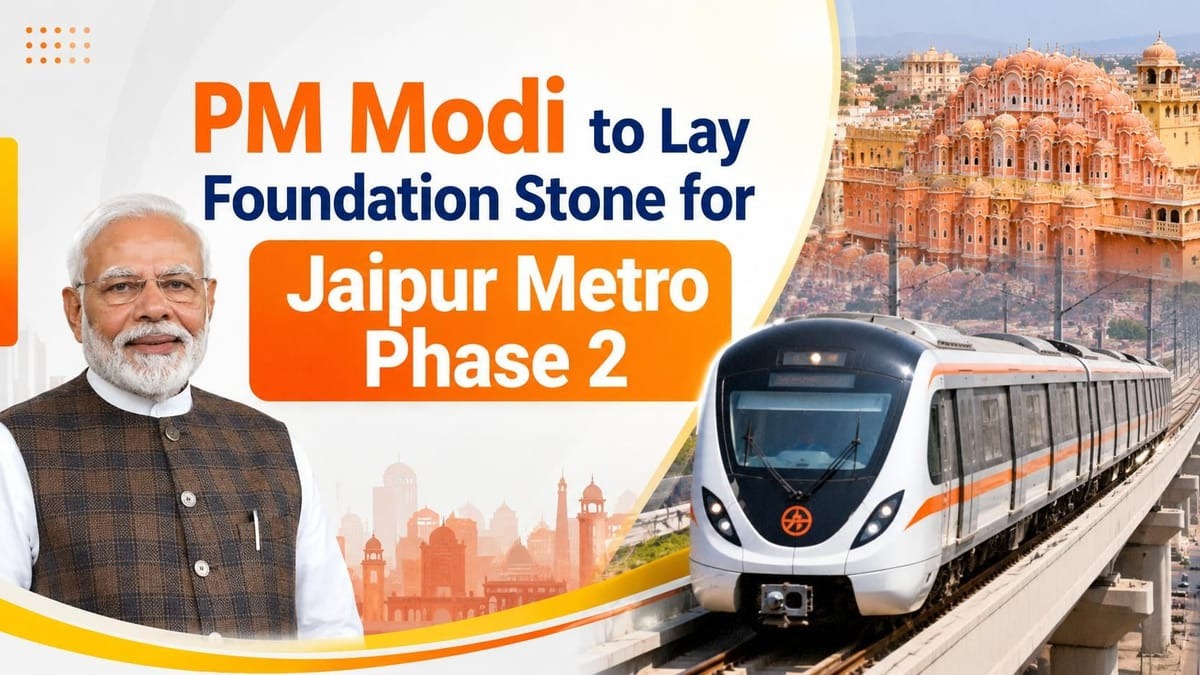
Prime Minister Narendra Modi will lay the foundation for the Rs 13,037-crore Jaipur Metro Phase-2 tomorrow. The 41-km North-South line will connect key industrial and residential hubs, including Jaipur Airport, through 36 stations. The project aims to improve urban mobility and reduce traffic congestion, with full completion expected by 2031.
The ambitious 41-kilometer North-South corridor aims to revolutionize urban transit and ease traffic congestion in Jaipur, with completion targeted for 2031.
JAIPUR – Prime Minister Narendra Modi is set to lay the foundation stone for the Jaipur Metro Phase-2 project tomorrow, July 4, 2026. This landmark infrastructure development, valued at approximately Rs 13,037 crore, marks a significant expansion of the city's transit network and is expected to provide a seamless, high-speed connection between Jaipur’s northern and southern residential and industrial hubs.
The Prime Minister will perform the foundation-laying ceremony virtually during his visit to the Balotra district in Rajasthan. The proceedings will be broadcast live at the Sawai Mansingh (SMS) Stadium in Jaipur, where local officials and residents are expected to gather for the event, which will also coincide with a regional Rozgar Utsav (Employment Festival).
Expanding Connectivity Across the Pink City
The Jaipur Metro Phase-2 project, implemented by the Rajasthan Metro Rail Corporation Limited (RMRCL), covers a 41-kilometer North-South corridor extending from Prahladpura in the south to Todi Mod in the north. Unlike the existing Phase-1, which operates on an East-West axis, the new "Orange Line" is designed to traverse the city's busiest traffic arteries.
According to project specifications, the corridor will feature 36 stations—comprising 34 elevated and two underground stations. The route is strategically planned to link vital areas including the Sitapura Industrial Area, Vishwakarma Industrial Area (VKI), Jaipur International Airport, Tonk Road, SMS Hospital, SMS Stadium, Ambabari, and Vidyadhar Nagar.
Strategic Urban Infrastructure Growth
The project is structured as a 50:50 joint venture between the Government of India and the Government of Rajasthan. It is aligned with the state’s urban development vision, including the Rajasthan Transit-Oriented Development (TOD) Policy-2025.
The expansion is organized into four distinct construction packages to ensure a time-bound execution. Officials anticipate that the new metro line will not only serve as a catalyst for economic growth in suburban pockets like Sikar Road but also drastically reduce vehicular pollution and road congestion, which have become pressing concerns for the growing city.
Official Sources and Project Oversight
The Prime Minister’s Office (PMO) confirmed the visit, noting that the Jaipur Metro project is part of a broader package of development initiatives for Rajasthan, covering sectors such as rail doubling, aviation, and energy infrastructure.
According to officials, the Jaipur District Administration, led by District Collector Sandesh Nayak, has completed all necessary preparations for the foundation ceremony. Security protocols, crowd management, and logistics for the simultaneous employment event at the SMS Stadium have been coordinated to ensure the event proceeds smoothly.
Why It Matters
The implementation of Phase-2 is critical for the long-term sustainability of Jaipur’s transport ecosystem. By integrating the new corridor with the existing Phase-1 network and Jaipur Airport, the state government aims to boost productivity by reducing commute times for the workforce. Furthermore, the project is expected to spur real estate development along the proposed transit nodes, providing a significant boost to the local economy and employment sector.
Key Facts at a Glance
Total Project Cost: Rs 13,037.66 crore.
Corridor Length: 41 kilometers (North-South).
Stations: 36 (34 elevated, 2 underground).
Key Connectivity: Links Sitapura Industrial Area, Jaipur Airport, and VKI.
Target Completion: September 2031.
Frequently Asked Questions
1. When will construction on the Jaipur Metro Phase-2 begin?
Construction for the entire 41-km corridor is scheduled to begin in phases, with initial activity expected to gain momentum starting in September 2026.
2. Which areas will benefit most from this new line?
Residents and workers in Sitapura, Sanganer, Tonk Road, and northern suburbs like Sikar Road and Todi Mod are expected to see the most significant improvements in daily connectivity.
3. Is this project funded by the state government alone?
No, it is a 50:50 joint venture between the central government and the Government of Rajasthan, with additional financial integration through programs like those supported by the Asian Development Bank (ADB).
4. How will this project impact current traffic?
The RMRCL has divided the project into zones to ensure construction is managed in a way that minimizes disruptions to the city’s major arterial roads.
Source: Press Information Bureau (PIB), Rajasthan Metro Rail Corporation (RMRCL), Ministry of Housing and Urban Affairs