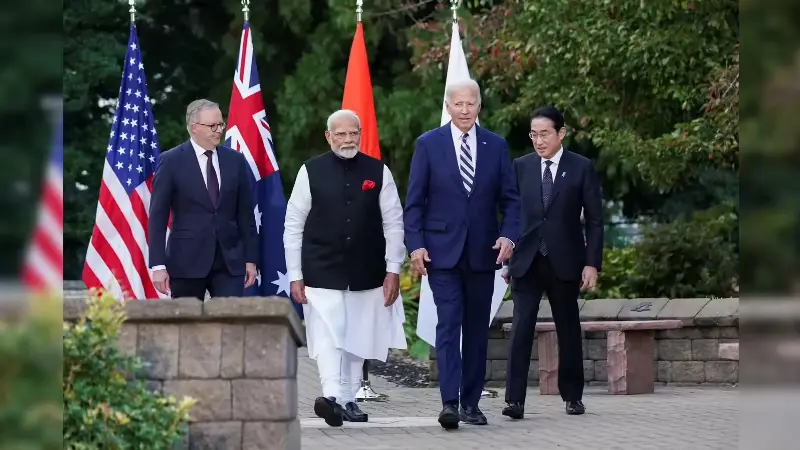
Foreign ministers of the Quad – the US, India, Japan and Australia – have rolled out a stronger, more structured agenda for the Indo‑Pacific, spanning “Ports of the Future”, an Indo‑Pacific energy security initiative, a critical minerals framework and upgraded maritime surveillance cooperation. Together, these moves aim to reduce strategic dependence on China‑centric supply chains and reinforce a rules‑based regional order.
Meeting at ministerial level, the four countries signalled that the Quad is shifting from loose coordination to concrete, sector‑specific initiatives with timelines and implementation tracks. The joint messaging again underlined opposition to unilateral attempts to alter the status quo by force or coercion in the East and South China Seas and across the wider Indo‑Pacific, while reaffirming support for ASEAN centrality and international law, including UNCLOS.
Ports And Infrastructure Push
Under the proposed Ports of the Future Partnership, Quad members intend to work with regional partners to upgrade critical ports, improve connectivity between sea routes and hinterland links, and embed higher standards on transparency, sustainability and cyber‑resilience. This is designed as a counterweight to opaque infrastructure models and to help smaller Indo‑Pacific economies negotiate better terms on port development.
Energy Security And Resilience
The Indo‑Pacific energy security initiative focuses on diversifying energy sources, routes and technologies, encouraging investment in LNG, renewables and grid‑resilience projects while reducing exposure to single‑country chokepoints. By pooling finance, technology and policy support, the Quad wants to make energy supply more predictable for partners from the Indian Ocean to the Western Pacific.
Critical Minerals Framework
The Quad’s critical minerals framework aims to de‑risk supply chains for rare earths, lithium, cobalt and other inputs vital for EVs, batteries, defence systems and clean‑tech manufacturing. It envisages cooperation on exploration, processing, standards, recycling and stockpiling among “trusted partners”, with an eye on diluting Beijing’s dominance in several of these value chains.
Maritime Domain Awareness
A parallel Indo‑Pacific maritime surveillance cooperation initiative will upgrade domain awareness for coastal and island states by sharing satellite data, vessel‑tracking information and maritime law‑enforcement training. The objective is to better monitor illegal fishing, grey‑zone tactics and other activities that undermine sovereignty and safe sea lanes.
Key Highlights
- Quad unveils linked initiatives on ports, energy security, critical minerals and maritime surveillance
- Ports of the Future aims to modernise Indo‑Pacific ports with transparent, resilient standards
- Energy security track targets diversified, cleaner and more reliable regional energy flows
- Critical minerals framework focuses on de‑risking rare earths and battery‑metal supply chains
- Maritime surveillance cooperation to sharpen Indo‑Pacific domain awareness and deter grey‑zone activity
Sources: Official readouts and statements from the US, Japanese and Australian foreign ministries on recent Quad ministerial meetings