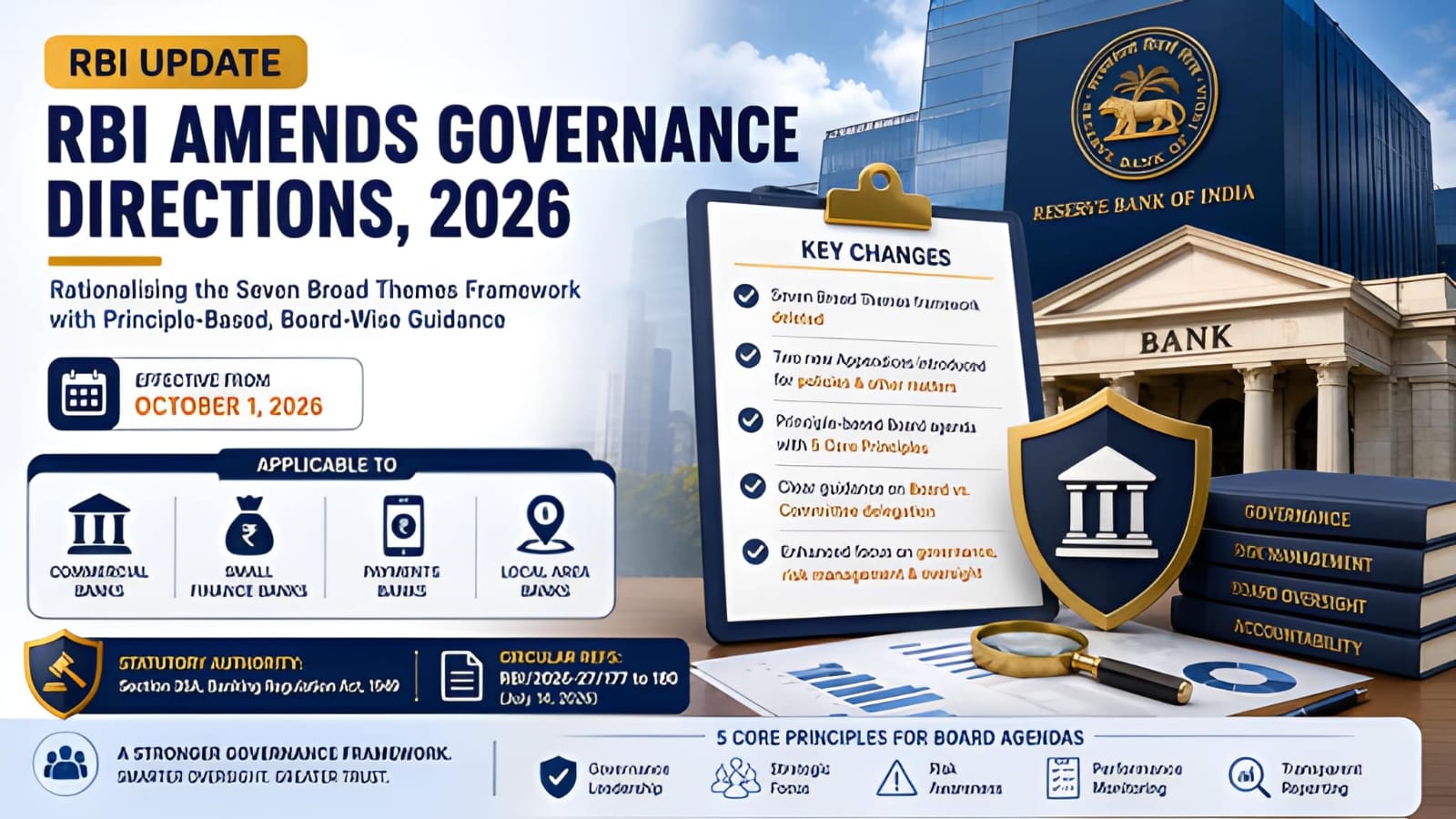
The Reserve Bank of India has issued the Reserve Bank of India (Payments Banks – Governance) Amendment Directions, 2026. Effective October 1, 2026, the regulation replaces rigid agenda mandates with principle-based guidelines, empowering payments bank boards to focus on risk management, cybersecurity, FinTech oversight, and customer protection.
MUMBAI — The Reserve Bank of India (RBI) has officially notified the Reserve Bank of India (Payments Banks – Governance) Amendment Directions, 2026, introducing a comprehensive overhaul of board-level governance standards for payments banks across the country. Issued under Section 35A of the Banking Regulation Act, 1949, the regulatory notification comes into force on October 1, 2026.
This regulatory update is designed to modernize governance structures by shifting board focus from routine compliance checklists to strategic risk management, operational discipline, and technology oversight. By streamlining administrative obligations, the central bank aims to enhance systemic stability and consumer trust within India’s rapidly growing digital financial ecosystem.
Strategic Shift Toward Principle-Based Governance
Under the updated regulatory directions, the central bank has discontinued the earlier requirement forcing boards to structure meeting agendas around "seven broad themes". Instead, the Reserve Bank of India (Payments Banks – Governance) Amendment Directions, 2026 establish principle-based guidance that allows boards to prioritize qualitative strategic deliberations.
The revised framework categorizes board obligations into structured schedules:
Appendix I: Compiles essential policies—such as risk management, IT governance, customer protection, and KYC compliance—that require explicit board approval.
Appendix II: Details non-policy operational matters, explicitly demarcating items that must be reviewed by the full board versus those eligible for delegation to specialized board committees.
Furthermore, the central bank has designated the Chairperson of the Board with primary responsibility for setting meeting agendas, ensuring critical risks are addressed proactively.
Enhanced Focus on FinTech, AI, and Cybersecurity Risks
As payments banks heavily rely on third-party technology providers, financial technology partners, and automated processing, the Reserve Bank of India (Payments Banks – Governance) Amendment Directions, 2026 mandate rigorous oversight over digital operations.
Boards must now maintain structured oversight over:
Artificial Intelligence and Machine Learning Models: Ensuring explainability, fairness, and output validation for automated algorithms used in fraud detection and customer assessments.
Cybersecurity and Incident Escalations: Establishing standardized escalation protocols so operational incidents or cyber threats are immediately reported to executive leadership and regulators.
Third-Party Risk Management: Conducting strict due diligence on vendor integrations and digital referral platforms to prevent operational bottlenecks and security breaches.
Eliminating Regulatory Redundancy
To prevent board overload, the Reserve Bank of India (Payments Banks – Governance) Amendment Directions, 2026 eliminate legacy operational reporting mandates. Matters such as routine reviews of failed ATM transactions or pre-paid instrument (PPI) interoperability tracking no longer require direct board-level agenda placement.
By pruning administrative clutter, the RBI enables payment bank directors to dedicate sufficient time to macro-financial risks, balance sheet liquidity, and customer grievance resolution mechanisms.
Impact on Consumers, Businesses, and Digital Banking Users
The implementation of the Reserve Bank of India (Payments Banks – Governance) Amendment Directions, 2026 brings direct advantages to all stakeholders in the digital economy:
For Account Holders & Consumers: Better board oversight translates directly into faster resolution of digital payment failures, stronger data privacy safeguards, and reinforced protection against online financial fraud.
For Payments Banks & FinTechs: Financial institutions gain operational efficiency through standardized delegation rules, allowing management to act swiftly while maintaining clear accountability to the board.
For Investors & Regulators: Improved transparency, standardized risk appetite statements, and clear governance documentation reduce structural risks and bolster investor confidence in India’s fintech sector.
Official Sources Section
According to official notifications issued by the central bank's Department of Regulation, the final directions incorporate feedback received from commercial banks, payments banks, and industry representatives following the publication of the initial draft directions in April 2026.
Official announcements confirm that all payments banks operating in India must align their internal committee charters, policy frameworks, and board procedure documents with the Reserve Bank of India (Payments Banks – Governance) Amendment Directions, 2026 prior to the mandatory deadline of October 1, 2026.
Official Quote Section
"The revised governance framework moves away from rigid procedural mandates toward principle-based guidance, enabling bank boards to utilize their time effectively and engage in high-impact qualitative oversight on strategy, risk management, and operational resilience," stated central bank officials in the regulatory release.
Why It Matters
In an increasingly digital financial ecosystem where payments banks handle millions of micro-transactions daily, structural governance failures can rapidly escalate into systemic risks. By enforcing the Reserve Bank of India (Payments Banks – Governance) Amendment Directions, 2026, the regulator ensures that board directors actively monitor technology architecture, vendor vulnerabilities, and consumer protection protocols. This proactive approach reduces operational disruptions and safeguards customer deposits across the nationwide digital payments grid.
Key Facts at a Glance
Regulatory Title: Reserve Bank of India (Payments Banks – Governance) Amendment Directions, 2026.
Statutory Authority: Issued under Section 35A of the Banking Regulation Act, 1949.
Effective Date: October 1, 2026.
Core Objective: Replaces the "seven broad themes" agenda mandate with principle-based guidelines and standardized delegation schedules (Appendix I & II).
Key Focus Areas: Board-level accountability for FinTech partnerships, AI models, cybersecurity escalation, and operational resilience.
Frequently Asked Questions (FAQ)
What are the Reserve Bank of India (Payments Banks – Governance) Amendment Directions, 2026?
They are updated regulatory instructions issued by the RBI that reform how payments bank boards conduct governance, approve internal policies, delegate responsibilities, and manage technology and operational risks.
When do the new governance rules take effect?
The directions officially come into force on October 1, 2026. Payments banks must complete internal alignment before this date.
How do these directions benefit everyday digital banking users?
By forcing bank boards to maintain direct oversight over technology infrastructure, fraud controls, and customer redressal, the rules foster safer, more reliable digital transactions and quicker dispute resolution.
Who is primarily responsible for setting board agendas under the new framework?
The Chairperson of the Board holds primary responsibility for setting board meeting agendas to ensure critical strategic and risk matters receive adequate attention.
Source: Reserve Bank of India Official Communications, RBI Regulatory Press Releases & Notifications.