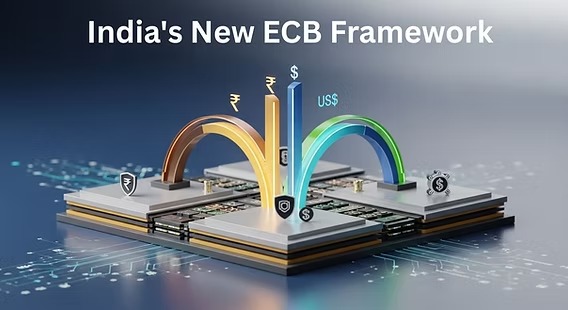
The RBI has released the April 2026 data for External Commercial Borrowings (ECB), Foreign Currency Convertible Bonds (FCCB), and Rupee Denominated Bonds (RDB). The figures offer a snapshot of corporate offshore fundraising under the newly liberalized borrowing framework, highlighting how Indian firms are navigating expanded limits and updated reporting requirements.
The Reserve Bank of India (RBI) has officially released the data on External Commercial Borrowings (ECB), Foreign Currency Convertible Bonds (FCCB), and Rupee Denominated Bonds (RDB) for the month of April 2026. This data release, covering both the automatic and approval routes, offers key insights into the appetite of Indian corporate entities for international capital amid the central bank’s recent liberalization of the borrowing framework.
The report serves as a critical pulse check for the domestic financial sector, especially following the implementation of the Foreign Exchange Management (Borrowing and Lending) (First Amendment) Regulations, 2026, which took effect in February 2026. The new regulations have significantly overhauled how Indian firms access offshore liquidity, making the monthly performance data a key metric for institutional investors and market analysts.
Contextualizing Offshore Fundraising Trends
The April data arrives during a period of strategic transition for the Indian debt market. Earlier this year, the RBI liberalized the ECB framework to provide borrowers with greater flexibility, including standardized maturity periods and expanded eligible borrower/lender bases. As firms adapt to these reforms—which include simplified reporting and higher borrowing thresholds—the monthly data helps market participants gauge the speed of adoption for these new rules.
Recent policy measures, including coordinated efforts by the RBI and the government to shore up the Indian Rupee (INR), have also influenced borrowing patterns. With the introduction of specialized foreign exchange swap windows for public sector undertakings and banks, the landscape for External Commercial Borrowings has evolved to support broader macroeconomic stability.
Why the ECB, FCCB, and RDB Data Matters
For businesses and investors, the monthly disclosure of ECB, FCCB, and RDB figures is more than just a regulatory formality. It provides granular information on:
Capital Flows: Understanding the volume of foreign currency entering the Indian corporate sector.
Cost of Capital: Monitoring how Indian entities are pricing their offshore debt against global interest rate environments.
Sectoral Demand: Identifying which sectors are most actively utilizing the automatic route versus the approval route for their expansion and refinancing needs.
According to financial analysts, the recent reforms—which raised borrowing limits and eased end-use restrictions—are expected to drive a gradual increase in offshore fundraising volumes throughout the 2026-27 fiscal year. The April figures will be closely analyzed to see how companies are leveraging the higher USD 1 billion outstanding borrowing cap or the 300% net worth limit introduced in the amended framework.
Official Reporting Standards
The data is compiled by the Reserve Bank of India as part of its ongoing monitoring of India’s external debt obligations. The central bank emphasizes that the transparency of these monthly statistics is vital for maintaining the integrity of the foreign exchange management system. All ECB, FCCB, and RDB transactions reported must comply with the updated Foreign Exchange Management (Borrowing and Lending) (First Amendment) Regulations, 2026.
"According to officials" at the RBI, the data includes all filings processed through the e-Kuber platform, ensuring a comprehensive view of both the automatic route—where firms report directly—and the approval route, which requires specific central bank consent.
Key Facts at a Glance
Coverage: The report details all External Commercial Borrowings, Foreign Currency Convertible Bonds, and Rupee Denominated Bonds processed in April 2026.
Reporting Routes: Includes both automatic and approval route data for Indian corporate borrowers.
Regulatory Basis: All borrowings are reported under the revised Foreign Exchange Management (Borrowing and Lending) (First Amendment) Regulations, 2026.
Market Significance: Tracks corporate participation in international debt markets following recent policy liberalizations aimed at easing external funding access.
Frequently Asked Questions
What are ECB, FCCB, and RDB?
ECB: External Commercial Borrowings are loans from non-resident lenders to Indian borrowers.
FCCB: Foreign Currency Convertible Bonds are equity-linked debt securities issued in foreign currency.
RDB: Rupee Denominated Bonds are bonds issued outside India by Indian entities, denominated in Indian rupees.
Why does the RBI publish this data monthly?
Monthly publication provides transparency into capital flows and helps the RBI monitor India’s external debt sustainability and currency market dynamics.
How have recent reforms affected these borrowing channels?
The 2026 amendments liberalized the framework by raising borrowing limits, standardizing maturity periods, and simplifying reporting requirements to encourage easier access to global capital.
Where can the full dataset be accessed?
The full statistical report is available on the official Reserve Bank of India (RBI) website under the 'Press Releases' or 'Data' sections.
Source: Reserve Bank of India (RBI) Press Releases, Foreign Exchange Management (Borrowing and Lending) (First Amendment) Regulations, 2026