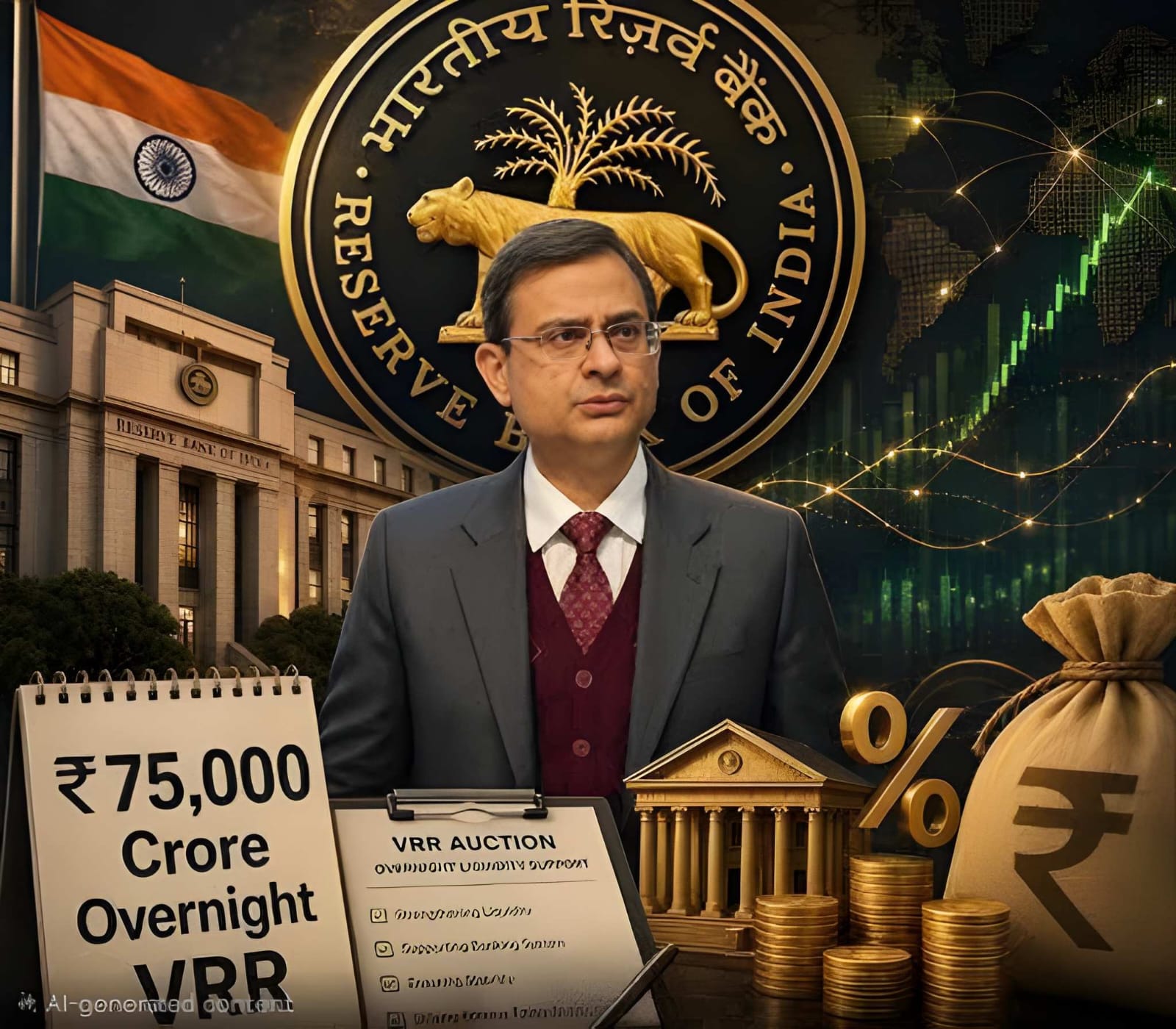
The Reserve Bank of India will conduct a three-day Variable Rate Repo (VRR) auction on July 27, 2026, to inject ₹75,000 crore into the banking system. Following a liquidity review, the operation aims to stabilize interbank funding, address short-term cash demand, and preserve overall domestic financial stability prior to the July 30 reversal.
MUMBAI, India — The Reserve Bank of India (RBI) announced on July 24, 2026, that it will conduct a three-day Variable Rate Repo (VRR) auction under its Liquidity Adjustment Facility (LAF) on July 27, 2026. The auction, carrying a notified amount of ₹75,000 crore ($750 billion rupees), aims to address temporary liquidity imbalances in the Indian banking system. The announcement follows a comprehensive review of current and evolving liquidity conditions by the central bank. By conducting the RBI VRR auction, the monetary authority ensures that commercial banks retain sufficient short-term funds to satisfy daily cash reserve mandates and smooth money market operations.
Technical Specifications of the RBI VRR Auction
According to an official press release issued by the central bank's Department of Communication in Mumbai, the three-day repo window will open on Monday, July 27, 2026. Commercial banks and primary dealers will be eligible to place their competitive bids between 09:30 AM and 10:00 AM IST on the auction date.
The funds injected into the system through this mechanism will carry a reversal date of Thursday, July 30, 2026, at which point participating institutions will repurchase their securities from the central bank. The operational framework for the bidding process will follow guidelines established under the Reserve Bank's previous operational framework release dated January 20, 2022.
Under the LAF mechanism, the RBI VRR auction allows banking institutions to borrow funds against government collateral at variable interest rates dictated by competitive market bidding above the prevailing repo rate.
Market Context and Banking Liquidity Dynamics
The central bank regularly deploys fine-tuning liquidity operations, including main and fine-tuning VRR transactions, to maintain interbank call money rates close to the policy repo rate. Short-term liquidity across the Indian financial system fluctuates based on seasonal tax outflows, government spending velocity, credit demand, and currency circulation trends.
When banking system liquidity slips into temporary deficit or experiences tight frictional conditions, the execution of an RBI VRR auction acts as a crucial liquidity relief valve. By offering short-term funds through the LAF window, the monetary authority prevents erratic spikes in overnight interbank borrowing costs.
Financial analysts note that fine-tuning operations like the upcoming RBI VRR auction provide immediate, temporary cash injections into primary dealers and commercial lending institutions without signaling changes in the central bank's broader monetary policy stance.
Practical Impact on Financial Institutions and Borrowers
The scheduled liquidity injection directly influences short-term money market instruments, commercial paper yields, and interbank lending rates:
For Commercial Banks: Participating lenders gain access to essential short-term liquidity to manage balance-sheet mismatches and fulfill daily regulatory reserve requirements without incurring higher call-market funding costs.
For Money Markets: The addition of ₹75,000 crore into overnight systems stabilizes short-term yields, mitigating volatility in overnight money market rates, treasury bills, and short-dated certificates of deposit.
For Businesses and Investors: Predictable interbank liquidity lowers funding uncertainty for corporate borrowers, helping maintain stable short-term interest rates across domestic credit markets.
Official Sources Section
Information regarding the auction date, notified amount, window timing, and reversal schedule is sourced directly from
Reserve Bank of India Press Release 2026-2027/755, issued by Ajit Prasad, Deputy General Manager (Communications), Central Office, Mumbai.
Operational guidelines for the LAF framework are established under RBI Press Release 2021-2022/1572, dated January 20, 2022.
Quote Section
"On a review of current and evolving liquidity conditions, it has been decided to conduct a Variable Rate Repo (VRR) auction on Monday, July 27, 2026," stated Ajit Prasad, Deputy General Manager (Communications) at the Reserve Bank of India.
Why It Matters
The RBI VRR auction highlights the central bank's proactive liquidity management strategy aimed at maintaining stability across domestic financial markets. By calibrating liquidity through variable-rate instruments, the Reserve Bank ensures that short-term interest rates remain aligned with macroeconomic policy objectives, protecting commercial credit flows and market efficiency.
Key Facts at a Glance
Auction Value: The central bank will auction ₹75,000 crore ($750 billion rupees) in short-term funds.
Tenor Duration: The liquidity facility carries a three-day tenor starting July 27, 2026.
Reversal Timeline: Funds provided during the auction are scheduled for reversal on July 30, 2026.
Bidding Window: Open to participating financial institutions on July 27 between 09:30 AM and 10:00 AM IST.
Frequently Asked Questions (FAQ)
What is an RBI VRR auction?
An RBI VRR auction (Variable Rate Repo) is an operational tool used by the Reserve Bank of India to inject temporary short-term liquidity into the banking system through competitive bidding under the Liquidity Adjustment Facility.
When will the ₹75,000 crore VRR auction take place?
The bidding window will operate on Monday, July 27, 2026, from 09:30 AM to 10:00 AM IST, with fund reversal set for July 30, 2026.
Why is the Reserve Bank conducting this liquidity operation?
The central bank decided to hold the auction after reviewing current and evolving liquidity conditions in the interbank market to ensure sufficient short-term funding availability.
How do VRR auctions affect daily banking operations?
VRR auctions allow commercial banks to borrow funds against government collateral, preventing sharp rises in interbank call money rates and ensuring smooth payment and clearing settlement operations.
Source: Official regulatory announcements published by the Reserve Bank of India.