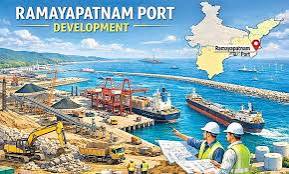
The Andhra Pradesh government has approved the Request for Proposal (RFP) for the private operation and expansion of the ₹4,929-crore greenfield Ramayapatnam Port. With Phase I construction crossing 80% completion and active capital dredging underway, the move transitions the strategic maritime asset into a competitive Public-Private Partnership model.
VIJAYAWADA — The Government of Andhra Pradesh has officially cleared a landmark Request for Proposal (RFP) aimed at the private operation and expansion of the ₹4,929-crore greenfield maritime project at Ramayapatnam. Issued via the Andhra Pradesh Maritime Board (APMB), the approval marks a critical milestone for India’s eastern logistics corridor.
As Phase I of the deep-sea infrastructure crosses 80% completion this June 2026, the state is moving rapidly to secure an international port operator under a Design, Build, Finance, Operate, and Transfer (DBFOT) concession model to manage immediate commercial deployment and subsequent phase scale-ups.
Shifting to a Private-Public Partnership Framework
The newly cleared technical and financial bidding guidelines delineate the contractual architecture for the private partner. Under the approved framework, the chosen concessionaire will take over the maintenance, commercial operations, and superstructure deployment for the initial berths, while assuming full financial and engineering responsibility for the future multi-phased expansion of the maritime hub.
The state government had initially funded the maritime development through the Ramayapatnam Port Development Corporation Limited (RPDCL), deploying both budgetary allocations and state-backed term loans. By transitioning to a Public-Private Partnership (PPP) model now, the administration aims to offload secondary capital expenditure requirements while leveraging the efficiency of specialized global terminal operators.
Maritime Access Enhanced by Deepening Infrastructure
The finalization of the procurement roadmap coincides with intense industrial activity at the coastal site in the Nellore district. Just weeks prior to the bidding document's approval, primary contractor Navayuga Engineering Company Limited (NECL) formally engaged global dredging giant DEME Group to execute comprehensive capital deepening works across the entire harbor basin.
The dredging scope covers the entry channel, the internal 600-meter-diameter turning circle, and the four dedicated berth pockets. This operation ensures a stable 16-meter draft capable of safely receiving large Panamax and Cape-size cargo vessels up to 120,000 Deadweight Tonnage (DWT). The completion of these maritime access works is synchronized with the new operational bid timeline, presenting incoming private bidders with a highly functional, deep-water port asset ready for swift commissioning.
Broad Regional Economic and Supply Chain Impact
The long-term master plan for the facility envisions a sweeping expansion scaling up to 19 operational berths with an aggregate cargo handling capacity of 138.54 Million Metric Tonnes Per Annum (MMTPA). The development is strategically positioned to dramatically lower logistics expenses for key export and manufacturing zones spanning coastal and interior India.
The designated primary hinterland encompasses the mineral-rich and industrial districts of Nellore, Prakasam, Guntur, and Kurnool within Andhra Pradesh. Crucially, the port's transport network links directly to the landlocked industrial clusters of Telangana—specifically the high-growth commercial zones of Hyderabad, Ranga Reddy, Nalgonda, and Mahbubnagar. By providing an alternative deep-water outlet situated roughly 93 kilometers north of Krishnapatnam Port, the new gateway will handle substantial bulk volumes of coal, iron ore, fertilizers, seafood, and containerized consumer goods.
Official Sources Section
According to official administrative notifications from the Department of Infrastructure and Investments and regulatory circulars published by the APMB, the approved bidding framework protects state asset ownership while offering clear commercial incentives. The government releases specify that the concessionaire will pay a predetermined revenue share or a minimum guaranteed annual fee to the maritime board, ensuring continuous non-tax revenue generation for the state exchequer over the multi-decade lease period.
Quote Section
State planning officials emphasized that private sector integration is essential to capture high-velocity global trade routes.
"The approval of the competitive guidelines for the operation and expansion of the ₹4,929-cr mega port represents our commitment to world-class infrastructure without overburdening public finances," an APMB director stated during the review brief. "This asset is poised to become a vital maritime node, transforming regional logistics efficiency."
Industry analysts also welcomed the development. "Integrating private efficiencies at an advanced construction stage minimizes gestational risks for incoming terminal operators," noted a regional port infrastructure consultant. "With deep-water access guaranteed via ongoing capital dredging, the location holds clear competitive advantages for global trade lines."
Why It Matters
The formal authorization of private operations carries significant economic implications for both public and private sectors:
For Businesses and Industries: Manufacturing units, thermal power plants, and agricultural exporters across southern and central India will benefit from reduced transit times and lower per-ton handling costs.
For Global Investors: The transparent bidding parameters offer an entry point into one of India's fastest-growing non-major port ecosystems, supported by existing national highway and rail freight connectivity.
For Regional Citizens: The transition from a construction site to a fully operational logistics and industrial zone is projected to generate thousands of direct and indirect employment opportunities across mechanical, maritime, and administrative sectors.
Key Facts at a Glance
Bidding Approval: The state government has authorized the comprehensive private procurement framework for the Ramayapatnam deep-sea project.
Investment Benchmark: The greenfield port infrastructure represents a total capital allocation of ₹4,929 crore.
Operational Readiness: Phase I engineering works have achieved an estimated 80% completion velocity heading into mid-2026.
Deep-Water Assets: Active capital deepening programs are carving out a 16-meter draft capable of docking large 120,000 DWT vessels.
Logistics Footprint: The facility’s designated commercial hinterland covers critical manufacturing and industrial sectors across two major states.
FAQ Section
What does the approval of the operation and expansion document mean?
It means the government has finalized and approved the competitive bidding rules (RFP). This permits private global port operators to bid for the rights to run the current berths and finance the future expansion of the port under a long-term contract.
Where is this mega port located and what is its budget?
The greenfield port is located at Ramayapatnam in the Nellore district of Andhra Pradesh, representing an infrastructure investment totaling ₹4,929 crore.
Which types of cargo will the port primarily handle?
The maritime facility is engineered as an all-weather hub configured to handle diverse bulk, break-bulk, and containerized commodities, including coal, fertilizers, minerals, agricultural outputs, and heavy machinery.
How does this development benefit landlocked regions like Telangana?
The port links directly to major transport routes like National Highway 16 and key rail freight networks. This provides industrial clusters around Hyderabad and neighboring districts with a highly efficient, cost-effective maritime gateway for international trade.
Source: Andhra Pradesh Maritime Board Official Portal, Department of Infrastructure & Investments Gazette Notifications, DEME Group Corporate Communications.