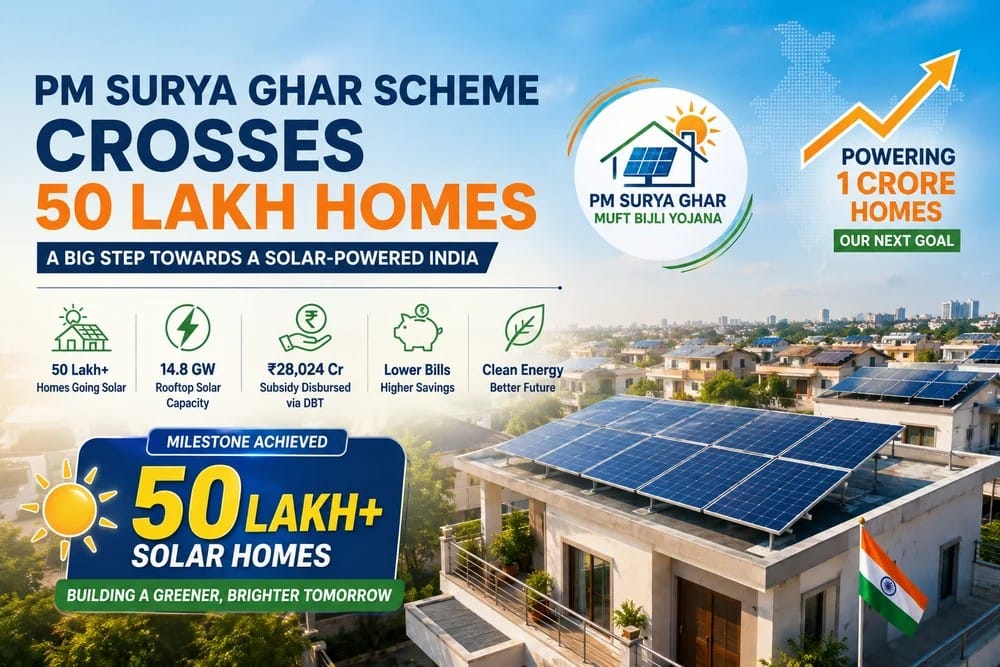
India's PM Surya Ghar: Muft Bijli Yojana has crossed 50 lakh residential rooftop solar installations, commissioning 14.8 GW of clean energy capacity. Supported by ₹28,024 crore in direct subsidies, over 19 lakh households now record zero electricity bills while contributing to India's 500 GW non-fossil fuel target by 2030.
NEW DELHI — India’s flagship residential solar initiative, the PM Surya Ghar: Muft Bijli Yojana, has officially crossed the 50-lakh (5 million) rooftop solar installation benchmark. The milestone marks a dramatic structural shift in the nation’s residential energy landscape, with solar installations reaching 50.06 lakh households and adding 14.8 gigawatts (GW) of commissioned clean capacity.
According to updates from the Ministry of New and Renewable Energy, adoption rates accelerated sharply through mid-2026, driven by streamlined direct benefit transfers (DBT) and digital net metering integration. The daily installation pace increased 3.2 times over nine months, rising from 5,038 daily installations in late 2025 to nearly 16,328 per day. Officials report that nearly one lakh new households are joining the national solar grid every six days.
National Impact and Structural Growth Pace
The central government launched the PM Surya Ghar: Muft Bijli Yojana with a total outlay of ₹75,021 crore aimed at solarising 1 crore domestic residences. Prior to the scheme's launch, India had fewer than 8 lakh residential rooftop solar installations nationwide.
Subsidies Disbursed: The government has released ₹28,024 crore directly into beneficiary bank accounts through Direct Benefit Transfers to offset upfront capital costs.
Zero-Bill Households: Approximately 19 lakh participating households now record zero net electricity charges per billing cycle after offsetting domestic consumption against rooftop generation.
Revenue Generation: Consumers exporting excess electricity back to local distribution companies (DISCOMs) generated a collective ₹421 crore during FY 2024–25, yielding an average supplementary household income of ₹3,500 annually.
Social Inclusion Models: Utility-led aggregation programs have completed over 1.6 lakh installations for low-income families and beneficiaries under the Pradhan Mantri Awas Yojana (PMAY) across multiple states.
Official Announcements and Administrative Framework
Data presented in parliament by the Ministry of New and Renewable Energy details the administrative and technological updates supporting the rapid scaling:
According to official releases from the Union Ministry of New and Renewable Energy, the adoption surge relies on a 100 percent paperless digital platform integrating more than 80 DISCOMs, paperless credit access via Jan Samarth, and automatic subsidy credits through the Public Financial Management System (PFMS) within 15 days of commissioning.
Organizers stated that systems up to 10 kW now receive deemed feasibility approvals without technical delays, while 32 States and Union Territories have waived application and net-metering processing fees to accelerate deployment.
Direct Quotes on Program Expansion
"According to officials at the Ministry of New and Renewable Energy, the achievement of 50 lakh installations represents half of the target to solarise one crore households, significantly contributing toward India's non-fossil fuel capacity goal of 500 GW by 2030."
"Organizers stated that third-party quality inspections across 23,000 sites and public star-ratings for over 34,000 registered vendors have established consumer trust and standardized equipment quality."
Why It Matters
The widespread expansion of residential rooftop solar alters economics for consumers, state utilities, and clean energy markets:
For Consumers: Upfront central subsidies covering up to 40% of installation costs enable households to eliminate routine monthly power bills while earning revenue through net-metering exports.
For Power Distribution Companies (DISCOMs): On-site rooftop generation reduces peak grid loads and transmission losses, while lowering the state government's financial burden for agricultural and domestic power subsidies.
For Domestic Manufacturers & Vendors: Over 29,000 active installation vendors and local photovoltaic manufacturers benefit from sustained, predictable domestic equipment demand.
Key Facts at a Glance
Total Installations: 50.06 lakh households connected to grid-tied rooftop solar systems.
Total Commissioned Capacity: 14.8 GW added to the national clean energy matrix.
Direct Financial Aid: ₹28,024 crore disbursed via Direct Benefit Transfer.
Monthly Record: July 2026 saw a record single-month addition of 5.06 lakh installations.
Target Objective: Solarisation of 1 crore homes backed by a total budget outlay of ₹75,021 crore.
Frequently Asked Questions (FAQ)
What is the PM Surya Ghar: Muft Bijli Yojana?
It is a central government scheme providing subsidies to residential households for installing rooftop solar panels, aiming to deliver up to 300 units of free electricity monthly to 1 crore homes.
How much subsidy does a household receive under the scheme?
The government provides ₹30,000 per kW for systems up to 2 kW, and ₹18,000 for the third kW, with total financial support capped at ₹78,000 for systems exceeding 3 kW.
How do households earn money from rooftop solar panels?
Through net-metering, surplus solar energy generated during the day flows into the local power grid. DISCOMs credit or pay the consumer for net excess units delivered at the end of the billing cycle.
Where can citizens apply for the rooftop solar subsidy?
Applications are processed online through the official national portal at PM Surya Ghar National Portal.
Source: Ministry of New and Renewable Energy (MNRE), PM Surya Ghar Official Portal, Press Information Bureau (PIB).