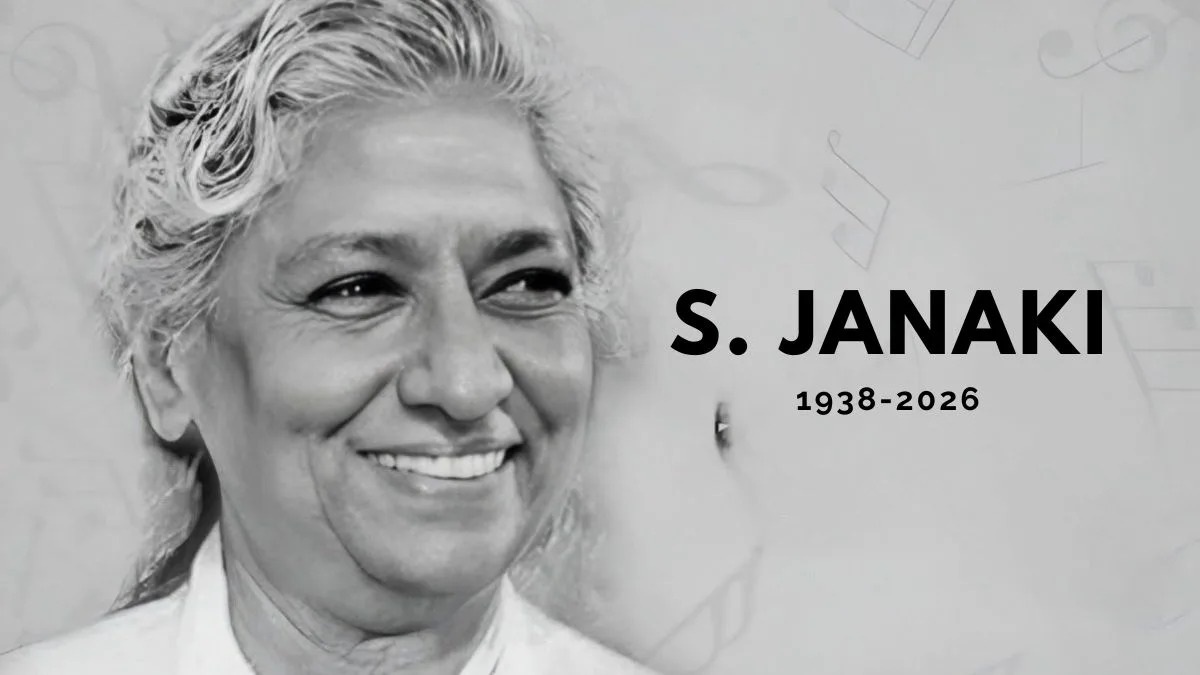
Legendary playback singer S. Janaki, celebrated as the "Nightingale of South India," has passed away at 88. With a prolific six-decade career and over 48,000 recordings in 17 languages, she remains one of India's most versatile and influential vocalists, having shaped the musical landscape of South Indian cinema for generations.
The legendary playback singer, whose voice defined decades of South Indian cinema, has passed away, leaving behind a monumental musical legacy.
CHENNAI — S. Janaki, the iconic playback singer affectionately known as the "Nightingale of South India," passed away on Saturday, July 11, 2026, at the age of 88. Her family confirmed the news in a brief statement, citing age-related health complications. The passing of the artist, who recorded over 48,000 songs across multiple Indian languages, marks the end of an era for the Indian film industry.
A titan of the recording studio, Janaki’s career spanned more than six decades. Her ability to navigate complex melodies and diverse linguistic registers made her an essential fixture of Indian cinema from the late 1950s through the 2010s. Her influence extended far beyond her native Telugu, as she became a household name in Tamil, Kannada, Malayalam, and Hindi cinema.
A Legacy of Unmatched Versatility
Born in Pallapatla, Andhra Pradesh, in 1938, S. Janaki began her career in 1957 with the Tamil film Vidhiyin Vilayattu. Over the next 60 years, she collaborated with legendary music directors, including M.S. Viswanathan, Ilaiyaraaja, and A.R. Rahman.
Her vocal range—often described as both soulful and technically precise—allowed her to adapt to everything from classical carnatic pieces to light-hearted pop and intense cinematic drama. Industry experts frequently cited her as a "singer's singer," noting her capability to record songs in a single take, regardless of the linguistic complexity.
Accolades and Cultural Impact
Throughout her prolific tenure, Janaki was recognized with numerous prestigious awards. She received four National Film Awards for Best Female Playback Singer and 33 state-level film awards across South India. In 2013, she famously declined the Padma Bhushan, stating that the honor had come too late and that the South Indian film industry had been largely overlooked by national-level recognition.
"According to officials," the Government of Andhra Pradesh and various cultural bodies have announced plans to honor her contributions with a state-level tribute. Condolences have poured in from across the country, with leaders and contemporary artists acknowledging her as the foundational voice of the modern South Indian soundscape.
Why It Matters
S. Janaki’s death is a significant cultural loss for India. Her voice served as a bridge between traditional Indian musical roots and the evolving demands of modern cinematic production. For listeners, she represented a golden era of film music where technical vocal perfection and emotional resonance were paramount. Her archive of thousands of songs continues to be a primary reference for contemporary music students and composers.
Key Facts at a Glance
Vocal Prolificacy: Recorded over 48,000 songs in 17 languages.
Career Span: Active from 1957 to 2017, earning the title "Nightingale of South India."
National Recognition: Four-time National Film Award winner for Best Female Playback Singer.
Iconic Status: Held as a central figure in the success of major South Indian cinema music directors like Ilaiyaraaja.
FAQ
Who was S. Janaki?
S. Janaki was a legendary Indian playback singer who dominated the South Indian music industry for over six decades, recording tens of thousands of songs.
How many languages did S. Janaki sing in?
She recorded songs in 17 different languages, primarily in Telugu, Tamil, Kannada, Malayalam, and Hindi.
When did S. Janaki retire?
She officially announced her retirement from singing in 2017, following a final recording for the film Pathu Kalpanakal.
Why did she decline the Padma Bhushan?
She declined the award in 2013, expressing that the honor came too late in her career and that South Indian artists deserve greater recognition from the national government.
Source: The Hindu, Indian Express, Press Information Bureau (PIB), Kerala State Film Awards Archives.