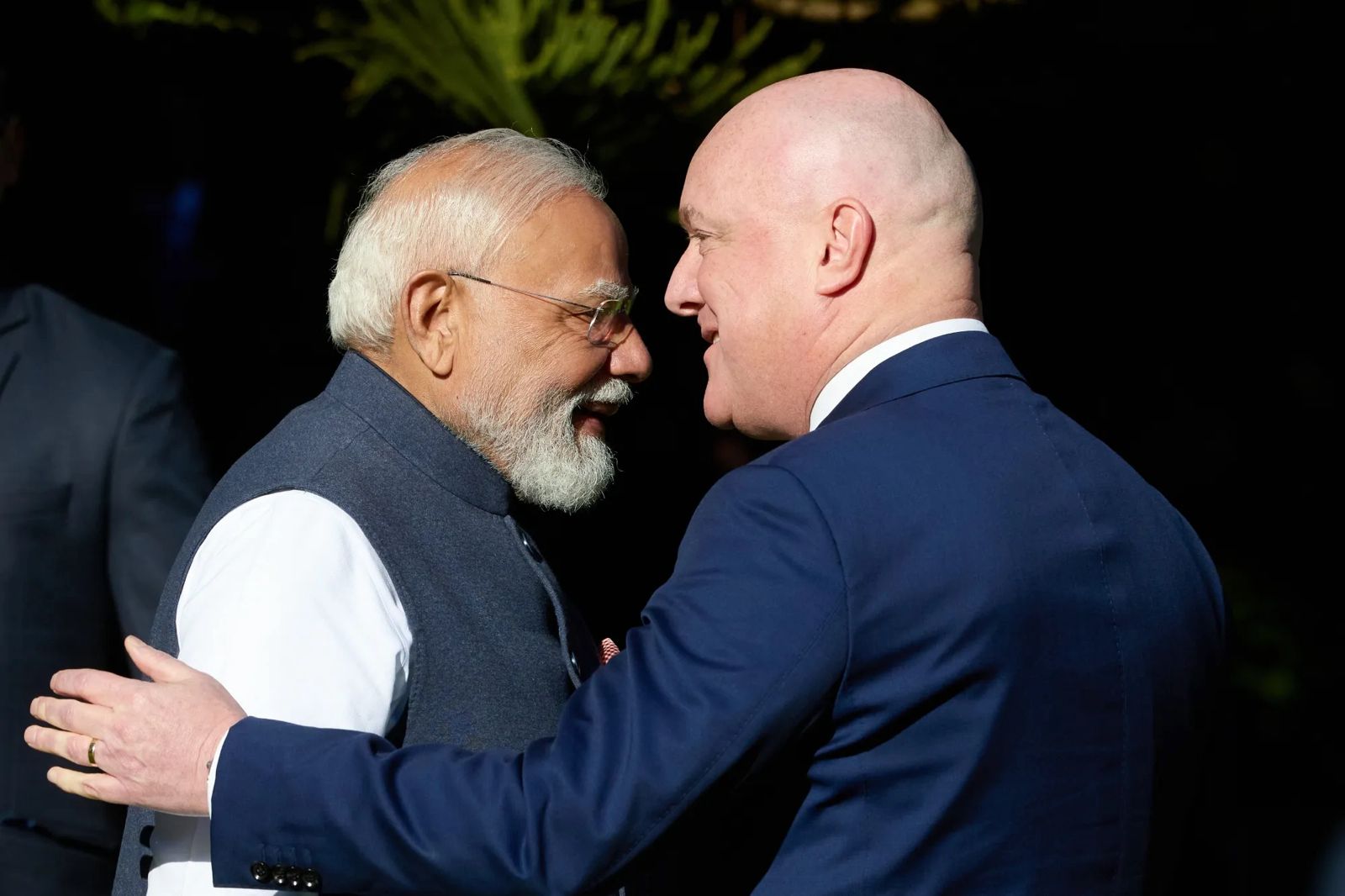
India and New Zealand have elevated their bilateral relationship to a Strategic Partnership, adopting a 2030 roadmap focused on maritime security, trade, and defense. The landmark agreement includes a new annual Maritime Security Dialogue and a mutual logistics pact, aiming to double bilateral trade to NZ$7 billion by 2030.
India and New Zealand have elevated their diplomatic ties to a Strategic Partnership, anchoring a new 2030 roadmap in maritime security and defense.
AUCKLAND — In a landmark move to strengthen their presence in the Indo-Pacific, India and New Zealand have officially elevated their bilateral relationship to a Strategic Partnership. The announcement came on July 11, 2026, following high-level talks between Prime Minister Narendra Modi and New Zealand Prime Minister Christopher Luxon in Auckland.
The partnership, unveiled at the conclusion of Prime Minister Modi's three-nation tour, is guided by the "India-New Zealand Strategic Partnership: Roadmap to 2030." This framework outlines a comprehensive plan to deepen cooperation across defense, economic trade, and regional stability.
A Focus on Maritime Security
As two major maritime democracies, the most significant component of this upgrade is a reinforced commitment to security in the Indo-Pacific. Both nations have pledged to uphold a free, open, and rules-based international order, emphasizing the importance of freedom of navigation in accordance with the 1982 United Nations Convention on the Law of the Sea (UNCLOS).
Key maritime initiatives announced during the visit include:
Maritime Security Dialogue: An annual dialogue led by the Ministry of External Affairs of India and the Ministry of Foreign Affairs and Trade of New Zealand to facilitate intelligence and information exchange.
Logistics Support: A Mutual Logistics Support Arrangement between the Indian Navy and the New Zealand Defence Force to enable reciprocal access to logistics facilities.
Indo-Pacific Oceans Initiative (IPOI): India has welcomed New Zealand’s formal nomination of Maritime Security as its priority pillar under the IPOI, marking a new phase of collaborative regional security.
Economic and Strategic Objectives
Beyond defense, the two leaders set an ambitious target to double bilateral trade in goods and services to NZ$7 billion (approximately ₹35,000 crore) by 2030. This economic roadmap follows the recent signing of the India-New Zealand Free Trade Agreement (FTA), which now serves as the foundation for broader sectoral growth.
The partnership also addresses non-traditional security threats, with the establishment of a Joint Working Group on Counter-Terrorism and a new Cyber Dialogue to align on shared digital security priorities. Furthermore, the countries have agreed to cooperate on disaster resilience through the Coalition for Disaster Resilient Infrastructure (CDRI).
Why It Matters
For businesses, travelers, and policymakers, this upgrade signifies a shift toward a more integrated regional role for both nations. The deepening of maritime ties and the harmonization of trade objectives are expected to create a more resilient supply chain network in the Indo-Pacific. By aligning their security and economic interests, India and New Zealand are positioning themselves as key stabilizers in a region increasingly marked by geopolitical complexity.
Key Facts at a Glance
Strategic Upgrade: India and New Zealand have officially established a "Strategic Partnership."
Trade Target: Doubling bilateral trade to NZ$7 billion (₹35,000 crore) by 2030.
Security Cooperation: New maritime logistics pact and annual Maritime Security Dialogue.
Roadmap to 2030: A four-year framework guiding joint actions across trade, defense, and technology.
Regional Security: New Zealand joins the Indo-Pacific Oceans Initiative (IPOI) with a focus on maritime security.
FAQ
What is the core significance of the India-New Zealand Strategic Partnership?
It elevates bilateral ties to a high-level strategic alignment, focusing on defense integration, economic growth, and regional maritime security in the Indo-Pacific.
How will the new maritime agreements impact both nations?
The pacts facilitate better naval cooperation, resource sharing, and information exchange, enhancing both countries' ability to maintain security and commerce in their shared maritime domain.
What is the target for bilateral trade by 2030?
The two nations have set an aspirational goal of doubling two-way trade in goods and services to NZ$7 billion (₹35,000 crore).
Source: Ministry of External Affairs (MEA), Press Information Bureau (PIB), The Indian Express