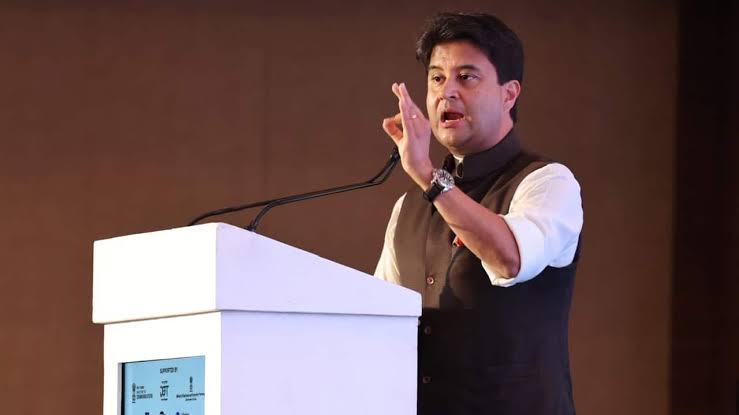
Union Communications Minister Jyotiraditya Scindia stated on C-DoT’s 43rd Foundation Day that India's indigenous telecom research will make the world reliant on Indian technology. Emphasizing leadership in 6G, quantum systems, and cybersecurity under the "Saptadhara" framework, Scindia highlighted C-DoT's role in building trusted, globally competitive digital networks.
NEW DELHI — Union Minister of Communications Jyotiraditya Scindia stated on Tuesday, August 25, 2026, that advanced C-DoT tech capabilities will make world rely on India for next-generation telecommunications infrastructure, secure networking, and digital standards. Speaking at the 43rd Foundation Day celebration of the Centre for Development of Telematics (C-DoT) in New Delhi, Scindia emphasized that India has transitioned from being dependent on foreign technology to achieving domestic self-reliance, and is now positioned to become a global supplier of trusted telecom hardware and software. The strategic push comes as global telecommunications networks prioritize trusted supply chains, artificial intelligence integration, and post-quantum encryption.
Transition from Import Reliance to Global Technology Leadership
Addressing scientists, engineers, and industry stakeholders, Scindia traced India’s telecommunications trajectory across successive mobile generations. While India lagged behind global adoption cycles during the rollout of 4G networks and subsequently matched global deployment speed in 5G, the minister asserted that indigenous research and domestic manufacturing will allow India to lead global standards in 6G.
Central to this transformation is the deployment of indigenous network architectures. A domestic consortium led by Tata Consultancy Services (TCS), with C-DoT supplying the core network stack and Tejas Networks providing radio access network (RAN) equipment, has successfully deployed an indigenous 4G technology stack across 100,000 Bharat Sanchar Nigam Limited (BSNL) tower sites. Scindia urged C-DoT to accelerate the commercialization of its 5G standalone core and expand early-stage 6G intellectual property to maintain this technological momentum.
The 'Saptadhara' Framework and Next-Gen Telecom Streams
The minister outlined "Saptadhara"—the government's seven-pillar developmental roadmap for a developed nation (Viksit Bharat)—as the foundational framework governing C-DoT's operational mandate. Under this directive, the institution must integrate its research across seven strategic domains:
Advanced Technology & Innovation: Rapidly developing intellectual property in 6G, AI, and quantum key distribution.
Indigenous Manufacturing: Designing hardware architectures suited for local production and global export.
Agritech Enablement: Deploying specialized rural connectivity solutions to support smart agriculture and sensor networks.
Smart Infrastructure: Engineering communications protocols for automated transportation, Gati Shakti logistics, and port management.
National Defense & Security: Providing encrypted, hardened communications platforms for armed services and strategic agencies.
Energy-Efficient Networks: Developing low-power transmission equipment for environmental and climate monitoring.
Soft Power & Digital Diplomacy: Exporting open, standardized, and cost-effective digital public infrastructure to partner nations.
Scindia reiterated that modern digital connectivity cannot be measured solely by consumer subscriber figures. Instead, telecom networks must be designed as trusted, resilient, intelligent, and tamper-proof national assets.
Strengthening Public Cybersecurity and Academic Partnerships
C-DoT's operational portfolio has expanded beyond switching systems and core routing into public digital security and disaster management infrastructure. The organization developed the central architecture for the citizen-centric Sanchar Saathi portal, which enables the detection and blocking of fraudulent SIM subscriptions and stolen mobile devices nationwide. Furthermore, C-DoT oversees the Common Alerting Protocol (CAP) system used by the National Disaster Management Authority (NDMA) to broadcast location-specific emergency warnings via telecom carriers during extreme weather events.
To expand basic scientific research, C-DoT has established a network of dedicated Centres of Excellence (CoE) at premier technical universities, including the Indian Institute of Science (IISc) Bengaluru and the Indian Institutes of Technology (IIT) in Hyderabad, Kanpur, Roorkee, and Gandhinagar. These collaborative research hubs focus on terahertz communications, massive MIMO arrays, and integrated sensing systems required for commercial 6G architectures.
Official Sources Section
The policy directives, strategic goals, and operational metrics referenced in this report are based on official addresses and press communiqués published by the Ministry of Communications and the Press Information Bureau. Institutional project details and deployment records are sourced from the Centre for Development of Telematics and Bharat Sanchar Nigam Limited.
Key Leadership Statements
Addressing researchers and engineers during the foundation day ceremony, Union Minister Jyotiraditya Scindia highlighted the evolving strategic mandate of domestic R&D:
"I am very confident that my family present here today will lead India from an India that was vishwa par nirbhar (dependent on the world) to an India today that is Atmanirbhar to a C-DoT that will contribute to India tomorrow on a vishwa Bharat par nirbhar (world dependent on India)," Scindia stated.
The minister added:
"C-DoT must move into the 6G, AI space, quantum technology, and cybersecurity with rapidity, and market them. We must create technologies that are affordable, dependable, scalable, and globally competitive. The next era of telecom is not going to be defined merely by connecting people, but by ensuring that connectivity and the networks that we evolve are trusted, resilient, intelligent, and most importantly, secure".
Why It Matters
As telecommunications infrastructure becomes central to national security, the belief that C-DoT tech capabilities will make world rely on India reflects a structural pivot in global tech supply chains. Developing indigenous core network stacks and open-standard 6G patents reduces long-term foreign royalty outflows, protects critical domestic data channels, and positions Indian equipment manufacturers to capture high-value export opportunities across international markets.
Key Facts at a Glance
Foundation Day Milestone: C-DoT marked its 43rd Foundation Day on August 25, 2026, in New Delhi.
Seven-Pillar Blueprint: R&D priorities structured around 'Saptadhara', covering 6G, AI, quantum computing, defense networks, and agritech.
Indigenous 4G/5G Deployment: C-DoT's indigenous core stack is operational across 100,000 BSNL tower sites via a TCS-led consortium.
Research Alliances: Five active Centres of Excellence established across IISc Bengaluru and leading IIT institutions to advance 6G research.
Frequently Asked Questions
What is C-DoT and what is its primary role in India's telecom sector?
The Centre for Development of Telematics (C-DoT) is the autonomous telecommunications research and development center under the Department of Telecommunications, Ministry of Communications, responsible for designing indigenous telecom equipment, secure network stacks, and disaster warning systems.
Why did Minister Scindia emphasize that C-DoT tech capabilities will make world rely on India?
Scindia highlighted C-DoT's transition from designing domestic replacement hardware to engineering globally competitive, trusted intellectual property in next-generation 6G, AI-driven networking, and quantum security.
What is C-DoT's contribution to BSNL's 4G and 5G network rollout?
C-DoT developed the indigenous core network software utilized in the TCS-led consortium deployment across 100,000 BSNL telecom sites, providing a fully domestic alternative to foreign equipment vendors.
How is C-DoT preparing for upcoming 6G standards?
C-DoT is actively funding research into terahertz bands, quantum communications, and intelligent network routing through dedicated academic Centres of Excellence at IISc Bengaluru and multiple IIT campuses.
Source: Ministry of Communications, Press Information Bureau, Centre for Development of Telematics, Department of Telecommunications.