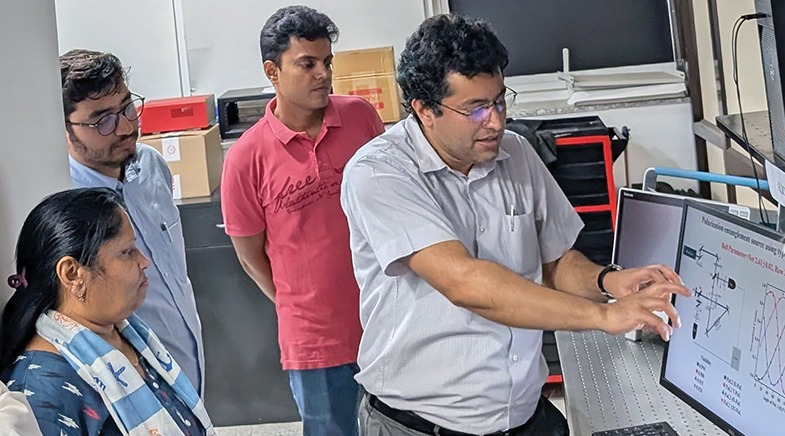
The Indian Institute of Technology Madras (IIT Madras) is supporting a deep-tech startup founded by three engineers to develop India's first room-temperature quantum computer. Backed by the IIT Madras Incubation Cell, the venture utilizes synthetic diamond and photonics technology to eliminate energy-intensive cryogenic cooling systems, dramatically lowering hardware deployment costs.
CHENNAI, India — The Indian Institute of Technology Madras (IIT Madras) announced on July 27, 2026, that its deep-tech incubation network is actively supporting a startup founded by three Indian engineers to build the nation's first room-temperature quantum computer. Supported by the IIT Madras Incubation Cell (IITMIC) and the institute's advanced photonics research facilities, the engineering team is developing a commercial quantum processor that operates at ambient temperatures without requiring sub-zero cryogenic cooling systems.
The development represents a major technical milestone for India’s National Quantum Mission, which seeks to establish domestic hardware capabilities across quantum computing, communication, and sensing. By removing cryogenic refrigeration requirements, the project aims to drastically reduce capital expenditure and power consumption, paving the way for desktop-scale quantum co-processors suitable for enterprise data centers and research institutions.
Overcoming the Cryogenic Barrier in Quantum Systems
Traditional superconducting quantum computers, such as those operated by major technology firms globally, require complex dilution refrigerators to maintain operating temperatures near absolute zero (0 Kelvin or -273.15°C). These cryogenic setups demand substantial electricity, specialized liquid helium supplies, and massive footprint requirements, limiting widespread enterprise deployment.
To overcome these constraints, the engineering team incubated at IIT Madras utilizes nitrogen-vacancy (NV) centers in synthetic diamonds combined with integrated photonics. This solid-state approach leverages the electron spin of diamond color centers to preserve quantum coherence at room temperature. The process enables qubits to perform computational calculations without decohering under ambient thermal conditions.
Strategic Mentorship and Institutional Ecosystem
Through the IIT Madras Research Park ecosystem, the startup receives comprehensive incubation support, including specialized cleanroom facilities, high-precision laser laboratories, and seed funding grants. Faculty mentors from the IIT Madras Department of Physics and Electrical Engineering provide technical validation and peer review for chip architecture designs.
In addition to laboratory infrastructure, the incubator facilitates connections with deep-tech venture funds, government research grants, and corporate R&D partners seeking early access to quantum hardware prototypes. This institutional backing ensures that foundational research translates directly into commercialized hardware IP registered within India.
Commercial Implications and Industry Applications
Developing room-temperature quantum computing systems offers transformative advantages for industrial and defense applications:
Data Center Integration: Compact, room-temperature units can fit into standard server racks without requiring specialized cooling infrastructure.
Cost Efficiency: Eliminating liquid helium and multi-stage refrigeration systems reduces operational hardware costs by up to 80%.
Strategic Autonomy: Local fabrication of photonics-based quantum chips strengthens India's semiconductor self-reliance under national deep-tech initiatives.
Sector-Specific Deployments: Accelerates complex simulations in logistics optimization, financial modeling, drug discovery, and materials science.
Official Sources and Institutional Announcements
Details regarding incubator funding, technical progress, and institutional alignment were confirmed by academic leaders and incubator representatives at the institute.
According to officials: "The incubation of room-temperature quantum computing technology at IIT Madras underscores our commitment to fostering high-impact, deep-tech innovation in India. By providing state-of-the-art laboratory infrastructure and technical mentorship, we empower young engineers to solve complex hardware engineering challenges that can position the nation at the forefront of the global quantum revolution."
Why It Matters
Building a room-temperature quantum computer shifts quantum processing from hyper-specialized research facilities to mainstream enterprise environments. For businesses, researchers, and government agencies, access to room-temperature systems significantly lowers the entry barrier for quantum-accelerated workloads. The initiative also reinforces India's position as a rising producer of original deep-tech hardware, driving skilled employment and high-value intellectual property creation.
Key Facts at a Glance
Incubation Partner: IIT Madras Incubation Cell (IITMIC) and IIT Madras Research Park.
Core Innovation: Room-temperature quantum computer utilizing diamond nitrogen-vacancy (NV) centers and photonics.
Founding Team: Founded by three Indian engineers specializing in quantum physics and hardware systems.
Primary Advantage: Eliminates the need for expensive, energy-intensive cryogenic cooling systems.
Strategic Alignment: Supports India's National Quantum Mission for domestic technological sovereignty.
Frequently Asked Questions (FAQ)
How does a room-temperature quantum computer differ from standard quantum computers?
Standard quantum computers rely on superconducting circuits that require cryogenic cooling near absolute zero. Room-temperature quantum systems use alternative qubit platforms, such as diamond NV centers or photonics, allowing them to operate in normal environmental conditions.
What role is IIT Madras playing in this startup's development?
IIT Madras provides seed funding, technical mentorship from faculty experts, access to specialized photonics and fabrication laboratories, and incubator support through the IIT Madras Research Park.
What are the main advantages of room-temperature quantum computing?
Room-temperature systems offer significantly lower deployment and operational costs, reduced energy consumption, smaller physical footprints, and easier integration into existing corporate data centers.
When will room-temperature quantum processors become commercially available?
Pilot testing and hardware prototyping are ongoing, with initial co-processor units aimed at academic research partners and specialized enterprise clients over the coming financial years.
Source: Official press disclosures and research announcements published by the Indian Institute of Technology Madras (IIT Madras), the IIT Madras Incubation Cell, and the Department of Science and Technology (DST).