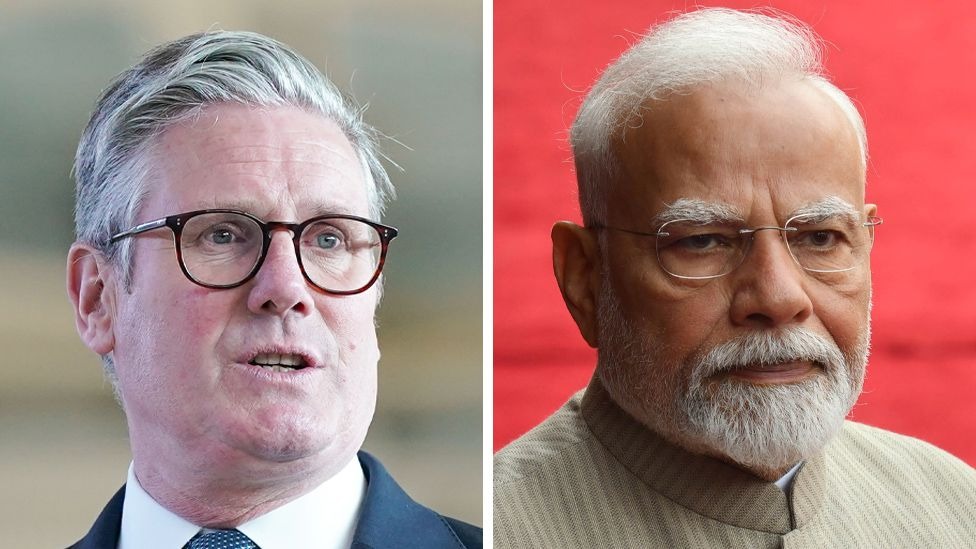
LONDON — Top British trade officials confirmed on Wednesday, June 24, 2026, that the upcoming implementation of the landmark India-UK free trade agreement will proceed entirely unaffected by the recent resignation of Prime Minister Keir Starmer. Addressing international trade desks in London, a seni...
LONDON — Top British trade officials confirmed on Wednesday, June 24, 2026, that the upcoming implementation of the landmark India-UK free trade agreement will proceed entirely unaffected by the recent resignation of Prime Minister Keir Starmer. Addressing international trade desks in London, a senior representative from the Department for Business and Trade clarified that the bilateral treaty is structurally locked into law and is fully insulated from domestic leadership changes. The legal confirmation ensures that the highly anticipated Comprehensive Economic and Trade Agreement (CETA) will formally enter into force on July 15, 2026, as mutually ratified by both governments.
Legal Continuity Secured Across Government Transitions
Institutional Framework Overrides Leadership Changes
The sudden political developments outside 10 Downing Street, where Starmer announced his departure as Labour leader earlier this week, initially generated uncertainty among cross-border trading desks and corporate investors. However, British trade diplomats emphasized that modern international economic treaties are concluded between sovereign states rather than individual administrations.
The structural agreement, which was formally signed following exhaustive negotiations, has already bypassed legislative clearance pipelines in both New Delhi and London. According to the UK Department for Business and Trade, internal technical teams are currently executing final electronic system synchronizations with Indian customs clearinghouses to ensure a seamless operational rollout on July 15.
Resolution of Pre-Existing Trade Hardspots
The upcoming activation comes immediately after negotiators resolved the final technical deadlock surrounding steel trade volumes. A sudden round of domestic steel safeguard measures introduced by London had threatened to restrict duty-free entry for Indian metal shipments.
Under the finalized consensus announced on June 17, 2026, the UK government carved out specialized country-specific quotas, exempting roughly 85% of India’s steel exports from punitive tariffs. In return, India preserved intended tariff reductions on major British consumer imports. This bilateral resolution finalized the timeline, leaving zero legal vulnerabilities for subsequent UK prime ministers to arbitrarily roll back.
Practical Impact on Corporate Networks and Consumers
Re-engineering Global Industrial Corridors
The confirmation provides immediate clarity for international logistics firms, supply chain managers, and equity investors who rely on stable regulatory horizons. The free trade agreement is structurally projected to increase long-term annual bilateral trade by £25.5 billion, providing an absolute gross domestic product (GDP) expansion of £4.8 billion to the United Kingdom and £5.1 billion to India respectively.
From day one of the implementation window, the treaty removes or sharply reduces long-standing tariff walls. For UK exporters, historical Scotch whisky duties will plummet from 150% to 40%, while automotive tariffs on British passenger vehicles—including advanced electric vehicles—will drop from 100% to 10% under a newly established preferential quota system.
Advantages for Transnational Labor and Retail Sectors
Concurrently, British and Indian retail consumers will see shifted pricing models. The UK will systematically liberalize 99% of its import tariff lines on Indian merchandise, allowing footwear, apparel, and agricultural goods to enter British high streets at lower prices.
Furthermore, alongside the core trade text, the parallel Double Contributions Convention (DCC) will also go live on July 15. This specific social security treaty allows highly skilled Indian professionals deployed to British offices on pre-existing visa routes to remain exempt from local national insurance contributions for up to five years, eliminating duplicate insurance taxation.
Official Sources Section
Regulatory implementation guidelines, customs code adjustments, and tariff reduction schedules are officially hosted within the statutory trade database of the UK Department for Business and Trade and the Ministry of Commerce and Industry, India. Joint communiqués issued during the recent G7 Summit further authenticate the operational timeline.
Quote Section
"According to officials at the Department for Business and Trade, the administrative timeline for the India-UK free trade agreement remains completely unchanged. The legal instruments have been formally exchanged, systems are undergoing active onboarding, and the transition of political leadership in London will not alter the international treaty obligations or the scheduled July 15 implementation date."
Why It Matters
The absolute insulation of the free trade agreement from political volatility proves the maturity of the institutional ties connecting London and New Delhi. For corporate enterprises currently planning capital deployments for the third quarter of 2026, the news confirms that market-entry strategies can proceed without fear of policy reversals. By securing non-partisan, state-to-state continuity, both countries safeguard a £48-billion trading pipeline from shifting domestic parliamentary alignments.
Key Facts at a Glance
Timeline Unchanged: The India-UK free trade agreement remains legally locked for implementation on July 15, 2026.
Political Continuity: Trade officials confirm Keir Starmer's resignation will not delay or alter the terms of the ratified sovereign treaty.
Steel Resolution: The deal proceeds after a last-minute consensus insulated 85% of Indian steel exports from British safeguard tariffs.
Tariff Liberalization: The pact eliminates 99% of UK import duties and slashes Indian tariffs on iconic British exports like automobiles and Scotch whisky.
Social Security Gains: The concurrent Double Contributions Convention extends social security exemptions for expatriate professionals to five years.
FAQ Section
Q1: Will the resignation of UK Prime Minister Keir Starmer delay the free trade agreement? A1: No. Official spokespersons from London have confirmed that because the treaty is signed between sovereign nations and has passed internal legal verifications, the scheduled implementation date of July 15, 2026, remains fully binding.
Q2: What are the main benefits for British companies exporting to India under the pact? A2: British exporters will see immediate tariff cuts, including a dramatic reduction in Scotch whisky duties from 150% to 40% and passenger vehicle tariffs falling from 100% to 10% within specialized quotas.
Q3: How does the agreement protect Indian steel exports to the UK? A3: Following bilateral talks, the UK agreed to a dedicated carveout configuration, ensuring that 85% of India’s steel exports enter the country free from protective domestic safeguard tariffs.
Q4: What is the Double Contributions Convention scheduled for July 15? A4: It is a reciprocal social security treaty that prevents corporate professionals on temporary visas from paying double insurance taxes, extending the UK-India social security exemption from three years to five years.
Source: UK Department for Business and Trade, Ministry of Commerce and Industry, India