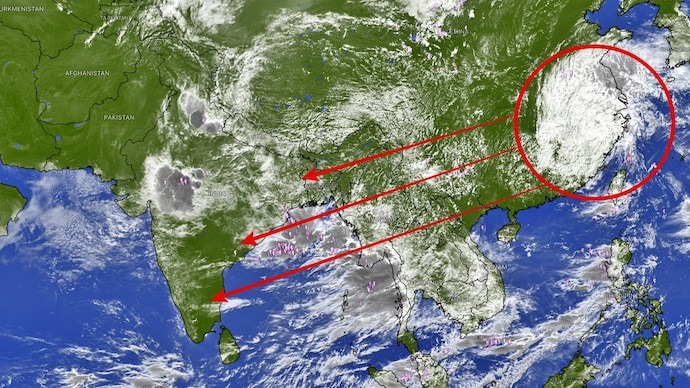
Super Typhoon Dolphin's activity over the western Pacific has indirectly impacted India's southwest monsoon. By drawing moisture eastward and disrupting the monsoon trough from 4,000 km away, the storm suppressed vital low-pressure formations in the Bay of Bengal, highlighting the interconnected mechanics of global atmospheric circulation.
NEW DELHI — While Super Typhoon Dolphin unleashed destructive winds and torrential downpours along China’s eastern coast following its landfall near Yuhuan in Zhejiang province, its massive atmospheric footprint has triggered far-reaching consequences nearly 4,000 kilometers away in India.
Meteorological tracking updates reveal that the intense Pacific system has begun suppressing the active phases of the Indian southwest monsoon. Although the tropical cyclone poses no direct physical threat to the Indian subcontinent, its colossal convective scale has fundamentally altered cross-continental moisture transport, presenting a notable challenge for regional agricultural belts.
Mechanics of Intercontinental Weather Disruption
The complex teleconnection between western Pacific typhoons and the Indian summer monsoon is dictated by large-scale atmospheric competition over thermal energy and humidity. Systems operating at the magnitude of Typhoon Dolphin function as atmospheric sponges, concentrating vast quantities of moisture and kinetic energy around their core.
According to meteorological analyses, this immense maritime suction affects regional circulation in two primary ways:
Siphoning Bay of Bengal Moisture: By drawing atmospheric humidity eastward toward the Pacific basin, the typhoon deprives the Bay of Bengal of the moisture necessary to foster low-pressure systems and depressions—the core engines driving precipitation across central, eastern, and northern India.
Displacing the Monsoon Trough: The intense cyclonic circulation disrupts upper-level wind fields, shifting the positioning of the monsoon trough and stalling the steady flow of rain-bearing winds inland.
Impact on Agriculture, Economy, and Regional Climate
Shifting weather dynamics driven by distant typhoons carry direct implications for various socio-economic sectors across the subcontinent.
For Agricultural Belts: Temporary dry spells driven by suppressed low-pressure activity can stress rain-dependent crops during crucial growth phases.
For Energy and Water Resources: Subdued rainfall activity reduces reservoir replenishment rates across peninsular and central river basins.
For Forecasters and Planners: The event underscores the growing necessity to monitor hyperactive Pacific typhoon seasons when projecting localized monsoon deficits.
Quote Section
"According to officials and meteorological experts, large convective systems like Typhoon Dolphin act as atmospheric sponges that draw moisture eastward, temporarily suppressing low-pressure formation in the Bay of Bengal and weakening active monsoon pulses across India."
Why It Matters
Understanding how remote meteorological anomalies like Typhoon Dolphin influence local weather highlights the interconnected nature of global climate systems. For millions of farmers and policymakers relying on consistent seasonal rainfall, recognizing these teleconnections helps refine drought preparedness and water management strategies during fluctuating monsoon cycles.
Key Facts at a Glance
Typhoon Intensity: Typhoon Dolphin tracked as a powerful tropical system with sustained winds exceeding 150 km/h prior to its landfall in eastern China.
Distance Factor: The system influenced Indian weather patterns from a distance of roughly 4,000 kilometers.
Primary Mechanism: Siphoned regional humidity away from the Bay of Bengal, stalling moisture-laden monsoon depressions.
Outlook: Weather experts expect normal monsoon circulation channels to realign as the system dissipates inland.
Frequently Asked Questions
How does Typhoon Dolphin affect India's monsoon from thousands of kilometers away?
The typhoon acts as an atmospheric sponge, siphoning moisture eastward toward the Pacific and depriving the Bay of Bengal of the humidity needed to generate monsoon depressions.
Did Typhoon Dolphin make direct landfall in India?
No, the storm posed no direct physical threat to India, making landfall instead along China's eastern coast near Zhejiang province.
Will this cause a permanent monsoon failure across the country?
Meteorological experts emphasize that the disruption is temporary; normal moisture channels are expected to recover as the remnant low-pressure system dissipates over land.
Which Indian regions are most sensitive to these Pacific disruptions?
Central, eastern, and northern agricultural corridors that rely heavily on low-pressure systems moving inland from the Bay of Bengal experience the most notable drying effects.
Source: India Meteorological Department (IMD) Official Bulletins, Joint Typhoon Warning Center (JTWC) Storm Disclosures, Ministry of Earth Sciences, Government of India