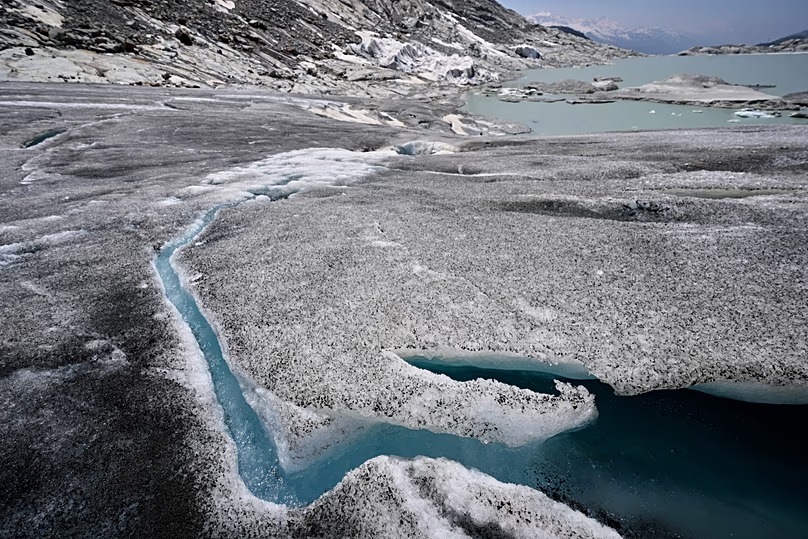
A severe European heatwave has accelerated melting across Swiss glaciers, triggering "Glacier Loss Day" on June 29, 2026—weeks ahead of schedule. Driven by poor winter snowfall, early heat, and Saharan dust, the rapid ice loss threatens the future of crucial European river systems and regional water security.
ZURICH, Switzerland — An intense summer heatwave gripping Europe has accelerated the melting of Swiss glaciers to an alarming pace. Scientists confirmed that by June 29, 2026, Switzerland reached its "Glacier Loss Day"—the critical tipping point when all protective snow accumulated during the previous winter completely vanishes, leaving the underlying bare ice exposed to solar radiation.
Data compiled by glaciologists shows that this annual threshold arrived nearly six weeks earlier than the historical mid-August average. Driven by a combination of a low-snowfall winter, unseasonably warm temperatures in May, and the current late-June thermal spike over 40°C across continental Europe, the rapid degradation has plunged the Swiss Alps into one of its most severe environmental crises on record.
Early "Glacier Loss Day" Sparks Scientific Alarm
Glacier Loss Day represents the moment an alpine glacier exhausts its seasonal budget and begins consuming its permanent ice reserves. According to monitoring models, the 2026 milestone stands as the second-earliest arrival ever documented since record-keeping intensified in 2000, surpassed only by the extreme climate anomalies of 2022.
Sustained high temperatures prevent the high-altitude ecosystem from cooling overnight. Field measurements at major glacial structures indicate an extraordinary pace of vertical recession. At the iconic Rhone Glacier, monitoring teams documented a vertical loss of one full meter of ice within a single 10-day span.
The Compounding Variables Accelerating Alpine Decline
The accelerated ablation observed throughout the Swiss Alps is not the result of the current European heatwave alone, but rather a sequence of compounding weather deficits:
Below-Average Snow Accumulation: The 2025–26 winter season produced roughly 25% less snow replenishment compared to the 2010–2020 decadal average.
Premature Spring Heatwaves: May recorded lowland temperatures crossing 30°C, stripping away the thin, high-altitude snowpacks prematurely.
Saharan Dust Contamination: Strong atmospheric winds in March deposited vast plumes of Saharan desert dust across the Alpine ridge. This dark sediment lowered the snow's reflectivity (albedo effect), causing it to absorb solar radiation up to twice as fast as clean snow.
When white protective snow yields to bare, dark glacial ice, the landscape shifts from a reflective shield to an energy absorbent, creating an accelerating climate feedback loop.
Regional Economic and Environmental Impacts
The rapid decline of Swiss glaciers has immediate, multi-sector consequences across Western Europe:
Energy and Continental Transport
Alpine glaciers act as critical water towers for the continent. Meltwater feeds directly into major European river arteries, including the Rhine and the Rhône. While the current deluge of meltwater temporarily fills reservoirs, the long-term depletion threatens hydroelectric power generation and inland commercial shipping lanes as river levels drop later in the summer.
Tourism and Local Businesses
Alpine communities and mountain resorts face structural instability due to degrading permafrost. The rapid loss of ice alters trekking routes, creates rockfall hazards for mountaineers, and forces scenic destinations to cover vulnerable glacial tongues with white geotextile blankets to preserve remaining local ice features.
Official Sources Section
Data and field findings regarding the current Alpine ablation rates have been provided by:
Quote Section
According to official assessments from the GLAMOS network monitoring team:
"We are seeing enormous ablation, ice melt rates, and snow melt rates all over the Alps. We are roughly three months too early compared to a healthy state. The problem is that we have very high temperatures that last for a very long time, which leads directly to permanent, long-term glacier loss."
Why It Matters
The transformation of the Swiss Alps serves as an active indicator of global climate disruption. While glaciers have been steadily retreating for 170 years, the Swiss volume plummeted by 38% between 2000 and 2024 alone. Over the last half-century, Switzerland has lost 1,200 individual glaciers. Experts warn that if the current multi-decade warming trajectory persists, only minor remnants of ice will remain in the Alps by 2100, permanently altering European freshwater security.
Key Facts at a Glance
Critical Date Reached: June 29 marked "Glacier Loss Day" for Swiss glaciers, six weeks earlier than the historical average.
Rapid Melting Rate: Field researchers recorded one vertical meter of ice melt over a 10-day period at the Rhone Glacier.
Snow Deficit: Winter snow replenishment fell 25% short of the 2010–2020 baseline average.
Historical Loss: Switzerland has lost 1,200 of its 2,500 glaciers over the past 50 years due to rising global temperatures.
River Security: The melting ice directly impacts downstream water flow for the Rhine and Rhône rivers, threatening shipping and energy sectors.
FAQ Section
Q: What exactly is 'Glacier Loss Day'? A: It is the specific day of the year when a glacier completely melts through the snow and ice it accumulated during the previous winter, meaning any subsequent melting directly shrinks the older, permanent core of the glacier.
Q: Is this the worst year on record for Swiss glacier melt? A: The current conditions rank as the second-most severe on record. The earliest recorded Glacier Loss Day occurred on June 26, 2022.
Q: Why does Saharan dust make the glaciers melt faster? A: The orange and grey dust particles settle on the white snow, darkening the surface. This lowers the reflectivity (albedo) of the snow, causing it to absorb more solar heat instead of reflecting it away.
Q: How many glaciers are currently left in Switzerland? A: There are approximately 1,300 glaciers remaining in Switzerland, mostly consisting of larger ice formations, after 1,200 smaller glaciers disappeared over the past five decades.
Source: Glacier Monitoring in Switzerland (GLAMOS), Swiss Federal Institute of Technology (ETH Zurich), Copernicus Climate Change Service.