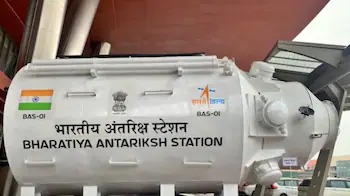
The Indian Space Research Organisation (ISRO) has commenced subsystem design and prototype hardware development for the first module of the Bharatiya Antariksh Station (BAS-01). Confirmed in Parliament on July 30, 2026, the initial 2028 module deployment lays the groundwork for India’s fully operational 5-module space station by 2035.
NEW DELHI — The Indian Space Research Organisation (ISRO) has formally transitioned from conceptual planning to active subsystem design and prototype hardware development for the Bharatiya Antariksh Station (BAS). Union Minister of State for Atomic Energy and Space, Dr. Jitendra Singh, informed the Rajya Sabha that the baseline design review and systems engineering work for the foundational module, BAS-01, have been completed.
A total of 31 baseline design documents have been formally released to guide engineering desks and domestic industry suppliers. The first module, scheduled for launch by 2028 using the Human-Rated LVM3 rocket, serves as the primary stepping stone toward India’s broader objective of establishing a 52-tonne, five-module permanent space station in Low Earth Orbit (LEO) by 2035.
Technical Progress and Subsystem Engineering
The government's Parliamentary submission outlined key milestones achieved in developing core orbital infrastructure and crew safety mechanics:
Baseline Engineering Review: Completion of overall architectural configurations and 31 baseline documentation packages for BAS-01.
Docking & Berthing Systems: Formulation of standardized mechanical and electrical interfaces for spacecraft docking, essential for joining future station modules and crew capsules.
In-Space Refueling: Successful concept demonstration testing of automated in-orbit propellant transfer mechanisms.
Indigenous Equipment Approval: Government clearance for domestic development of space suits, crew seats, viewports, and environmental control systems to reduce reliance on external suppliers.
The project builds directly on technological foundation testing under the Gaganyaan human spaceflight program, including human-rated propulsion, emergency escape systems, and crew recovery procedures.
Five-Module Roadmap to 2035
The Bharatiya Antariksh Station will operate in a circular orbit 400 to 450 kilometers above Earth at an orbital inclination of 51.5 degrees. Designed to house three to four astronauts during nominal operations (and up to six during crew rotation periods), the completed 52-tonne laboratory will comprise five distinct functional units:
BAS-01 (Base Module): Foundational power generation, primary propulsion, and initial crew living quarters targeted for 2028.
BAS-02 (Core-Docking Module): Central hub providing multiple docking ports for visiting crew vehicles and secondary modules.
BAS-03 & BAS-04 (Science & Research Modules): Specialized microgravity research laboratories for material sciences, pharmaceuticals, and biological experiments.
BAS-05 (Common Berthing Module): Automated cargo handling, extra-vehicular activity (EVA) airlocks, and robotic arm support.
Impact on High-Tech Industry and Scientific Research
Impact on Domestic Manufacturing and Aerospace Supply Chains
Transitioning from external sourcing to indigenous production for docking nodes, spacesuits, and life-support systems provides domestic private aerospace firms and precision engineering vendors with high-value manufacturing contracts.
Impact on Scientific Advancement
Establishing a permanent low-Earth orbit laboratory allows Indian researchers to conduct long-duration microgravity experiments in pharmaceuticals, advanced materials, and human physiology, positioning India alongside global spacefaring nations.
Official Sources Section
Parliamentary disclosures and technical progress metrics were confirmed through official statements presented to the Rajya Sabha by the Department of Space (DOS) and official releases issued by the Press Information Bureau (PIB) on behalf of the Indian Space Research Organisation (ISRO).
Quote Section
"According to officials from the Department of Space, baseline design reviews for BAS-01 are complete, establishing the technological foundation required for the indigenous design and assembly of all remaining space station modules."
Why It Matters
Designing and assembling an indigenous space station grants India complete operational autonomy for long-term human spaceflight. Operating a permanent orbital facility ensures continuous microgravity research capabilities, strengthens sovereign defense and communications tech, and lays the required infrastructure for future deep-space and crewed lunar missions.
Key Facts at a Glance
First Module Target: BAS-01 scheduled for development and launch by 2028 via LVM3.
Full Completion Target: 5-module, 52-tonne station fully operational by 2035.
Orbit Parameters: 400–450 km altitude at 51.5° inclination.
Current Phase: Subsystem design underway following completion of baseline design review.
Frequently Asked Questions (FAQ)
What is the Bharatiya Antariksh Station (BAS)?
The Bharatiya Antariksh Station is India's planned modular space station designed by ISRO to conduct scientific experiments in Low Earth Orbit.
When will the first module of the Indian space station launch?
The first module, BAS-01, is targeted for development and launch in 2028.
How many modules will the space station contain when completed?
The completed station will consist of five interconnected modules and is expected to be fully established by 2035.
Source: Parliamentary proceedings recorded by the Rajya Sabha, updates from the Department of Space, press communications from the Press Information Bureau (PIB), and mission documentation published by the Indian Space Research Organisation (ISRO).