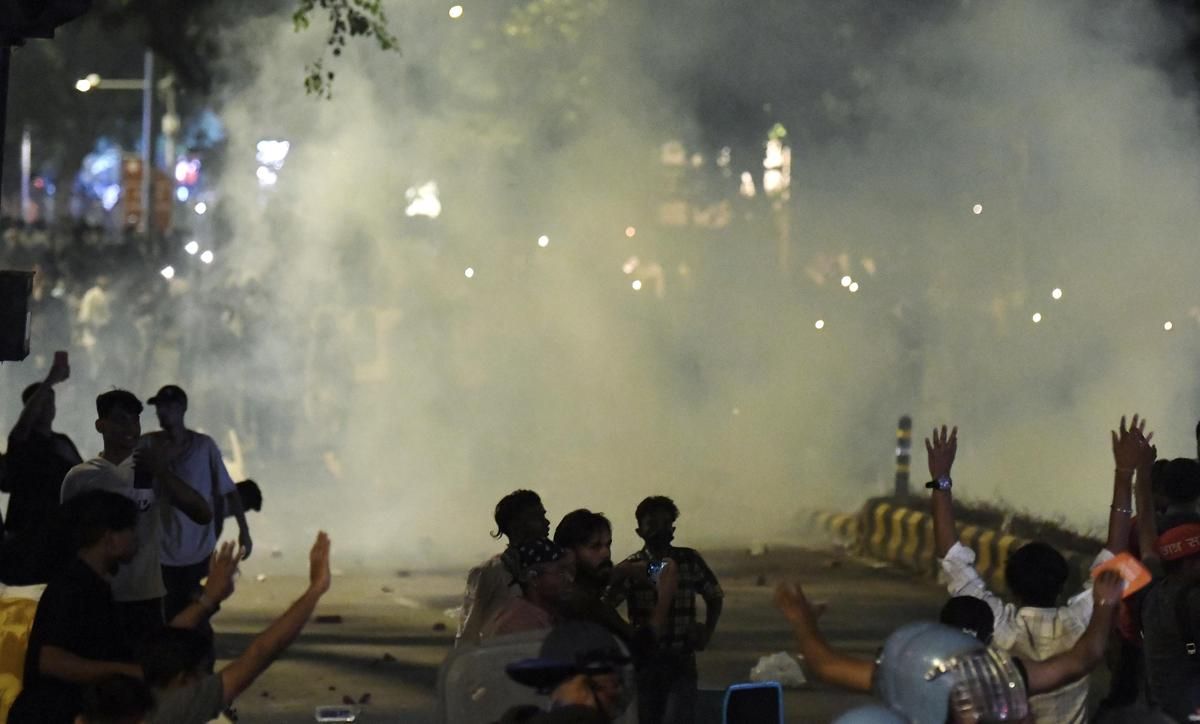
The deployment of tear gas by law enforcement in India during recent protests highlights an ongoing debate over public order tactics. While permitted under domestic laws and international treaties for policing, concerns persist regarding the legal proportionality, chemical safety, and human cost of riot control agents.
Examining the legal frameworks, chemical science, and human toll of crowd control agents used during recent protests across India.
Recent public demonstrations in New Delhi, including the July 2026 student-led marches demanding accountability in the education system, have once again placed the deployment of crowd-control weapons under intense national and international scrutiny. Security forces heavily relied on baton charges and tear gas canisters to disperse crowds near key administrative hubs. While law enforcement agencies maintain that chemical irritants are necessary to restore public order, legal experts, human rights organizations, and medical professionals continue to raise critical questions regarding the legality, physiological impacts, and human cost of tear gas usage in domestic policing.
The Legal Architecture Governing Force in India
According to constitutional provisions and criminal procedure frameworks, the power of Indian law enforcement to disperse assemblies is legally bound by principles of necessity and proportionality. While the Bharatiya Nagarik Suraksha Sanhita (BNSS)—which succeeded the Code of Criminal Procedure (CrPC)—empowers executive magistrates and police officers to command unlawful assemblies to disperse and use force if necessary, legal analysts point out critical regulatory gaps.
Constitutional Limits: Article 19(1)(b) guarantees the right to assemble peacefully, subject to reasonable restrictions under Articles 19(2) and 19(3) concerning public order and state security.
Vague Thresholds: Critics note that while domestic laws authorize force, they frequently fail to explicitly define the graduated degree of force permitted, leaving tactical implementation dependent on state police manuals and executive discretion.
Judicial Precedents: Supreme Court rulings emphasize that police must issue clear prior warnings, attempt peaceful negotiation, and deploy only minimum force, as excessive measures violate the protection of life and personal liberty under Article 21.
The Chemical Science and Physiological Impacts
Often mischaracterized as a gas, tear gas is actually a fine aerosolized suspension of solid chemical compounds—most commonly CS (chlorobenzalmalononitrile) or CN (chloroacetophenone)—packaged in grenades or ballistic projectiles.
When discharged, these compounds stimulate sensory nerve endings in the eyes, mucous membranes, and respiratory tract. According to medical studies and documentation from public health organizations like Physicians for Human Rights, exposure triggers immediate involuntary responses: severe ocular pain, excessive tearing, temporary blindness, coughing, and upper respiratory tract irritation.
While symptoms typically subside within 15 to 30 minutes following fresh air exposure and decontamination, high-dose exposure or deployment in confined spaces can provoke severe asthma attacks, chemical burns, and long-term pulmonary complications, particularly among vulnerable populations such as children and individuals with pre-existing respiratory conditions. Furthermore, direct physical impact from high-velocity canisters fired by security personnel introduces severe risks of blunt-force trauma, fractures, and catastrophic head injuries.
International Standards vs. Domestic Enforcement
At the international level, the Chemical Weapons Convention (CWC) strictly prohibits the use of riot control agents as a method of warfare. However, the treaty explicitly permits their use for domestic law enforcement and riot control purposes.
Global watchdogs, including Amnesty International and Human Rights Watch, argue that this domestic exception is frequently stretched or abused, citing instances where chemical irritants are deployed indiscriminately against non-violent demonstrators to suppress political dissent. International human rights standards mandate that tear gas must never be used to disperse peaceful assemblies and should only be applied as a last resort against active violence when individual targeted measures fail.
Why It Matters
Balancing the maintenance of public order with the protection of fundamental democratic rights is vital for civic stability. Clear operational protocols and accountability mechanisms prevent the excessive use of less-lethal weapons from causing severe public health crises.
Key Facts at a Glance
Agent Composition: Typically utilizes aerosolized CS or CN chemical compounds designed to irritate sensory nerve receptors.
Legal Basis in India: Governed by provisions under the Bharatiya Nagarik Suraksha Sanhita (BNSS) relating to unlawful assemblies.
International Status: Banned in warfare under the Chemical Weapons Convention but permitted for domestic policing under strict guidelines.
Health Risks: Causes temporary sensory incapacitation, respiratory distress, and potential physical trauma from high-velocity projectile impacts.
Frequently Asked Questions
What chemical substances make up tear gas?
Tear gas primarily consists of synthetic chemical compounds like CS (chlorobenzalmalononitrile) or CN, dispersed as a fine aerosol or particulate powder via pyrotechnic grenades.
Is tear gas legal under international law?
Yes, while banned from use in international armed conflict by the Chemical Weapons Convention, it is legally permitted for domestic law enforcement and riot control under national guidelines.
What immediate steps should someone take after tear gas exposure?
Individuals should immediately move away from the exposure zone to fresh air, flush irritated eyes with clean water, remove contaminated clothing, and seek medical attention if severe respiratory symptoms persist.
Source: Ministry of Home Affairs, Amnesty International, Human Rights Watch, Physicians for Human Rights, Organization for the Prohibition of Chemical Weapons