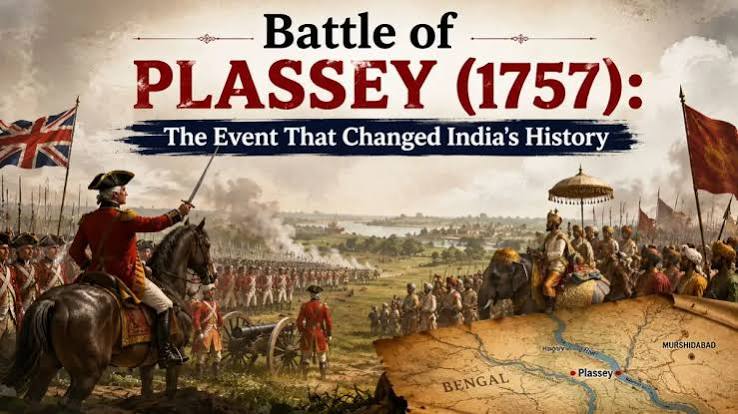
Fought on June 23, 1757, the Battle of Plassey saw the British East India Company defeat Bengal's Nawab Siraj-ud-Daulah through strategic betrayal by Mir Jafar. This pivotal event replaced native rule with corporate dominance, initiating nearly two centuries of British colonial exploitation across the Indian subcontinent.
KOLKATA — Long before the struggle for independence culminated in 1947, the trajectory of the Indian subcontinent was fundamentally altered on a monsoon-drenched battlefield along the Bhagirathi-Hooghly River. Fought on June 23, 1757, the Battle of Plassey (Palashi) remains one of the most consequential turning points in modern history.
Pitting the forces of the young Nawab of Bengal, Siraj-ud-Daulah, against the military apparatus of the British East India Company led by Lieutenant Colonel Robert Clive, the confrontation was decided less by tactical superiority and more by high-level political betrayal. The resulting victory transitioned a foreign trading corporation into an imperial power, sealing the fate of the region for nearly two centuries.
Anatomy of a Conspiracy: The Fall of Bengal
By the mid-18th century, Bengal stood as the wealthiest and most commercially lucrative province in the crumbling Mughal Empire. Alarmed by unauthorized British fortifications and aggressive trade manipulations, Nawab Siraj-ud-Daulah struck back by capturing Fort William in Calcutta. In response, Robert Clive returned from Madras with reinforcements, recapturing the city and setting the stage for a decisive showdown.
However, the military contest was crippled from within. According to historical records and archival evaluations:
The Mir Jafar Compact: Clive forged a secret pact with Mir Jafar, the commander-in-chief of the Nawab’s army, promising to install him as the puppet Nawab of Bengal in exchange for financial reparations and political dominance.
The Battlefield Standstill: On June 23, 1757, while Siraj-ud-Daulah’s massive army of roughly 50,000 men engaged the vastly outnumbered British force of 3,000, Mir Jafar’s division and allied factions stood idle, refusing to enter the combat.
The Weather Turning Point: A torrential downpour rendered the Nawab's unprotected gunpowder useless, whereas British forces swiftly safeguarded their munitions, turning a standard skirmish into a rout.
Official Sources Section
Quote Section
According to historical evaluations and institutional documentation maintained regarding the transition of power:
"The engagement at Plassey was less a traditional military victory and more a commercial takeover facilitated by internal political treachery, transforming corporate traders into sovereign arbiters of the Indian subcontinent."
Why It Matters
Understanding the events of June 23, 1757, is essential for contextualizing the structural exploitation that followed. The victory at Plassey granted the East India Company undisputed control over Bengal's tax revenues (diwani rights secured in 1765), which were subsequently leveraged to fund military expansions across the rest of the subcontinent. It initiated a massive economic drain that ultimately reshaped global trade balances and impoverished local industries, setting the stage for the long freedom struggle that ended in 1947.
Key Facts at a Glance
Date of Engagement: June 23, 1757.
Location: Palashi (Plassey), roughly 160 kilometers north of Kolkata.
Key Figures: Robert Clive (British East India Company) and Nawab Siraj-ud-Daulah, betrayed by commander Mir Jafar.
Immediate Consequence: Establishment of de facto Company rule in Bengal and the systematic expansion of British hegemony across India.
FAQ Section
What was the primary cause of the Battle of Plassey?
The conflict arose from escalating tensions between Nawab Siraj-ud-Daulah and the British East India Company over unauthorized military fortifications in Calcutta, trade privileges, and political sovereignty.
How did Mir Jafar influence the outcome of the battle?
As the commander-in-chief of the Nawab's army, Mir Jafar conspired with Robert Clive, keeping his massive cavalry inactive during the engagement and ensuring the defeat of Siraj-ud-Daulah.
Why is June 23, 1757, considered a turning point in Indian history?
The battle marked the de facto beginning of British political and economic control over India, transforming a foreign trading entity into an imperial governing power.
What happened to Bengal immediately after the battle?
Mir Jafar was installed as the Nawab, but he functioned as a puppet ruler forced to grant massive financial tributes and revenue collection rights (diwani) to the East India Company.
Source: National Archives of India, National Army Museum, West Bengal District Gazetteers