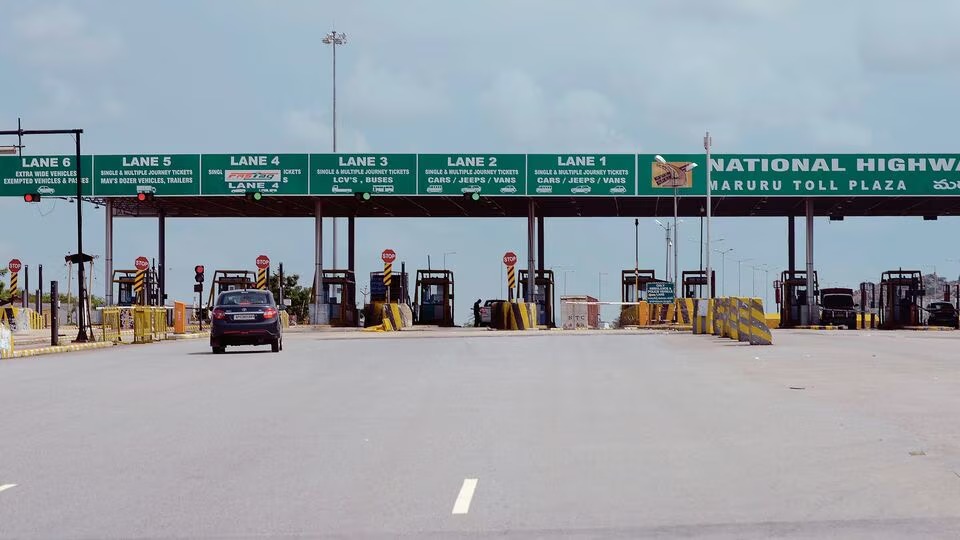
India's national highway toll collections are expanding rapidly, projected to breach the landmark ₹1 trillion mark by FY27. Detailed official data and charts unpack how user fees are generated, who pays the heaviest burden, and where capital flows across the nation's vast transportation network.
Official data highlights how soaring traffic volumes, digital toll adoption, and massive high-speed corridor expansions are reshaping India's highway economics.
National Toll Revenue Growth and Surging Collections
India's national highway toll collections have experienced exponential growth, reflecting accelerated infrastructure development and rising commercial traffic. According to data tabled by the Ministry of Road Transport and Highways (MoRTH), cumulative toll collections across national networks have scaled rapidly, driven by wider adoption of electronic toll collection systems like FASTag and the expansion of access-controlled expressways.
Internal government projections indicate that annual toll revenues are positioned to approach record-breaking figures, targeting approximately ₹75,000 crore, on course to breach the ₹1 trillion milestone by financial year 2026-27. Official reports attribute this upward trajectory to robust GDP growth, a 15% year-on-year increase in commercial vehicle movement, and the deployment of advanced electronic tolling infrastructure that minimizes transactional leakages.
Geographic Distribution and Regional Toll Plazas
An analysis of regional toll infrastructure reveals wide disparities in plaza density and revenue generation across Indian states. According to Ministry releases, states with extensive industrial corridors and heavy freight transit handle the highest volume of toll transactions.
Top Toll-Plaza States: Rajasthan leads the country with the highest number of operational toll plazas, followed closely by Uttar Pradesh, Madhya Pradesh, and Maharashtra.
Leading Revenue Generators: Uttar Pradesh remains the highest toll revenue-generating state, propelled by major arterial expressways linking key metropolitan and industrial clusters.
Regional Disparities: While northern and western states record dense networks of Build-Operate-Transfer (BOT) and Hybrid Annuity Model (HAM) stretches, southern states like Tamil Nadu and Karnataka maintain significant institutional toll frameworks supported by high passenger and commercial traffic.
Impact on Commuters, Logistics, and Investors
The expansion of the toll network carries direct economic consequences for everyday citizens, commercial transporters, and infrastructure investors. For daily commuters and inter-state travelers, higher user fees add to travel expenditures, though proponents argue that tolls offset costs by drastically reducing transit times and vehicle fuel consumption.
For the logistics sector—which relies on roads for over 60% of freight movement—efficient highways lower overall supply chain friction, even as toll expenses form a predictable component of operating overheads. Meanwhile, institutional investors and Infrastructure Investment Trusts (InvITs) view stable toll revenues as predictable, long-term yield assets backed by sovereign highway development mandates.
Quote Section
"According to official ministry statements and parliamentary data, national highway toll collections are scaling rapidly on the back of higher traffic volumes, wider electronic toll adoption, and the aggressive expansion of high-speed corridors."
Why It Matters
Understanding the economics of India's toll landscape matters because infrastructure financing relies heavily on user-pay models to fund future highway expansions without overburdening public debt. Analyzing collection trends and distribution helps policymakers balance fiscal sustainability with affordable transit for citizens and commercial transporters.
Key Facts at a Glance
Revenue Trajectory: National toll collections are projected to approach ₹75,000 crore and target ₹1 trillion by FY27.
Primary Driver: Exponential rise in electronic tolling adoption via FASTag, boasting an active user base of approximately 80 million.
Geographic Spread: Rajasthan records the highest number of toll plazas, while Uttar Pradesh leads in total revenue generation.
Strategic Shift: Government recalibration toward the Build-Operate-Transfer (BOT) model to recycle capital into new high-speed corridors.
Frequently Asked Questions (FAQ)
How much do national highway toll collections generate annually in India?
According to official ministry data, toll revenues have climbed significantly year-on-year, approaching ₹75,000 crore and tracking toward the ₹1 trillion threshold by FY27.
Which state has the highest number of toll plazas and revenue?
Official records indicate that Rajasthan features the highest count of toll plazas, while Uttar Pradesh generates the highest total toll revenue in the country.
Why are toll fees collected on national highways?
According to government policy, toll collections serve to recover construction and maintenance costs, fund the rapid expansion of access-controlled expressways, and reduce dependence on direct budgetary support through public-private partnerships.
Source: Ministry of Road Transport and Highways (MoRTH) Official Portal, National Highways Authority of India (NHAI) Disclosures, and Press Information Bureau (PIB) Government Releases.