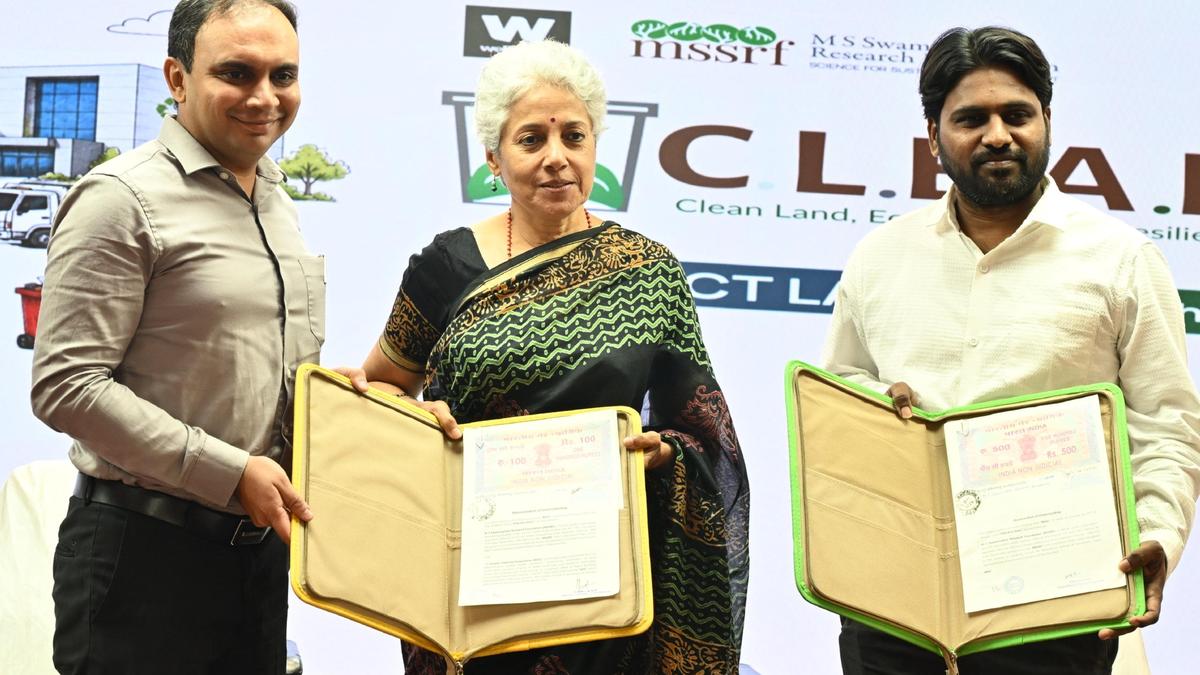
The M.S. Swaminathan Research Foundation launched a four-year transdisciplinary research project titled "Clean Land, Equitable Air & Resilience" (CLEAR) on July 28, 2026. Funded by the Wellcome Trust, U.K., the initiative partners with civic bodies in Chennai and Warangal to study health impacts from dumpsites and improve waste infrastructure.
CHENNAI — The M.S. Swaminathan Research Foundation (MSSRF) announced a four-year transdisciplinary action research initiative aimed at tackling public health risks and environmental hazards stemming from urban dumpsites. Titled "Clean Land, Equitable Air & Resilience" (CLEAR), the project was formally launched on July 28, 2026, at the MSSRF campus in Chennai following the signing of a Memorandum of Understanding (MoU) with municipal authorities and academic institutions. Supported by funding from the Wellcome Trust, U.K., the initiative will generate environmental and epidemiological data across Chennai and Warangal to help municipal authorities optimize waste processing and protect vulnerable urban populations.
Academic and Municipal Consortium for Action Research
The CLEAR project establishes an interdisciplinary consortium that pairs scientific research institutions with municipal administrative bodies. Operational partners include the Indian Institute of Technology Madras (IIT-M), the Sri Ramachandra Institute of Higher Education and Research (SRIHER), and Shristi Waste Management Services, working alongside the Greater Chennai Corporation (GCC) and the Greater Warangal Municipal Corporation (GWMC).
The consortium's primary objective is to track emissions from open dumpsites and evaluate their direct health effects on nearby communities, informal waste pickers, and young children who face elevated exposures to toxic particulates and methane combustion.
Target Objectives Across Chennai and Warangal
In Chennai a metropolitan area generating roughly 6,000 to 6,150 metric tonnes of municipal solid waste daily the CLEAR project will focus on ward-level waste audits, decentralised processing operational revamps, and source segregation protocols. Academic partners noted during the launch that nearly 300 decentralised waste management facilities in Chennai currently face operational bottlenecks or closure due to gaps in scientific and technical training for facility operators.
In Warangal, Telangana, the project will conduct comprehensive baseline environmental and health risk assessments. The resulting data will be utilized by municipal health officers to formulate an inclusive solid waste management action plan tailored to mid-sized Indian cities undergoing rapid urbanization.
Key field interventions planned under the CLEAR framework include:
Landfill Emission Mapping: Measuring ground-level air pollutants, volatile organic compounds (VOCs), and greenhouse gas emissions around dumpsites.
Health System Training: Capacity building for healthcare workers and municipal officials to diagnose and manage waste-driven environmental health conditions.
Livelihood Upgrading: Partnering with informal waste workers to improve occupational safety standards and explore alternative income-generating avenues.
Focus on Environmental Health and Evidence-Based Policy
Speaking at the launch event, Dr. Soumya Swaminathan, Chairperson of MSSRF and former Chief Scientist at the World Health Organization (WHO), highlighted the global burden of environmental degradation, noting that air pollution accounts for nearly 8 million deaths worldwide every year. She emphasized that linking environmental monitoring directly with public health metrics is necessary to generate actionable evidence for municipal policymakers.
Municipal representatives added that vulnerable urban communities residing near major landfills often remain outside formal policy frameworks. By collecting site-specific data, municipal corporations can transition toward evidence-based solid waste management strategies that align public health priorities with urban sustainability goals.
Official Sources Section
Details regarding project scope, inter-institutional agreements, and administrative goals are sourced from official communications issued during the MoU signing event held on July 28, 2026, at the M.S. Swaminathan Research Foundation. Additional administrative details conform to releases by the Greater Chennai Corporation and research framework disclosures from IIT Madras. Environmental public health parameters comply with operational guidelines administered by the Ministry of Environment, Forest and Climate Change.
Quote Section
"According to officials from the M.S. Swaminathan Research Foundation, the four-year program will connect real-time environmental monitoring with community health data to strengthen municipal waste systems."
"Municipal representatives stated that the initiative provides necessary empirical evidence to protect vulnerable populations living in close proximity to urban landfills."
Why It Matters
Rapid urban growth across Indian municipalities has outpaced waste processing infrastructure, resulting in massive open dumpsites that pose severe public health risks. The CLEAR initiative establishes a scientific foundation for waste policy by demonstrating the direct link between landfill mismanagement, toxic air emissions, and chronic health conditions. For urban residents and informal waste workers, translating this data into policy promises safer living environments, improved waste segregation, and structured occupational health protections.
Key Facts at a Glance
Program Name: Clean Land, Equitable Air & Resilience (CLEAR).
Duration & Funding: Four-year transdisciplinary action research program funded by the Wellcome Trust, U.K.
Target Cities: Chennai (Tamil Nadu) and Warangal (Telangana).
Core Institutional Consortium: MSSRF, IIT-Madras, SRIHER, Shristi Waste Management Services, GCC, and GWMC.
Frequently Asked Questions (FAQ)
What is the CLEAR research project launched by MSSRF?
CLEAR (Clean Land, Equitable Air & Resilience) is a four-year action research program aimed at studying environmental pollution and health risks associated with open dumpsites to strengthen solid waste management policies.
Which cities are covered under the CLEAR program?
The program will be implemented in Chennai, Tamil Nadu, and Warangal, Telangana, in direct partnership with local municipal bodies.
Who is funding and leading the project?
The project is funded by the Wellcome Trust, U.K., and is led by a consortium comprising MSSRF, IIT-Madras, SRIHER, Shristi Waste Management Services, the Greater Chennai Corporation, and the Greater Warangal Municipal Corporation.
How will the project assist informal waste pickers?
The program will document occupational health hazards, support safety protocols, and work with informal waste workers to identify alternative livelihood opportunities and formal health system responses.
Source: Official event dispatches and MoU signing disclosures published by the M.S. Swaminathan Research Foundation, the Greater Chennai Corporation, IIT Madras, and the Ministry of Environment, Forest and Climate Change.