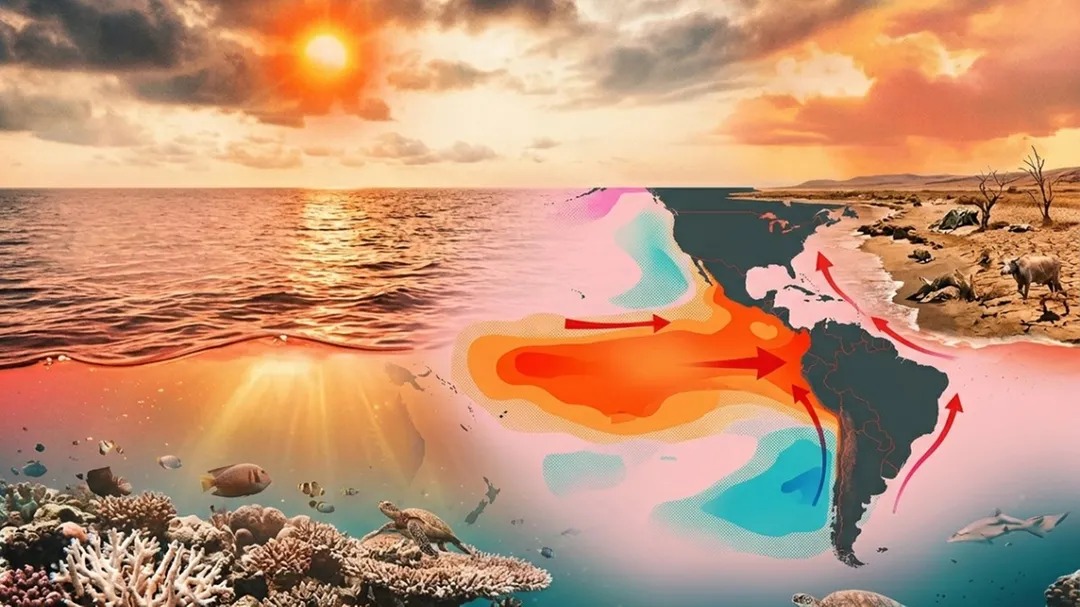
Global ocean temperatures hit their second-highest April levels ever, with seas in the tropical Pacific approaching all-time highs set during the devastating 2024 El Nino. Climate scientists warn a powerful new El Nino event could develop between May and July 2026, threatening harsher summers, weaker monsoons, extreme heatwaves, and potential food security disruptions across Asia and beyond.
The planet's oceans are flashing a warning sign that climate scientists haven't seen since 2024, and that year was already the hottest on record. The seas are warming fast, and what follows could make this decade's climate story even more alarming.
The Numbers That Should Alarm Everyone
April 2026 recorded an average global sea surface temperature of 21 degrees Celsius, the second-highest ever measured for any April, just a fraction behind the record 21.04 degrees Celsius set in April 2024. The Copernicus Climate Change Service confirmed that marine heatwaves are already breaking records across the tropical Pacific stretching to the western coasts of the US and Mexico. Meanwhile, global air temperatures in April came in 1.43 degrees Celsius above pre-industrial levels, dangerously close to the 1.5-degree Paris Agreement threshold.
El Nino Is No Longer A Forecast, It's A Countdown
The World Meteorological Organization has confirmed that El Nino conditions could formally develop as early as May to July 2026. ECMWF scientist Samantha Burgess put it bluntly: it is a matter of days before ocean temperatures break all-time records again. The ECMWF's own models suggest that central Pacific temperatures near the equator could rise to as much as 3 degrees Celsius above average by autumn.
What This Means For India
For India, the timing could not be more consequential. South Asia is already reeling from a record heatwave with temperatures breaching 45 degrees Celsius in several locations. A strengthening El Nino pattern is associated with weaker monsoon rainfall over the Indian subcontinent, raising serious concerns for agriculture, water availability, and rural livelihoods ahead of the critical Kharif season.
2027 Could Be The Hottest Year In Human History
Scientists are now raising a possibility that would have seemed extreme just two years ago. A strong El Nino layered on top of an already warming baseline could make 2027 the hottest year humanity has ever recorded, surpassing even 2024. Climate agencies caution it is too early to be fully confident about the event's strength, but the direction of travel is unmistakable.
Climate Watch Highlights
- April 2026 global sea surface temperature hits 21 degrees Celsius, second-highest on record
- Marine heatwave records broken across the tropical Pacific and US western coastline
- Global air temperatures in April sit 1.43 degrees Celsius above pre-industrial levels
- El Nino expected to develop between May and July 2026 per WMO forecasts
- ECMWF warns central Pacific could warm 3 degrees Celsius above average by autumn
- India faces risk of weaker monsoon and harsher summer under El Nino conditions
- Scientists warn 2027 could become the hottest year ever recorded in human history
Sources: Hindustan Times, Euronews, Copernicus Climate Change Service, ECMWF, World Meteorological Organization, Al Jazeera, WION, DD News