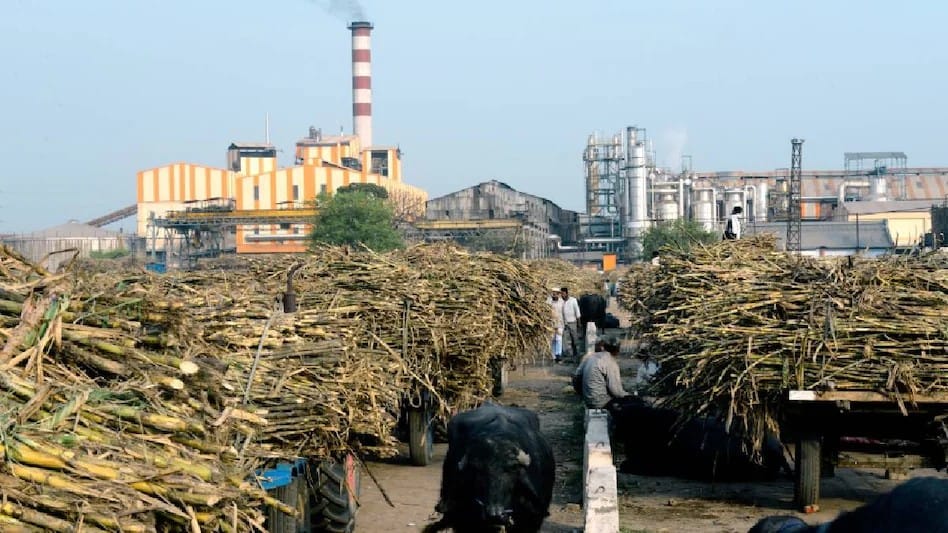
India’s sugar industry is executing a strategic pivot from traditional sugar manufacturing to multi-feedstock biorefining. Driven by early E20 ethanol blending achievements and mandatory Sustainable Aviation Fuel targets, sugar mills are integrating food, fuel, bio-gas, and circular bio-products to optimize capital utilization and maintain year-round operational capabilities.
NEW DELHI — India’s sugar sector is undergoing a structural transition from seasonal commodity milling into an integrated biorefinery ecosystem. The transformation allows agricultural processors to convert sugarcane and associated biomass into food, fuel, renewable energy, and industrial bio-products.
The movement follows India’s achievement of 20 percent ethanol blending in petrol (E20) in 2025, executed five years ahead of initial targets. Under current industrial policy, the shift addresses seasonal supply constraints by enabling facilities to deploy dual-feedstock infrastructure across varied agricultural cycles.
Policy and Feedstock Diversification Drive Year-Round Distilling
Sugarcane harvesting in India remains seasonal, historically limiting standalone distillery operations to crop timelines. Government policy actively supports converting single-stream sugarcane distilleries into multi-feedstock facilities. Modernized plants process sugar-based streams alongside grains including maize and broken rice during off-season periods.
This multi-feedstock model changes operational economics by maintaining high capacity utilization throughout the calendar year. Procurement strategies are shifting accordingly, as processors manage a broader portfolio of agricultural inputs to hedge against seasonal crop variations and localized feedstock shortfalls.
Beyond Ethanol: Expansion into CBG, Circular Bio-Products, and Aviation Fuel
The biorefinery blueprint extends beyond liquid transport fuels:
Biomethane & Compressed Bio-Gas (CBG): Press mud and distillery spent wash are increasingly routed to biomethanation units. Maharashtra inaugurated its first cooperative multi-feedstock CBG plant situated within a sugar-mill ecosystem in 2025.
Fertilizers & Bioplastics: Industrial processing streams are generating Potash Derived from Molasses (PDM) alongside bioplastic precursors such as Polylactic Acid (PLA).
Carbon Capture: Integrated mills capture and purify process carbon dioxide ($CO_2$) for conversion into liquid $CO_2$ and solid dry ice.
Sustainable Aviation Fuel (SAF): India has established indicative SAF blending mandates for international flights set at 1 percent in 2027, 2 percent in 2028, and 5 percent in 2030.
Official Sources Section
According to official releases from the Ministry of Petroleum and Natural Gas, national regulations governing fuel marketing have been amended to incorporate Sustainable Aviation Fuel (SAF) blending specifications alongside traditional Aviation Turbine Fuel (ATF).
Government data further classifies press mud and spent wash as critical feedstocks for the expansion of national Compressed Bio-Gas (CBG) infrastructure under circular economy initiatives.
Quote Section
"The sugar mill of the future may be defined not by how much sugar it produces, but by how intelligently it converts cane and its associated streams into food, fuel, energy and higher-value products," stated Uppal Shah, Chairman and Managing Director of JK India eAgriTech Ltd.
Industry officials noted that capital allocation must align with supply-chain integration, cautioning that adding processing streams without clear operational integration adds structural complexity.
Why It Matters
For agricultural markets and fuel consumers, biorefineries stabilize rural cash flows by decoupling sugar producer revenues from fluctuating global sugar commodity prices.
By operating year-round on flexible feedstocks, integrated units optimize capital assets, reduce carbon emissions, support domestic energy security, and establish early supply pathways for emerging green aviation mandates.
Key Facts at a Glance
E20 Landmark: India achieved 20% ethanol blending in petrol in 2025, five years ahead of schedule.
SAF Targets: Mandatory international flight blending targets established at 1% (2027), 2% (2028), and 5% (2030).
Feedstock Flexibility: Distilleries are transitioning to dual-feedstock systems using sugarcane, maize, and broken rice.
Circular Value Streams: Expansion incorporates CBG, Potash Derived from Molasses (PDM), Polylactic Acid (PLA), and industrial $CO_2$ capture.
Frequently Asked Questions (FAQ)
Q1: What is a sugar biorefinery?
A sugar biorefinery is an integrated processing facility that converts sugarcane and related agricultural inputs into a broad spectrum of products, including sugar, ethanol, biomethane, electricity, fertilizers, and biochemicals.
Q2: Why are sugar mills transitioning to multi-feedstock models?
Sugarcane is a seasonal crop. Utilizing alternative feedstocks like maize and damaged grains during the off-season allows ethanol plants to maintain continuous year-round production and improve capacity utilization.
Q3: How does Sustainable Aviation Fuel (SAF) link to the sugar industry?
Ethanol and agricultural residues produced by biorefineries serve as foundational feedstocks for alcohol-to-jet technology to meet upcoming SAF blending mandates.
Source: Official statements from the Ministry of Petroleum and Natural Gas, industry documentation from JK India eAgriTech Ltd, and reported sector data from The Hindu BusinessLine.