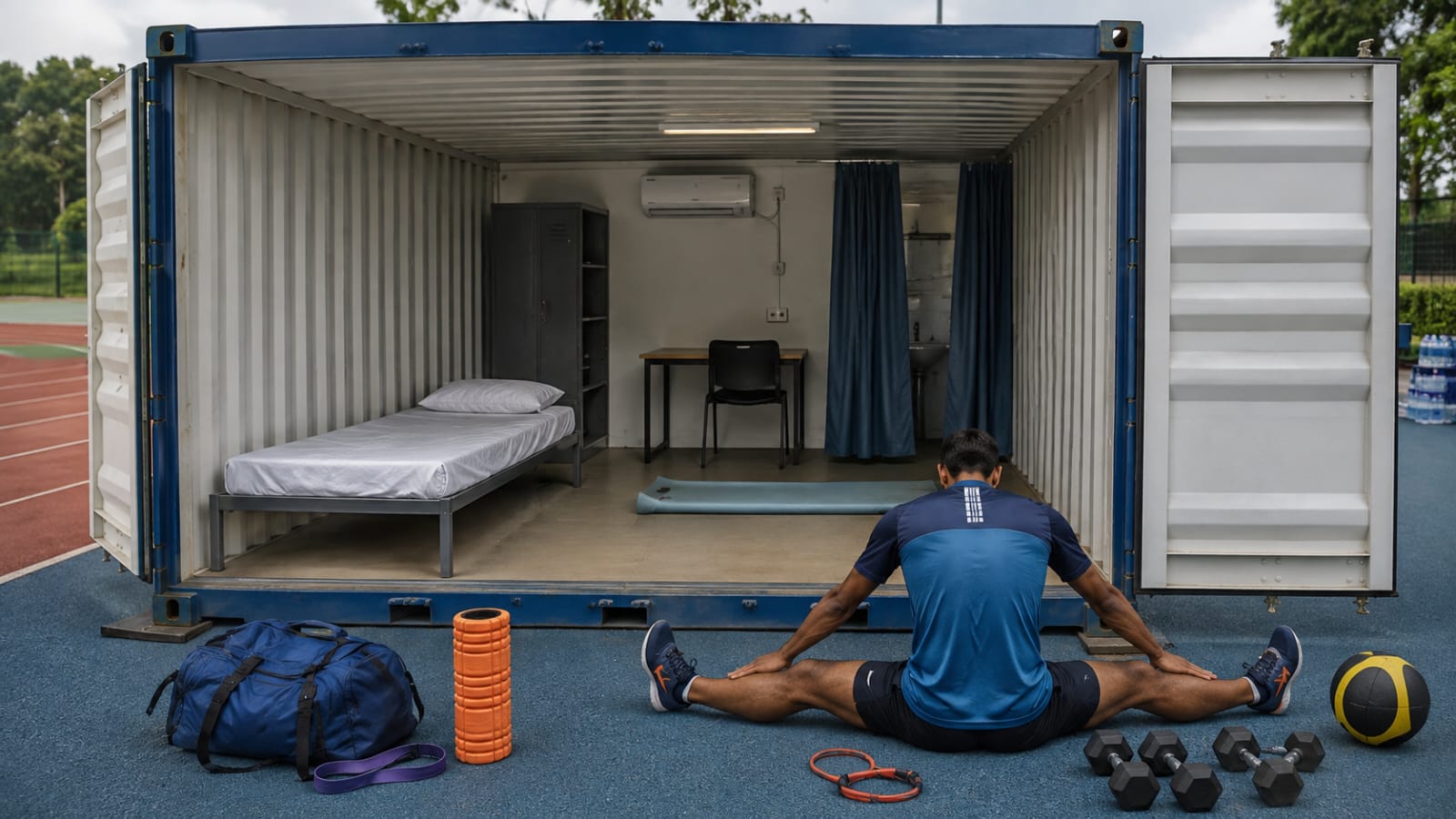
The Sports Authority of India has installed custom shipping container accommodation simulators in Patiala and Bengaluru. Designed to replicate unusual modular housing at the Aichi-Nagoya Asian Games, the initiative helps Indian athletes mentally and physically acclimatize to confined living spaces ahead of international competition, preventing performance anxiety.
New Delhi - To prevent psychological shock and logistical discomfort, the Sports Authority of India (SAI) has engineered customized shipping container accommodation units at its premier training facilities in Patiala and Bengaluru. Unveiled in September 2026, the simulation initiative prepares Indian competitors for the unconventional housing framework established by organizers for the upcoming Asian Games in Japan. With the regional multisport quadrennial event running from September 19 to October 4, 2026, host cities Aichi and Nagoya have forgone a traditional athletes' village to curtail capital expenses, opting instead to house over 17,000 participants across hotels, a cruise ship, and temporary modular units.
Replicating Japan's Modular Living Quarters
The newly constructed simulation units replicate the exact spatial dimensions and physical constraints of the temporary quarters awaiting the Indian contingent abroad. Measuring approximately 40 feet in length and 8 feet in width, each retrofitted container houses compact multi-bed arrangements, split air-conditioning units, integrated storage spaces, and compartmentalized washroom facilities.
According to administrative updates from SAI, athletes across track and field, boxing, fencing, and team sports have been slotted into a strict overnight rotation schedule. By spending consecutive nights within the confined steel quarters, competitors experience firsthand the close quarters and restricted movement handling required for bulky sports kits, effectively eliminating unfamiliarity before arrival in Japan.
Strategic Psychological Adaptation and Training Focus
The operational rollout directly targets athlete welfare and mental resilience under unusual living conditions.
For Elite Competitors: High-profile athletes, including continental medalists, undergo simulated night stays to adapt to restricted personal space and eliminate potential competition anxiety.
For Support Staff and Coaches: Trainers monitor adjustment metrics to ensure that compact room layouts do not interfere with recovery protocols or sleep patterns.
For Long-Term Infrastructure: Post-games, the durable steel structures are slated for permanent conversion into guest suites for visiting athlete families at national training hubs.
Official Sources Section
Operational guidelines, spatial configurations, and acclimatization strategy metrics are drawn from formal project disclosures released by the Sports Authority of India (SAI) and executive briefings from regional training centers in Patiala and Bengaluru.
"According to officials, the container simulators were designed to ensure that athletes experience zero psychological setback or claustrophobia upon arriving in Japan, allowing them to step into international competition without environmental pressure," SAI representatives stated.
Why It Matters
In major international sports competitions, minor logistical hurdles can critically fracture a competitor's psychological focus. By proactively replicating foreign housing anomalies on home soil, sports administrators insulate athletes from unexpected environmental shocks, safeguarding overall performance standards during high-stakes medal events.
Key Facts at a Glance
Training Sites: Prototype facilities established at Netaji Subhas National Institute of Sports (NSNIS) Patiala and the SAI South Centre in Bengaluru.
Structural Dimensions: Approximately 40 feet long and 8 feet wide, replicating international modular container specs.
Core Amenities: Four-bed layouts, split air conditioning, compact pantries, washing machines, and compartmentalized bathrooms.
Event Context: Aichi-Nagoya Asian Games 2026 features no conventional athletes' village, utilizing modular units, cruise liners, and hotels instead.
FAQ Section
Why are Indian athletes training inside shipping containers?
SAI set up the container simulators to help athletes acclimatize to the compact, non-traditional modular accommodations being used at the 2026 Asian Games in Japan.
Where have these simulation units been installed in India?
The prototype units are operational at SAI training campuses in Patiala (Punjab) and Bengaluru (Karnataka).
What are the primary amenities provided inside the container units?
Each container features four beds, climate control air conditioning, a compact kitchenette, a washing machine, and segmented washroom facilities.
Why is there no traditional athletes' village at the 2026 Asian Games?
To curb operational costs and manage large participant numbers, Japanese organizers opted to distribute athletes across hotels, a cruise ship, and temporary modular units.
Source: Sports Authority of India (SAI) announcements, NSNIS Patiala administrative briefings, and regional training center reports.