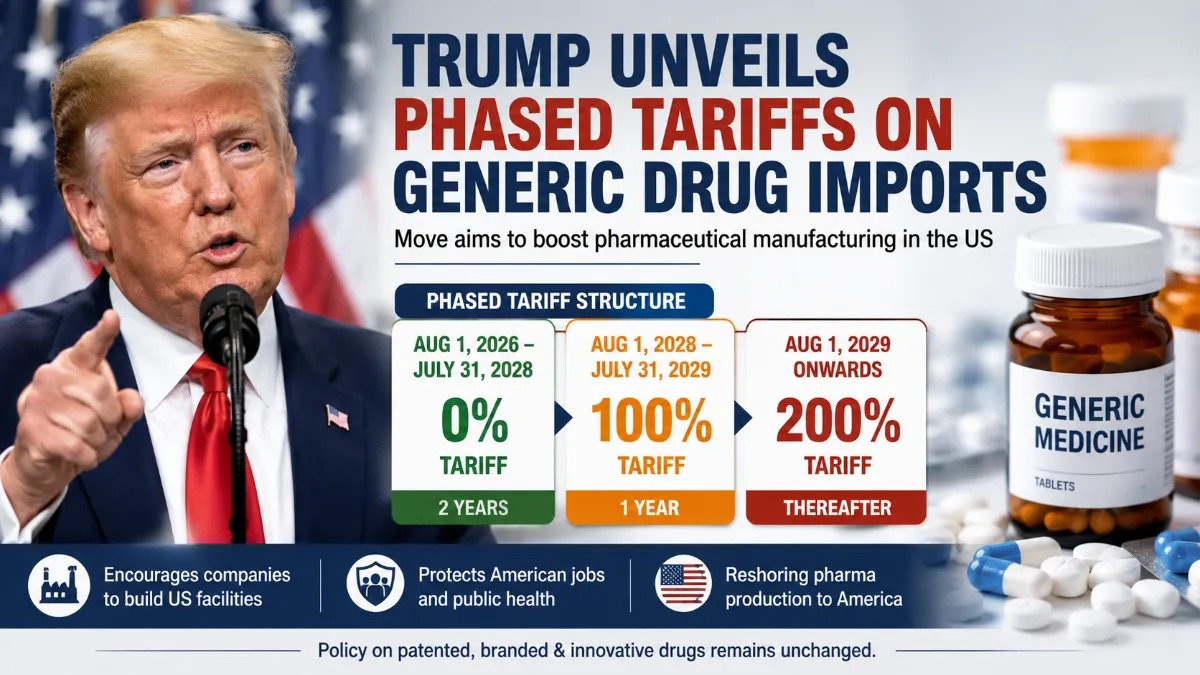
U.S. President Donald Trump has announced a structured tariff plan targeting imported generic medicines. The policy maintains zero percent tariffs for two years starting August 1, 2026, before imposing a 100% duty in August 2028 and escalating to 200% thereafter to incentivize domestic pharmaceutical reshoring.
WASHINGTON — United States President Donald Trump announced a phased tariff framework targeting imported generic medicines. Under the directive, imported generic pharmaceuticals will continue to enter the American market duty-free for two years starting August 1, 2026.
Following the grace period, tariffs will rise to 100% on August 1, 2028, for one year before escalating to a permanent 200% rate.
The policy aims to force global pharmaceutical companies to establish manufacturing plants and equipment within the United States. The announcement directly impacts major international suppliers, particularly India the world's largest exporter of generic medicines which supplies nearly half of all generic prescriptions dispensed across American pharmacies.
Strategic Timeline and Enforcement Mechanics
The tariff framework establishes a defined transition window for global drugmakers supplying the U.S. market:
President Trump clarified on Truth Social that the existing trade frameworks for patented, branded, or innovative drugs remain unchanged, focusing the new measure entirely on generic off-patent formulations.
Impact on India's $9.7 Billion Pharmaceutical Export Sector
India, frequently characterized as the "pharmacy of the world," stands as the largest foreign supplier of generic formulations to the United States.
According to trade data compiled by the Global Trade Research Initiative (GTRI), Indian pharmaceutical companies exported $9.7 billion worth of medicines to the United States in 2025, accounting for 38% of the country's total global pharmaceutical export revenue. Indian generic medicines account for roughly 47% of all generic prescriptions dispensed across the American healthcare system.
Healthcare analysts note that Indian drugmakers including Sun Pharma, Dr. Reddy's Laboratories, Cipla, and Lupin face a choice: absorb heavy capital expenditure by acquiring or building U.S. manufacturing facilities, face high tariffs, or pass increased costs to American health insurers and consumers.
Official Sources Section
Policy directives, presidential statements, and international trade reports are archived on the White House Official Portal and tracked by the Office of the United States Trade Representative (USTR). Trade impact metrics are compiled by the Global Trade Research Initiative (GTRI) and monitored by the Ministry of Commerce and Industry.
Quote Section
"According to statements published by President Donald Trump on Truth Social, effective August 1st, 2026, all generic drugs entering the United States will maintain a zero percent tariff for two years, after which the tariff will rise to 100 percent for one year and 200 percent thereafter to force domestic reshoring of pharmaceutical production."
Why It Matters
For American Healthcare Consumers: Protects prescription costs through July 2028, but raises potential risks of higher drug prices or shortages if global manufacturers fail to shift production on time.
For Indian Drug Manufacturers: Sets a firm two-year deadline for major pharmaceutical companies to establish domestic U.S. manufacturing facilities or diversify into non-U.S. export markets.
For Global Trade Policy: Marks an aggressive expansion of "America First" trade measures directly into the healthcare supply chain.
Key Facts at a Glance
Grace Period: 0% import duty on generic drugs for two years starting August 1, 2026.
Escalating Rates: 100% tariff starting August 1, 2028, rising to 200% on August 1, 2029.
India's Exposure: $9.7 billion in U.S. exports at risk, representing 38% of India's total pharmaceutical export volume.
Exclusions: Patented, branded, and innovative medicines are excluded from this specific generic policy framework.
Frequently Asked Questions (FAQ)
When do the new U.S. generic drug tariffs take effect?
The tariffs will keep a 0% rate from August 1, 2026, to July 31, 2028. A 100% tariff applies starting August 1, 2028, and increases to 200% on August 1, 2029.
How does this generic drug policy impact Indian pharmaceutical companies?
India supplies 47% of all generic prescriptions in the U.S. Companies must build U.S.-based manufacturing infrastructure within two years to avoid high tariffs on their $9.7 billion export trade.
Are branded and patented medicines subject to this 200% generic tariff?
No. President Trump confirmed that existing trade frameworks governing patented, branded, or innovative drugs remain unchanged.
Source: Statements by U.S. President Donald Trump via Truth Social, foreign trade analysis from the Global Trade Research Initiative (GTRI), and reports published by Times of India and Business Today.