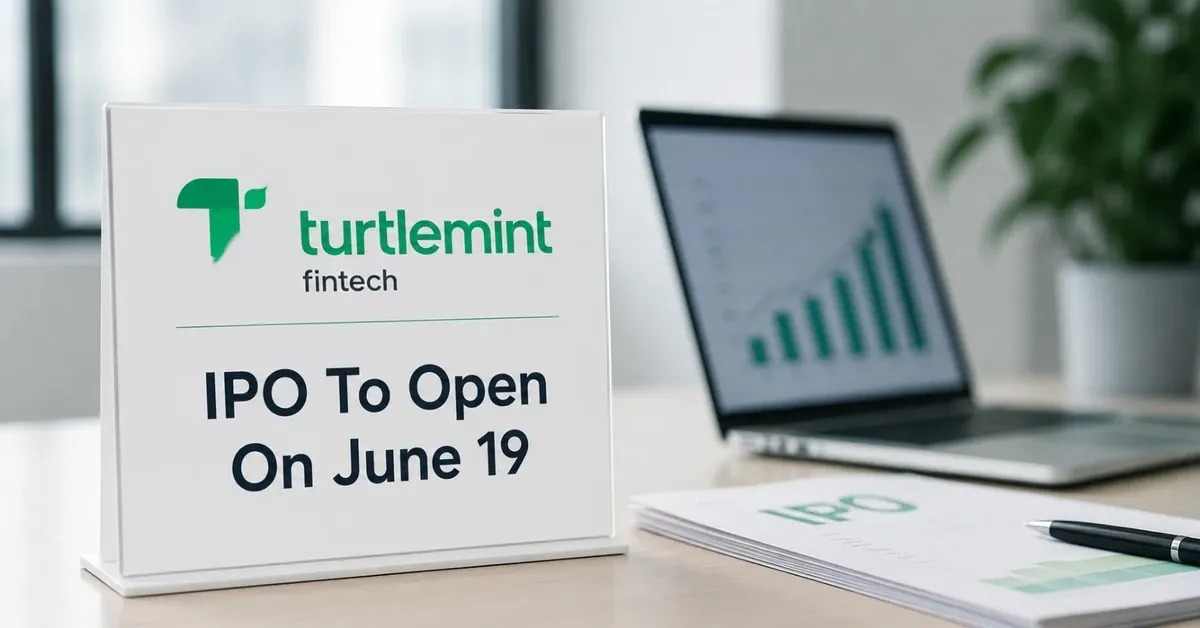
Insurtech aggregator Turtlemint Fintech Solutions Limited will launch its ₹882.67 crore IPO on June 19, 2026, at a price band of ₹144–₹152 per share. Closing on June 23, the issue will fund server infrastructure and technology expansion before listing on the BSE and NSE on June 29.
MUMBAI — Turtlemint Fintech Solutions Limited has officially announced that its Initial Public Offering (IPO) will open for public subscription on Friday, June 19, 2026. The book-built issue, targeting an aggregate capital raise of ₹882.67 crore, will remain open for a three-day bidding window, closing on Tuesday, June 23, 2026. This market debut represents a major milestone for India's digital insurance distribution sector, expanding public equity avenues into the country's technology-enabled financial services landscape.
The public rollout aims to accelerate Turtlemint's technology localization and expand its grass-roots agent distribution network. By transitioning onto public bourses, the insurtech firm seeks to optimize its balance sheet during a period of steady regulatory transformation within the domestic financial services ecosystem.
Issue Price Band, Lot Size, and Allotment Structure
According to the official Red Herring Prospectus (RHP) filed with capital market regulators, Turtlemint has fixed its initial price band between ₹144 and ₹152 per equity share. The total issue size consists of a fresh capital issuance worth up to ₹660.72 crore, alongside a secondary Offer for Sale (OFS) component of ₹221.95 crore from early corporate promoters and institutional backers.
For retail individuals, the minimum bidding application has been restricted to a single lot size of 98 equity shares. This places the baseline investment commitment for small-scale allocators at ₹14,896 at the upper cap of the price band. Under statutory allotment guidelines, the public offer is structured primarily to attract long-term institutional blocks, reserving 75% of the net issue for Qualified Institutional Buyers (QIBs), 15% for Non-Institutional Investors (NIIs), and the remaining 10% for individual retail applications.
Financial Recovery, Grey Market Activity, and Operational Risks
Unlisted equity tracking desks report a conservative baseline for the asset's early secondary sentiment. Three days prior to the public open, the unofficial Turtlemint IPO Grey Market Premium (GMP) stabilized at ₹0 (nil). This indicating that unlisted shares are currently changing hands right at par with the official corporate offer price of ₹152, signaling stable, non-speculative initial trading expectations.
On the balance sheet side, the company's financial indicators show a sharp operational turnaround after a challenging fiscal cycle. Restated financial records highlight that operational revenues recovered strongly by 456% to reach ₹662.71 crore for the fiscal year ended March 31, 2025, rebounding from a severe FY24 contraction of ₹119.12 crore.
| Financial & Operational Metric | Fiscal Year 2023 | Fiscal Year 2024 | Fiscal Year 2025 |
| Revenue from Operations | ₹419.92 crore | ₹119.12 crore | ₹662.71 crore |
| Net Profit After Tax (PAT) | ₹288 crore loss | ₹193.35 crore loss | ₹194.11 crore loss |
| Certified Digital Partners | 3,76,618 PoSPs | — | 5,43,972 PoSPs |
| National Pin Code Coverage | — | — | Nearly 98% reach |
Despite this top-line acceleration, potential public participants are parsing significant structural hazards. The insurtech major continues to register net operational losses, logging a net loss of ₹194.11 crore for FY25. Furthermore, the asset-light, commission-based business model faces high product concentration, with a majority of platform premiums stemming from motor and general insurance lines. The company remains highly dependent on maintaining its network of 5.43 lakh certified Point-of-Sale Persons (PoSPs) to sustain its extensive rural footprint.
Official Sources Section
The operational parameters, financial statements, and structural allocations discussed have been verified through the official Red Herring Prospectus (RHP) submitted to the Securities and Exchange Board of India (SEBI). The institutional fund placement is managed by an advisory syndicate including ICICI Securities Limited and Jefferies India Private Limited, with KFin Technologies Limited serving as the official registrar.
Quote Section
"According to officials and public management declarations detailed within the corporate issue briefs, approximately ₹193.04 crore of the fresh issue proceeds is legally bound to fund technology salaries, with an additional ₹128.64 crore designated for direct investment in its core brokerage subsidiary, TIB."
Why It Matters
The transition of top-tier insurtech platforms like Turtlemint onto public stock exchanges carries immediate practical significance for the broader consumer economy and retail financial sectors. For rural populations, the expansion of tech-backed distribution networks ensures easier, localized access to essential health and life protection products across underpenetrated tier-three towns. Practically, for public market participants, this offering provides a pure-play entry path into digital insurance aggregates, although retail allocators must carefully monitor the company's timeline to achieve net profitability.
Key Facts at a Glance
Bidding Timeline: The Turtlemint IPO opens for public subscription from June 19 through June 23, 2026.
Fixed Lot Structure: The price band is established at ₹144 to ₹152 per share, requiring a minimum retail block size of 98 units.
Capital Allotment: Out of the total ₹882.67 crore issue, ₹660.72 crore will inject fresh capital directly into the company's corporate development goals.
Bourse Debut: Following the finalization of the basis of allotment on June 24, trading is scheduled to begin on both the BSE and NSE on Monday, June 29, 2026.
Frequently Asked Questions
What is the phygital model used by Turtlemint?
The phygital business model combines a physical network of over 5.43 lakh local certified agents (PoSPs) with proprietary digital tools like the Turtlemint Pro mobile application, simplifying insurance onboarding for end consumers across rural regions.
Why is the retail allocation quota limited to 10% for this issue?
Under regulatory frameworks, the issue is heavily focused on institutional participants (75% QIB allocation). This structure ensures that sophisticated institutional backers drive the primary price discovery process for the loss-making fintech entity.
How do I check my share allotment status once the issue closes?
Bidders can check their individual allocation status starting on June 24, 2026, by logging onto the official platform of the registrar, KFin Technologies Limited, or checking exchange tracking boards.
Source: