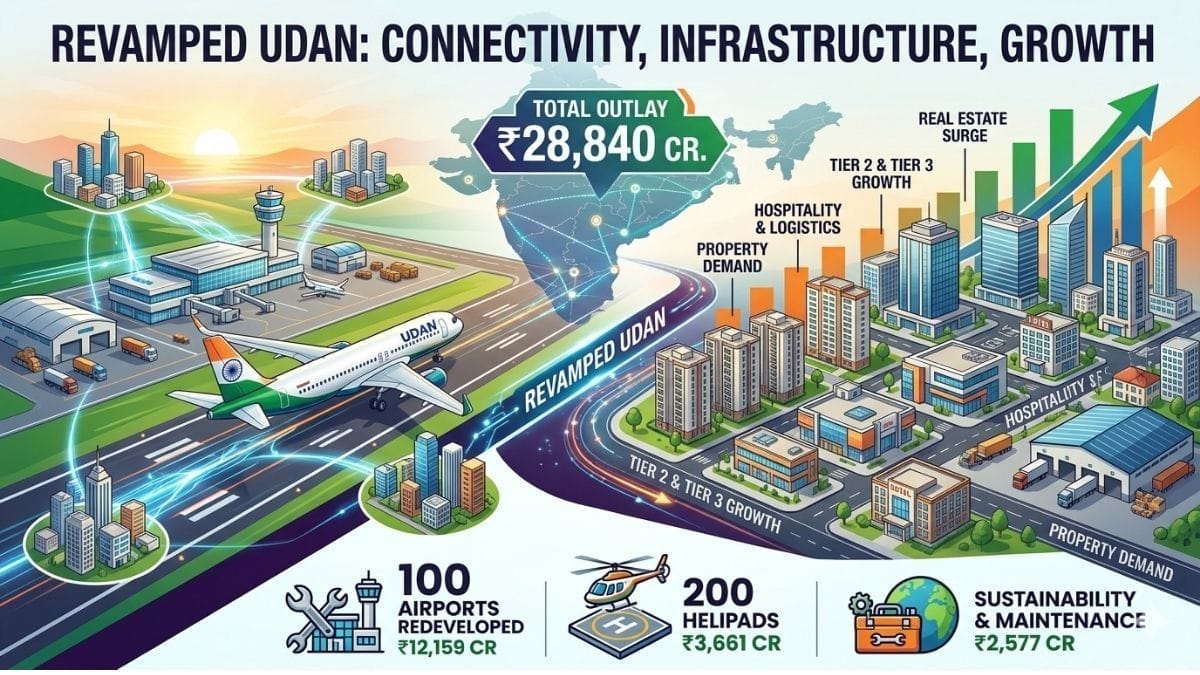
Union Minister Ram Mohan Naidu announced a ₹28,840 crore investment over ten years for the next phase of India's UDAN regional connectivity scheme. The outlay funds 100 new airports, 200 helipads, viability gap funding, and air cargo expansion, aiming to boost aviation access across Tier-2 and Tier-3 regions.
MYSURU — The Union Government has announced a plan to invest ₹28,840 crore over the next ten years to expand the flagship Ude Desh ka Aam Nagrik (UDAN) regional air connectivity scheme. The announcement was made by Union Civil Aviation Minister Ram Mohan Naidu Kinjarapu during a Civil Aviation Consultative Committee meeting in Mysuru on August 21, 2026.
The multi-year financial outlay aims to build on the progress made over the past decade by extending affordable air travel to unserved and underserved regions. The funding allocation will support viability gap funding (VGF) for regional airline operators, the development of new regional airports, the expansion of helipads, and the modernization of air cargo facilities across India.
Strategic Infrastructure Expansion and Financial Allocation
The ₹28,840 crore budgetary commitment represents a structural scale-up from the approximately ₹10,000 crore invested in regional connectivity during the first decade of the UDAN initiative.
Under the revised roadmap prepared by the Ministry of Civil Aviation, the government intends to develop 100 new airports from unserved airstrips and build 200 modern helipads.
| Fund Purpose | Earmarked Capital | Target Focus Area |
| Viability Gap Funding (VGF) | ₹10,043 Crore | Airline route subsidies over 10 years |
| Airport & Aerodrome Development | ₹12,159 Crore | 100 new airports at ~₹100 Cr per site |
| Helipad Infrastructure | ₹3,661 Crore | 200 modern helipads in remote/hilly areas |
| Operations & Maintenance (O&M) | ₹2,577 Crore | O&M support for ~441 aerodromes |
| Specialized Aircraft Procurement | ₹400 Crore | Acquisition of 2 Dhruv helicopters & 2 Dornier planes |
State Level Collaboration and Air Cargo Integration
Union Minister Ram Mohan Naidu emphasized that active engagement with state governments remains central to executing the next phase of airport development. The strategy shifts toward developing regional airports through a "Challenge Mode," encouraging sub-national administrations to streamline land acquisition, operational clearances, and last-mile connectivity.
In addition to passenger transport, the expanded UDAN framework integrates transshipment cargo reforms. The initiative reduces cargo transit times and handling fees by eliminating redundant re-screening procedures for transshipment freight.
According to data released by the Ministry of Civil Aviation, transshipment trials on key routes reduced average transit times from 60 hours to 20 hours while elevating aircraft capacity utilization from 75% to nearly 100%.
Official Sources Section
According to official releases from the Press Information Bureau (PIB) and statements issued by the Ministry of Civil Aviation, the budgetary outlay spans the 10-year period from FY 2026–27 to FY 2035–36. Regulatory oversight and technical evaluations will continue to be administered via the Directorate General of Civil Aviation (DGCA) and the Airports Authority of India (AAI).
Official Quotes
Addressing reporters and members of the Parliamentary Consultative Committee, Union Civil Aviation Minister Ram Mohan Naidu stated:
"In the last 10 years, we have achieved tremendous success in UDAN. Now we are taking it to the upper level, and for the next 10 years, the Government of India is going to spend around ₹28,840 crore. Driven by Prime Minister Narendra Modi's vision, aviation is increasingly becoming an engine of regional development and inclusive economic growth, benefiting farmers, exporters, businesses, and communities."
Why It Matters for Citizens and Economy
The continuation of the UDAN scheme directly impacts regional connectivity across Tier-2, Tier-3, and Tier-4 locations in India.
Passengers & Travelers: Extended subsidy mechanisms help stabilize fare caps on regional routes, making air travel viable for first-time flyers.
Local Businesses & Agriculture: Perishable goods—such as produce from aspirational districts and remote regions—can reach global markets faster through direct regional air corridors.
Aviation & Logistics Operators: Subsidies via Viability Gap Funding reduce initial loss risks for regional carriers operating on low-density routes.
Key Facts at a Glance
Total Investment: ₹28,840 crore over a 10-year period (FY 2026–27 to FY 2035–36).
Infrastructure Targets: 100 new regional airports and 200 modern helipads.
Passenger Track Record: Over 1.68 crore passengers have flown on UDAN flights since the scheme launched.
Existing Network: India's operational airport count grew from 75 in 2014 to 165 as of 2026.
Frequently Asked Questions (FAQ)
1. What is the total allocation announced for the UDAN scheme expansion?
The Union Government has announced a ₹28,840 crore budgetary investment for the next 10 years to expand regional air transport infrastructure and operations.
2. How many new airports and helipads will be developed under this scheme?
The 10-year roadmap includes the development of 100 new regional airports and 200 modern helipads, particularly in remote, island, and hilly geographies.
3. What is Viability Gap Funding (VGF) under UDAN?
Viability Gap Funding is financial support provided by the government to regional airline operators to subsidize passenger ticket prices and cover operational losses on less-frequented routes.
4. How many passengers have benefited from the UDAN initiative so far?
Official records indicate that approximately 1.68 crore passengers have used regional flights operating under the UDAN umbrella.
Source: Press Information Bureau (PIB) | Ministry of Civil Aviation | Airports Authority of India (AAI)