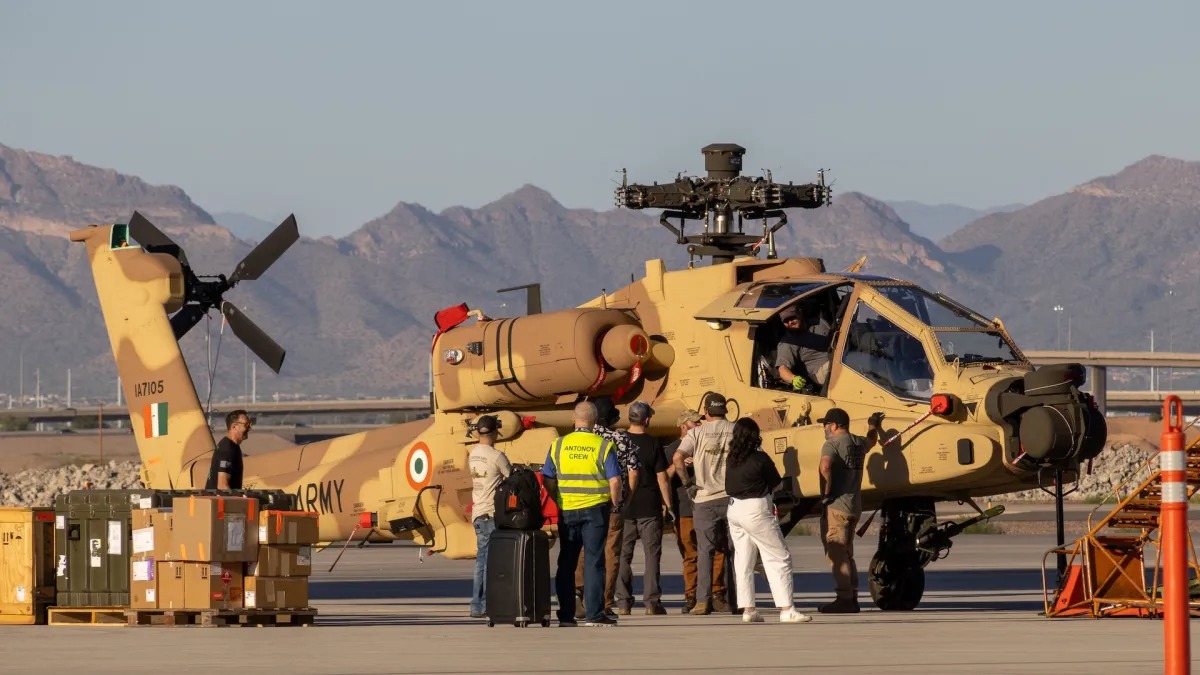
Following a US Army Apache crash near the Strait of Hormuz causing a ₹850 crore loss, focus has shifted to India's frontline capabilities. India operates 28 advanced AH-64E Apache "flying tanks" 22 within the Air Force and 6 within the Army forming a vital component of its national defense grid.
NEW DELHI, India — A high-profile crash of a United States Army AH-64E Apache attack helicopter near the strategically volatile Strait of Hormuz on Monday, June 9, 2026, has turned global attention toward the immense costs and critical operational roles of these premium aerial platforms. The crash, which has resulted in a direct asset loss estimated at approximately ₹850 crore ($100 million) for the US military, highlights the extreme financial and defense stakes tied to operating what military analysts widely classify as modern "flying tanks."
With both US crew members rescued safely, defense researchers are evaluating how the crash impacts global threat perceptions. The development simultaneously raises vital questions regarding India's own military preparedness, specifically the strength, deployment, and strategic purpose of the advanced Apache platform within the Indian Armed Forces.
The Strategic Loss: Analyzing the ₹850 Crore Flying Tank
According to an official report from the United States Central Command (CENTCOM) and regulatory defense intelligence trackers, the downed aircraft was operating as part of an assertive maritime monitoring mission. The Apache platform equipped with precision-guided AGM-114 Hellfire missiles and a nose-mounted 30 mm automatic chain gun is engineered with heavily armored tandem cockpits and redundant engine networks designed to absorb severe combat damage.
The sheer financial weight of the crash is immense. At an acquisition and lifecycle maintenance valuation of roughly ₹850 crore per fully integrated unit, the Apache represents one of the most expensive battlefield assets in modern warfare. Security experts note that the technical capabilities packed into an AH-64E Apache make it as tactically significant to ground combat operations as fifth-generation stealth platforms, such as the Lockheed Martin F-35 Lightning II or France's Rafale omnirole jets, are to regular air-to-air superiority campaigns.
How Many Apache Helicopters Does India Have?
As global defense observers analyze the American loss, India's own inventory of these heavy-duty attack platforms remains a cornerstone of its dual-border deterrence strategy. The Indian Armed Forces operate a combined total of 28 AH-64E Apache attack helicopters split across two distinct services to optimize frontline hitting power.
The deployment of India's Apache fleet is structured under a clear institutional framework:
The Indian Air Force (IAF) Fleet: The IAF operates the primary block of 22 AH-64E Apache helicopters. Procured under a landmark $1.4 billion deal signed with the United States government and Boeing in September 2015, these units are actively deployed at critical airbases, including Pathankot near the western border and Johrat in the eastern sector.
The Indian Army Aviation Fleet: The Indian Army operates a dedicated fleet of 6 AH-64E Apache helicopters. Contracted under a separate $600 million follow-on agreement signed in February 2020, the final batch of three units was officially delivered to the 451 Army Aviation Squadron based in Jodhpur, Rajasthan, on December 16, 2025.
Integration with Indigenous Attack Helicopters
The combination of 28 heavy-tier Apaches provides India with an elite, tank-busting vanguard. However, the Ministry of Defence is pairing these American-origin assets with a larger, indigenous mass-production pipeline.
According to recent modernization briefings from Hindustan Aeronautics Limited (HAL) and the Indian Army, the military is progressively inducting the indigenous Light Combat Helicopter (LCH) Prachand. The Indian Army has already deployed 5 LCH units alongside its 6 Apaches, with an additional 90 Prachand helicopters on order. Concurrently, the IAF has 10 Prachand units in service with an active order for 66 more.
Once these deliveries conclude over the coming decade, India’s unified attack helicopter architecture will comprise nearly 200 dedicated attack airframes, seamlessly blending the heavy armor of the US-built Apache with the high-altitude performance of the home-grown Prachand.
Official Sources Section
Inventory data, acquisition figures, and operational histories documented in this brief are compiled from official statements released by the Indian Ministry of Defence, regulatory filings from Boeing Defense, procurement archives from the Indian Air Force, and active deployment records from the Securities and Exchange Board of India (SEBI) linked corporate filings.
Quote Section
Reflecting on the heavy capabilities of the platform during a recent integrated border exercise, a senior Indian military aviation official stated:
"According to officials, the AH-64E Apache functions less like a traditional utility helicopter and more like an agile, low-altitude armor asset. Its capability to seamlessly network with multi-role fighter assets and direct battlefield artillery makes it an indispensable component of our integrated battle groups."
Why It Matters
The financial fallout of the US crash demonstrates the massive vulnerability and economic risk countries face when deploying high-value defense assets in active theater checkpoints. For Indian defense planners, maintaining a robust, well-maintained fleet of 28 Apaches provides an immediate tactical counterbalance against armored incursions along flat desert terrains and high-altitude valleys. It underscores why diversifying with domestic production, like the LCH Prachand, is vital to offsetting potential asset losses without bankrupting national defense procurement budgets.
Key Facts at a Glance
The Inventory: India possesses a total of 28 US-manufactured AH-64E Apache attack helicopters in active service.
Service Divide: The Indian Air Force operates 22 units for wide-area tactical strikes, while the Indian Army Aviation Corps commands 6 units for direct ground support.
The American Crash: A US Army Apache crashed near the Strait of Hormuz on June 9, 2026, resulting in a ₹850 crore operational loss.
Future Arsenal: India is integrating its Apache fleet with a planned pipeline of 156 additional indigenous LCH Prachand combat helicopters.
Frequently Asked Questions
Why is the Apache helicopter compared to an F-35 or Rafale jet?
While they operate in entirely different altitude bands, the Apache commands a similar level of electronic warfare systems, target-acquisition sensors, and destructive precision over ground targets that an F-35 or Rafale brings to the airspace.
Where are India's Apache helicopters stationed?
The Indian Air Force stations its units at highly strategic border outposts, primarily out of Pathankot Air Force Station (Punjab) and Johrat (Assam). The Indian Army’s newest units are stationed with the 451 Army Aviation Squadron in Jodhpur, Rajasthan.
What weapons can the Indian AH-64E Apache fire?
The helicopter is armed with a rapid-fire 30 mm M230 chain gun located under the fuselage, precision-guided AGM-114 Hellfire anti-tank missiles, and Hydra 70 air-to-ground rocket pods.
Source: Official asset registries from the Indian Air Force; Corporate delivery logs from Boeing Defense, Space & Security; Operational military briefings published by the Press Information Bureau (PIB) of India.