The United States nuclear industry is preparing comprehensive submissions for India concerning the newly released draft SHANTI Rules, 2026. As India opens its civil nuclear sector to private participation, international vendors are evaluating strict liability caps, mandatory insurance requirements, and design-certification mandates ahead of the consultation deadline.
Evaluating the Draft SHANTI Framework
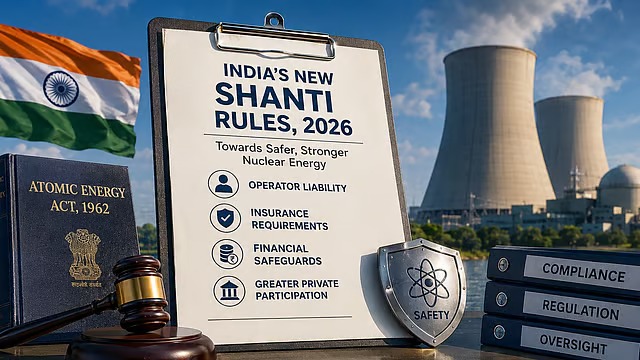
Released by the Department of Atomic Energy, the draft SHANTI Rules operationalize the broader legal reset intended to expand India's nuclear energy capacity. The framework introduces provisions for private companies and joint ventures to build, own, and operate nuclear installations, including Small Modular Reactors (SMRs).
According to industry briefings and policy analyses, the US nuclear sector—represented by organizations such as the Nuclear Energy Institute (NEI)—is actively reviewing key operational stipulations. These include mandatory insurance and financial security requirements for operators, tier-based nuclear damage liability caps, and regulatory conditions requiring foreign reactor designs to be certified and operational in their countries of origin.
Key Regulatory Focus Areas for Global Vendors
Foreign technology providers and domestic stakeholders are closely examining several technical and compliance benchmarks outlined in the draft rules:
Liability and Insurance Mandates: The rules require operators to maintain irrevocable financial protection, such as insurance policies or pledged financial instruments with specific security margins, covering the entire lifecycle until spent fuel is cleared.
Technology Origin Requirements: Provisions stipulate that imported reactor designs must be approved by the regulatory body of a self-reliant country of origin and be operational elsewhere, prompting detailed technical feedback from international engineering firms.
Single Composite Licensing: The framework introduces a consolidated licensing regime covering construction, operation, and decommissioning, designed to reduce bureaucratic delays for project developers.
Official Sources Section
Regulatory texts, draft notifications, and public consultation timelines are issued by the Department of Atomicenergy, Government of India.
Industry policy discussions and international stakeholder consultations are coordinated through organizations such as the Nuclear Energy Institute (NEI).
Legal and structural breakdowns of India's nuclear legislative updates are monitored via trade advisory bodies and legal analysis repositories.
"According to officials and industry representatives, international technology suppliers are finalizing structured feedback to ensure the final implementation of the SHANTI rules aligns with global commercial financing and nuclear safety standards."
Why It Matters
For international investors, equipment manufacturers, and global energy developers, clarity on India's nuclear liability and operational rules is vital. As India targets an ambitious expansion of its atomic energy capacity—including a push toward Small Modular Reactors and non-power applications like hydrogen production—accommodating international supply chain participation will depend heavily on predictable, risk-balanced regulatory structures.
Key Facts at a Glance
Consultation Window: Public and industry feedback on the draft SHANTI rules is open ahead of the September deadline.
Core Focus: Establishing clear operator liability, insurance mandates, and single-license mechanisms for private nuclear projects.
Global Participation: US and international vendors are assessing technology certification prerequisites and liability limits.
Strategic Goal: Supporting India's broader target to expand nuclear power generation and foster industrial decarbonization.
Frequently Asked Questions
What are the draft SHANTI Rules, 2026?
The draft SHANTI Rules provide the regulatory and operational framework for India's updated nuclear legislation, setting guidelines for private sector participation, licensing, insurance, and liability.
Why is the US nuclear industry reviewing these rules?
US technology providers and equipment suppliers are examining the liability caps, insurance requirements, and design-certification mandates to determine how international partnerships can participate in India's emerging private nuclear market.
What is the deadline for feedback on the draft rules?
Stakeholders and industry groups are preparing submissions ahead of the review cutoff set for early September.
Source: Department of Atomic Energy, Nuclear Energy Institute (NEI), Industry Regulatory Disclosures