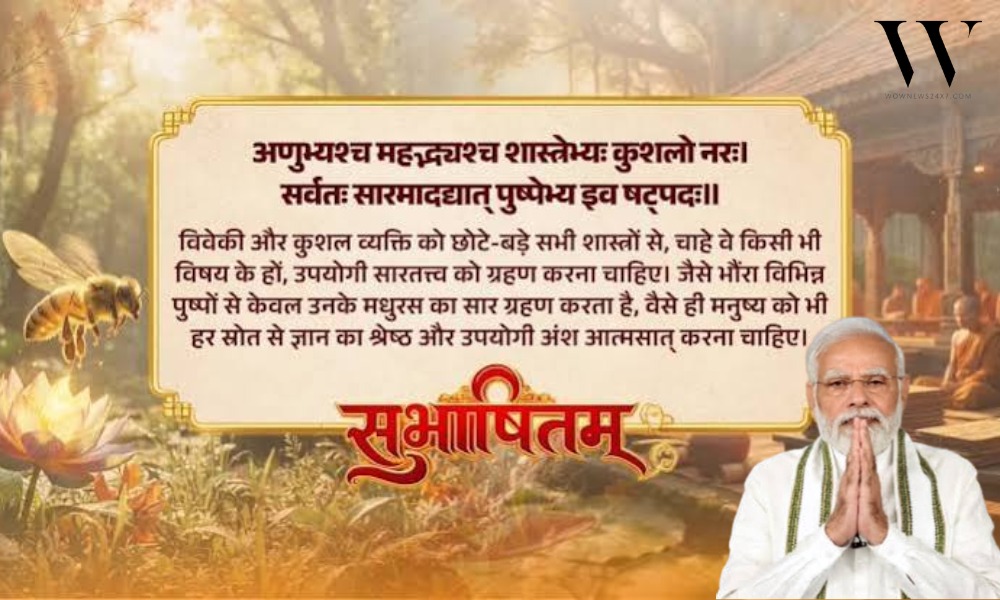
Prime Minister Narendra Modi shared a Sanskrit Subhashitam emphasizing that discerning individuals should extract essential wisdom from all sources, comparing the pursuit of knowledge to a bee gathering nectar. The message promotes lifelong learning, intellectual openness, and the integration of classical heritage into modern education.
Prime Minister Narendra Modi shares a classical Sanskrit verse emphasizing that a discerning person should extract valuable knowledge from all sources.
Prime Minister Narendra Modi took to social media to share a traditional Sanskrit Subhashitam focusing on the acquisition of knowledge, drawing a parallel between a wise individual and a bee collecting nectar from flowers. Released via official communication channels, the message underscores the importance of continuous learning and synthesizing wisdom from diverse branches of study, regardless of their scale or origin.
Extracting Essential Wisdom from Diverse Sources
According to official releases from the Prime Minister's Office, the shared verse—originating from traditional texts—reads: "Anubhyashcha Mahadabhyashcha Shastrebhyah Kushalo Narah. Sarvatah Saramadyat Pushpebhya Iva Shatpadah". The aphorism illustrates that just as a bee gathers sweet nectar from numerous flowers to produce honey, a perceptive learner must assimilate core insights from every available intellectual source without prejudice.
Cultural analysts and educators note that highlighting classical Sanskrit literature encourages contemporary youth and scholars to engage with ancient philosophical frameworks. Integrating foundational ethical concepts into public discourse fosters a culture of lifelong learning, intellectual humility, and cross-disciplinary curiosity among citizens, students, and academics.
Broader Societal and Educational Impact
For students, researchers, and educators, the recurring dissemination of classical Subhashitams serves as a bridge connecting timeless indigenous wisdom with modern educational pursuits. Observers point out that emphasizing open-minded inquiry and knowledge-seeking reinforces cognitive flexibility and strengthens national intellectual heritage in an increasingly complex global information ecosystem.
Official Sources Section
Details concerning the Sanskrit Subhashitam, its philosophical translation, and public communications are based on official announcements and media releases issued by the Prime Minister's Office and government information portals.
Quote Section
According to officials, the shared verse conveys that a wise and discerning individual should draw the essential essence from every branch of knowledge, great or small, just as a bee gathers nectar from every flower.
Why It Matters
Promoting classical aphorisms encourages continuous intellectual growth and open-minded learning across society. For modern educational frameworks, embracing diverse sources of wisdom supports holistic development, critical thinking, and a deeper appreciation of indigenous knowledge systems.
Key Facts at a Glance
Prime Minister Narendra Modi shared a classical Sanskrit Subhashitam highlighting the value of discerning knowledge acquisition.
The verse draws an analogy to a bee gathering nectar from various flowers to collect universal wisdom.
The communication emphasizes extracting valuable lessons from both major and minor sources of learning.
Official updates and translations were published via the Prime Minister's Office communication channels.
FAQ Section
What was the core message of the Sanskrit Subhashitam shared by the Prime Minister?
The verse emphasizes that a wise person should extract valuable essence from all branches of knowledge, akin to a bee gathering nectar from flowers.
Where is the shared Subhashitam traditionally sourced from?
The verse is part of classical Sanskrit literature, frequently cited in traditional texts like the Shrimad Bhagavata Mahapurana to denote diligent learning.
Where can citizens view official updates and statements from the Prime Minister?
Official communications, releases, and policy updates are published regularly on the Prime Minister of India Official Website.
Source: Prime Minister's Office, Press Information Bureau