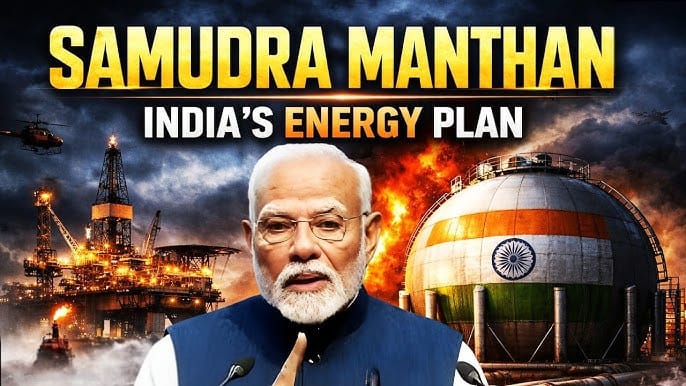
The Union Cabinet has approved "Samudra Manthan," an Rs 84,084 crore offshore exploration scheme running through FY 2030–31. Aimed at adding over 600 MMTOE in hydrocarbon reserves, the initiative provides targeted funding for deepwater seismic mapping, exploratory drilling, shared infrastructure, and specialized domestic manufacturing zones.
NEW DELHI — The Union Cabinet, chaired by Prime Minister Narendra Modi, approved "Samudra Manthan" — the National Offshore Exploration Scheme — with an outlay of Rs 84,084 crore. The Central Sector Scheme, under the Ministry of Petroleum and Natural Gas, will run through fiscal year 2030–31. The decision represents a national effort to accelerate deepwater and ultra-deepwater oil and gas exploration across unexplored marine basins.
The scheme fulfills a vision outlined by the Prime Minister during his 2025 Independence Day address, where he called for a "Samudra Manthan" (churning of the ocean) to tap the country's vast maritime energy potential.
Detailed Breakdown of Component Allocations and Funding Architecture
The Rs 84,084 crore capital allocation covers key interventions across the entire offshore exploration value chain:
Seismic Data Acquisition: ₹28,534 crore is earmarked for acquiring, processing, and interpreting high-quality 2D and 3D seismic data in deepwater frontier basins.
Exploratory Drilling Support: ₹43,200 crore is allocated to drill 60 deepwater exploration wells. The government will provide financial risk-sharing support of up to 50% of eligible costs or ₹675 crore per well, whichever is lower.
Shared Infrastructure Hubs: ₹10,000 crore will fund common offshore production and evacuation infrastructure, reducing entry costs for commercial operators.
Manufacturing and Service Zones: ₹2,000 crore will establish integrated Oil & Gas Manufacturing and Services Zones to foster domestic fabrication under the Make in India framework.
State-owned energy major Oil and Natural Gas Corporation (ONGC) plans to drill 150 deepwater wells over seven years to evaluate nearly 5,600 million metric tons of oil equivalent (MMTOE) in hydrocarbon potential.
Easing Regulatory Barriers in India's Exclusive Economic Zone
The introduction of Samudra Manthan builds on legal and regulatory reforms in India's upstream oil and gas sector. The government has opened more than 99% of previously restricted "No-Go" offshore areas. This policy change makes over one million square kilometers of India's Exclusive Economic Zone (EEZ) available for exploration.
The initiative aligns with recent legislative updates, including the Oilfields (Regulation and Development) Amendment Act and the Petroleum and Natural Gas Rules. These frameworks transitioned the sector from production-sharing contracts to revenue-sharing models. They also established standardized administrative rules via the Empowered Committee of Secretaries to streamline environmental and operational clearances.
Official Sources Section
According to official press disclosures and government filings:
"The Union Cabinet chaired by the Prime Minister Shri Narendra Modi has approved 'Samudra Manthan' – the National Offshore Exploration Scheme, a Central Sector Scheme of the Ministry of Petroleum & Natural Gas with an approved outlay of Rs 84,084 crore for implementation up to FY 2030–31." — Press Information Bureau (PIB)
"The scheme provides for large-scale acquisition, processing and interpretation of seismic data, accelerated deepwater and ultra-deepwater exploratory drilling, scientific drilling in frontier basins, and development of common offshore production infrastructure to catalyse reserve accretion of over 600 MMTOE." — Ministry of Petroleum & Natural Gas
Quote Section
"Samudra Manthan translates the vision of unlocking India's offshore energy potential. It marks a landmark step towards strengthening India's energy security, accelerating domestic exploration, promoting technological leadership, and advancing the goal of a developed nation." — Government of India Official Release
Why It Matters
The rollout of the National Offshore Exploration Scheme carries broad structural implications for the Indian economy:
Energy Security: India currently imports over 85% of its crude oil requirements; adding 600 MMTOE in reserves helps buffer against international supply shocks and price volatility.
Macroeconomic Stability: Increased domestic output reduces foreign exchange outflows for fossil fuel imports, helping narrow the trade deficit.
Industrial and Technical Growth: Establishing local manufacturing zones creates high-skilled jobs and expands domestic capabilities in deepwater engineering, platform fabrication, and maritime logistics.
Key Facts at a Glance
Approved Outlay: Rs 84,084 crore implemented as a Central Sector Scheme through FY 2030–31.
Target Reserve Accretion: Over 600 Million Metric Tons of Oil Equivalent (MMTOE).
Exploration Scope: Support for 60 deepwater exploration wells with up to 50% government cost-sharing.
Acreage Expansion: Over 1 million square kilometers of maritime EEZ opened by removing former "No-Go" defense restrictions.
FAQ Section
What is the primary objective of the Samudra Manthan scheme?
The scheme aims to accelerate deepwater and ultra-deepwater oil and gas exploration in India's offshore basins, strengthen energy security, and reduce reliance on energy imports.
What is the total financial outlay for Samudra Manthan?
The Union Cabinet approved a total financial outlay of Rs 84,084 crore for implementation up to fiscal year 2030–31.
How much energy reserve does the government expect to add through this scheme?
The initiative is expected to add over 600 Million Metric Tons of Oil Equivalent (MMTOE) to India's domestic hydrocarbon reserves.
Which offshore areas will be covered under this exploration drive?
Exploration will target deepwater and ultra-deepwater frontier basins across the Krishna-Godavari, Cauvery, Mahanadi, and Andaman regions.
Source: Press Information Bureau (PIB), Ministry of Petroleum & Natural Gas, Oil and Natural Gas Corporation (ONGC), BSE India.