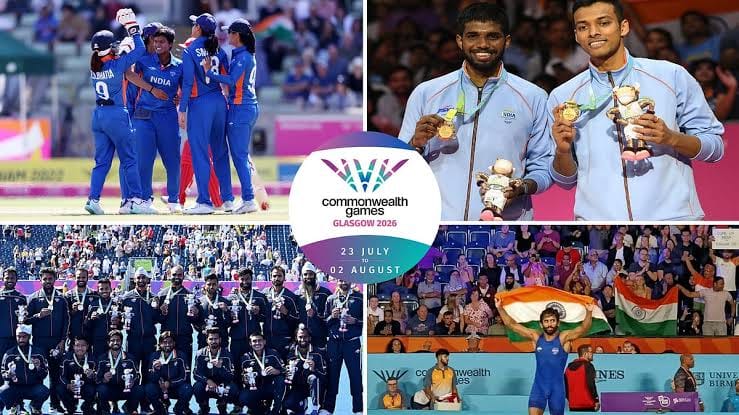
The Commonwealth Games 2026 in Glasgow will exclude major sports like cricket, badminton, hockey, and wrestling to control operational costs. This compact ten-sport model presents a major challenge for Team India, which faces a significant reduction in its traditional medal-winning opportunities.
GLASGOW — The Commonwealth Games Federation (CGF) and local organizing committees have officially stripped the Commonwealth Games 2026 of several anchor disciplines, implementing a heavily downsized sports program for the upcoming multi-sport event. Scheduled to take place in Glasgow, Scotland, from July 23 to August 2, 2026, the 23rd edition of the Games will completely exclude marquee sports such as cricket, hockey, badminton, wrestling, and table tennis. The aggressive operational restructuring represents a dramatic shift toward a low-cost, logistically manageable competition framework following the abrupt withdrawal of the original host state, Victoria, Australia.
The elimination of these foundational disciplines is particularly consequential today as it alters international qualification procedures and directly damages the historical medal trajectories of prominent sporting nations, most notably India.
Severe Cost Management Drives the Pruned Roster
According to official statements from the Commonwealth Games Federation, the primary drivers behind reducing the roster to just 10 sports—down from the 20 featured at Birmingham 2022—are strict cost management and the mitigation of operational risks. When Glasgow agreed to step in as a emergency replacement host, local municipal authorities mandated that the event be delivered using existing infrastructure to avoid public debt accumulation.
Organizers confirmed that adding specialized venues for sports like shooting or hockey introduces complexity regarding transport, security, and lease hire. By compressing the entirety of the Commonwealth Games 2026 inside an eight-mile concentrated corridor utilizing just four existing facilities—Scotstoun Stadium, Tollcross International Swimming Centre, Emirates Arena, and the Scottish Event Campus (SEC)—the host city is removing heavy structural investments.
Impact on Team India: Dropping the Bedrock of Medals
The structural decisions finalized for the Commonwealth Games 2026 have drawn sharp criticism from sports administrators across South Asia. Historically, sports like wrestling, badminton, shooting, and table tennis have formed the absolute bedrock of India's international sports success.
| Axed Discipline | Historical Indian Success Ledger | Birmingham 2022 Output |
| Wrestling | 114 Total Medals (49 Gold) | 12 Medals (6 Gold) |
| Badminton | Topped 2022 Standings | 6 Medals (3 Gold) |
| Field Hockey | Continuous presence since 1998 | Men's Silver, Women's Bronze |
| Table Tennis | 20 Medals accumulated since 2002 | Multiple Podium Finishes |
During the 2022 quadrennial meet, India's 210-member contingent secured 61 total medals, finishing fourth in the global standings. Statistical reviews show that exactly 30 of those podium finishes—including a massive chunk of gold medals—came directly from the disciplines that have been axed from the Commonwealth Games 2026. The complete absence of these core categories means India’s prospective delegation will likely shrink to around 125 athletes, with podium hopes shifting heavily toward athletics, boxing, weightlifting, and judo.
Strategic Shift and the Future of the Games
The severe downsizing of the Commonwealth Games 2026 highlights growing anxieties surrounding the long-term relevance and economic viability of the entire Commonwealth sports movement. For fans, sponsors, and global broadcasting networks, the omission of world-class events like T20 cricket or elite badminton diminishes commercial drawcards, sparking fears that the tournament field will become watered down.
However, sports ministries are already looking ahead. Indian officials have used the disappointment of the Glasgow omissions to adjust long-term preparation strategies. National programs are shifting funding priorities toward the Asian Games and the upcoming Olympic cycles, while simultaneously preparing structural bids for future editions, with Ahmedabad locked in to host a expanded, multi-sport format for the 2030 Commonwealth Games.
Official Sources Section
The official competition structures, approved venue limits, and final regulatory bylaws are managed and distributed by the Commonwealth Games Federation Media Center and the local Glasgow 2026 Organizing Committee.
Quote Section
"According to officials at the Indian Olympic Association, formal protests were submitted directly to the international governing council regarding the dropping of core sports, but the host city's absolute requirement for fiscal containment ultimately dictated the final compact lineup."
Why It Matters
The structural evolution of the Commonwealth Games 2026 proves that the era of massive, debt-fueled sporting events is quickly drawing to a close. For international sporting bodies and corporate stakeholders, this model serves as a practical test tube for a cheaper, highly efficient tournament presentation. For elite athletes across the Commonwealth, it demands instant versatility, forcing competitors to continuously calibrate their training parameters around unpredictable global event calendars.
Key Facts at a Glance
Drastic Reduction: The Commonwealth Games 2026 will feature only 10 sports, compared to the 20 held during the previous cycle.
Core Sports Axed: Major global draws including cricket, field hockey, wrestling, table tennis, and badminton have been completely omitted.
Fiscal Motivation: The compact setup is designed to prevent local municipalities from incurring heavy public debt.
Indian Tally Risk: Over 45 percent of India’s traditional medal-winning categories have been removed from the roster.
FAQ Section
Which 10 sports are officially included in the Commonwealth Games 2026?
The approved lineup consists of athletics, swimming, 3x3 basketball, track cycling, weightlifting, lawn bowls, artistic gymnastics, netball, boxing, and judo.
Why was field hockey dropped for the first time since 1998?
Field hockey was left out due to a lack of existing, multi-use facilities within the tight 8-mile venue zone, making the installation of temporary water-turf pitches too complex and expensive.
Will badminton return in future editions of the Commonwealth Games?
Yes. Indian national coaching directors have confirmed that badminton is scheduled to return to the official program when Ahmedabad hosts the 2030 Commonwealth Games.
Sources: Commonwealth Games Federation, Indian Olympic Association Bureau.