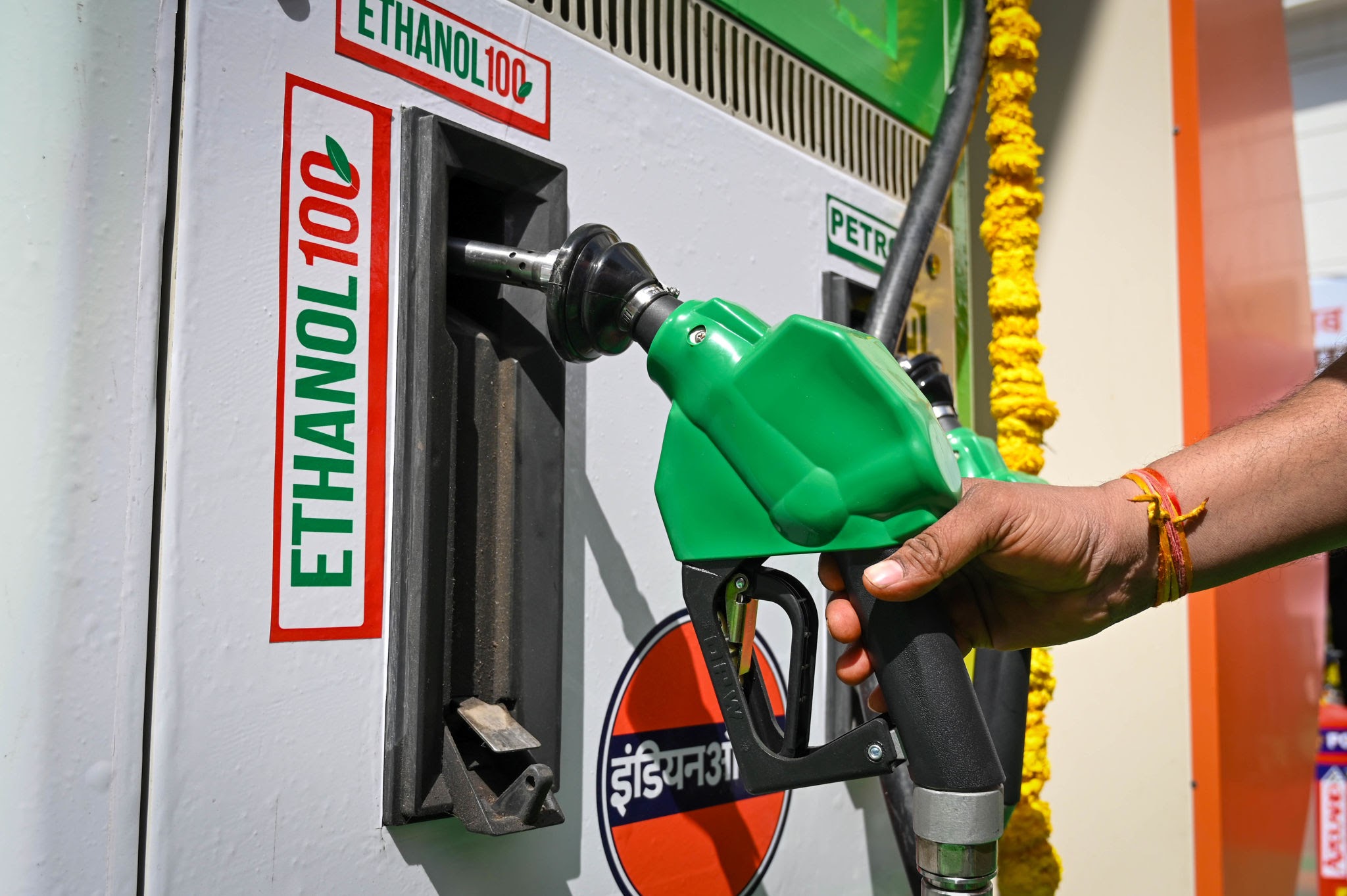
India's Ministry of Petroleum and Natural Gas confirmed that retail petrol prices in New Delhi would have reached Rs 125 per litre during peak global crude spikes without ethanol blending. By incorporating 20% domestic ethanol (E20), the government capped pump prices at Rs 94.77, delivering significant foreign exchange and consumer savings.
NEW DELHI — Petrol prices in India's capital could have reached Rs 125 per litre when international crude oil prices surged to nearly $135 per barrel had oil marketing companies not implemented ethanol blending, the Ministry of Petroleum and Natural Gas (MoPNG) announced in an official clarification.
The development highlights the structural buffer provided by India's Ethanol Blended Petrol (EBP) Programme during volatile global energy cycles. By substituting imported crude with domestically produced bio-ethanol, state-run oil refiners maintained retail petrol at Rs 94.77 per litre in Delhi during the height of the market shock, delivering direct consumer savings of approximately Rs 30 per litre.
Shielding Consumers from International Energy Volatility
According to government calculations released by the Press Information Bureau (PIB), crude oil imports account for nearly 88% of India's total petroleum requirements. When international benchmark crude prices spiked to $135 per barrel due to geopolitical disruptions, unblended fuel costs would have forced retail prices well above historic highs.
Because 20% of every litre sold under the E20 mandate consists of domestically sourced ethanol acquired at pre-agreed, fixed procurement rates, the retail price was insulated from global market shifts. The government clarified that ethanol blending functions primarily as an energy insurance framework rather than a daily price-discounting mechanism.
The ministry addressed public debates surrounding fuel pricing logic, noting that procuring domestic feedstocks like maize and sugarcane at remunerative rates protects both agrarian incomes and national energy stability.
Macroeconomic Gains and Agricultural Impact
The Ethanol Blended Petrol Programme has reshaped India's import balance sheet while directing revenues into the rural economy. Official records indicate the following key milestones achieved under the policy:
Foreign Exchange Savings: Over Rs 1.97 lakh crore in foreign currency preserved by reducing crude oil imports by more than 316 lakh metric tonnes.
Direct Farmer Transfers: More than Rs 1.66 lakh crore disbursed directly to Indian farmers and distillers for feedstocks, including sugarcane juice, B-heavy molasses, damaged food grains, and maize.
Carbon Emission Reductions: More than 950 lakh metric tonnes of carbon dioxide emissions mitigated through renewable fuel integration.
The petroleum ministry refuted assertions that foodgrains intended for social welfare schemes were diverted to biofuel plants, confirming that subsidized rice from the Food Corporation of India (FCI) is not utilized for ethanol blending operations.
Vehicle Efficiency and Compatibility Validation
Addressing driver concerns regarding potential impacts on engine performance and fuel efficiency, the Ministry of Road Transport and Highways presented joint technical findings with the Automotive Research Association of India (ARAI), the Society of Indian Automobile Manufacturers (SIAM), and Indian Oil Corporation (IOC).
Laboratory and field trials indicate that older vehicles designed for E10 fuel experience a minor efficiency variance of 2% to 6% when operated on E20 blends, depending on engine displacement and age. Government technical panels confirmed that over 20 crore two-wheelers and 3 crore passenger cars currently operate on blended fuels across India without verified structural engine failures linked to ethanol exposure.
Official Sources Section
Data and policy details in this report are sourced from official government publications and regulatory disclosures:
Official Statements and Quotes
"When the Indian crude basket surged to around $135 per barrel, petrol without ethanol blending was projected to cost around Rs 125 per litre in Delhi. Instead, consumers paid Rs 94.77 per litre because 20 per cent of every litre was domestically produced ethanol, procured at stable, pre-agreed prices."
— Ministry of Petroleum and Natural Gas Official Release
"The purpose of ethanol blending is to reduce India's dependence on imported crude oil, which still meets nearly 88 per cent of the country's oil requirement. It is an insurance policy against global oil shocks and not a day-to-day price competition."
— Ministry Statement on E20 Policy Objectives
Why It Matters
For citizens and logistics operators, ethanol blending acts as a macroeconomic circuit breaker against wild swings in crude oil markets. By insulating domestic fuel stations from foreign price shocks, the policy limits inflationary pressures on transport costs, consumer goods, and industrial inputs.
For investors and agricultural businesses, the guaranteed procurement mechanism provides sustained capital investment into bio-refineries, grain processing facilities, and rural supply chains across key agricultural states.
Key Facts at a Glance
Peak Price Defense: Blended petrol prevented pump rates from rising to Rs 125/litre in New Delhi during crude spikes.
Consumer Savings: Delivered approximately Rs 30/litre in direct savings during global energy crises.
National Impact: Generated Rs 1.97 lakh crore in foreign exchange savings and Rs 1.66 lakh crore in direct agrarian payments.
Current Standard: E20 petrol (20% ethanol, 80% petrol) serves as the primary national auto fuel standard.
Frequently Asked Questions
Why is E20 fuel not priced significantly lower than pure petrol?
Ethanol procurement prices are fixed to compensate domestic farmers fairly for agricultural feedstocks like maize and sugarcane. When global crude prices trade lower, processing and handling costs can make E20 production comparable to pure petrol, whereas during global crude price spikes, E20 produces substantial savings.
Does E20 petrol reduce vehicle mileage?
Government test data from ARAI and SIAM shows a minor fuel efficiency reduction between 2% and 6% for older vehicles designed specifically for lower ethanol ratios. Newer vehicle models engineered for E20 material compatibility show negligible performance shifts.
Are food grains meant for welfare schemes used for ethanol?
No. The Ministry of Petroleum and Natural Gas confirmed that subsidized rice allocated under national food security programs is not diverted for bio-ethanol manufacturing.
Source: Ministry of Petroleum and Natural Gas, Press Information Bureau, Ministry of Road Transport and Highways.