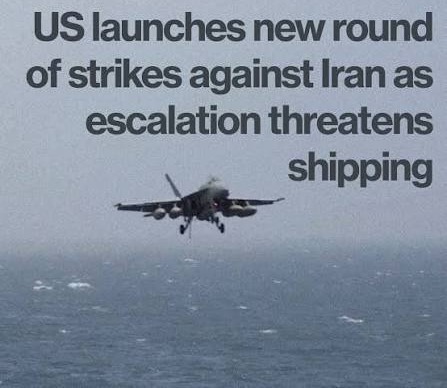
The US launches new wave of strikes against Iran following the collapse of the Islamabad Memorandum. Deployed by CENTCOM, precision strikes targeted cruise-missile sites and coastal defenses on Greater Tunb Island. The renewed fighting has triggered immediate energy market shocks, sending Brent crude prices upward amid an enforced naval blockade.
WASHINGTON — The United States military completed a new wave of strikes against Iran early Wednesday, deployment officials confirmed, significantly escalating the conflict over control of the world’s most critical maritime oil corridor. The precision aerial campaign, executed by U.S. Central Command (CENTCOM), targeted fortified coastal defense networks, cruise-missile storage arrays, and active launch infrastructure situated on Greater Tunb Island and adjacent littoral positions near the Strait of Hormuz. Coming less than a month after the unraveling of a tentative diplomatic memorandum of understanding, these kinetic operations signal an aggressive turn by the Trump administration to forcibly break the Iranian naval blockade of regional ports and secure commercial shipping lanes.
Central Command Details Targeted Precision Infrastructure
According to a formal operational release from the U.S. Department of Defense, the high-intensity aerial bombardment commenced at approximately 6:00 a.m. Eastern Time (1000 GMT) and was successfully concluded within a 90-minute operational window. U.S. forces utilized advanced precision-guided munitions deployed from Carrier Air Wing 7, currently operating from the USS George H.W. Bush in the Arabian Sea.
The primary tactical focus centered on neutralising threats to international shipping corridors. Bombers and unmanned surface vessels successfully disabled three anti-ship cruise missile battery installations and multiple long-range coastal radar platforms.
This morning operation followed a broader seven-hour offensive late Tuesday, during which U.S. joint forces hit dozens of military assets, including drone integration sites, fast-attack naval craft, and command-and-control bunkers along Iran’s southern coastline. Pentagon officials described the latest maneuvers as vital "shaping operations" designed to systematically degrade Iranian air defense envelopes. The action establishes broader operational leverage should the White House authorize more intensive campaigns against underground facilities or key regional distribution points.
Diplomatic Breakdown and the Battle for Hormuz
The renewed hostilities mark a severe breakdown of the Islamabad Memorandum of Understanding, a diplomatic framework signed remotely in June 2026 that had briefly halted full-scale fighting between Washington, Israel, and Tehran. The fragile truce fractured completely after Iranian Islamic Revolutionary Guard Corps (IRGC) units conducted missile and drone attacks on three commercial tankers transiting the Strait of Hormuz. Following those maritime disruptions, the U.S. Navy officially reimposed its comprehensive naval blockade on all primary Iranian maritime points, including the critical shipping hubs of Bandar Abbas and Chabahar.
Tehran has historically sought to assert sovereign jurisdiction over the waterway, threatening to enforce arbitrary transit tariffs on foreign commercial transport. In retaliation for the renewed U.S. economic and naval blockade, the IRGC launched counter-strikes targeting international logistical infrastructure, claiming to have hit western military assets in Bahrain and Jordan, while regional authorities confirmed the interception of several inbound drones.
Economic Shockwaves and Energy Market Impacts
The return to open conflict has immediately disrupted global commercial trade infrastructure, causing deep anxiety across international financial institutions. Brent crude futures surged by over 1 percent immediately following the CENTCOM announcement, compounding a month-long rally that pushed oil to its highest trading baseline in several weeks. Because the Strait of Hormuz traditionally handles roughly 20 percent of global petroleum and liquefied natural gas (LNG) shipments, prolonged military confrontation directly threatens Western consumer supply chains.
International shipping conglomerates have diverted heavy transport vessels away from the Persian Gulf, forcing logistical networks to utilize longer, more expensive shipping routes around the African continent. Market analysts warn that if the conflict expands to include adjacent chokepoints, such as the Bab el-Mandeb strait through Iranian-aligned Houthi forces in Yemen, global energy supply disruptions could trigger severe inflationary spikes for western economies.
Official Announcements Section
Statements published via official state channels highlight the stark divisions between the warring leaderships. The [suspicious link removed] emphasized that the international community cannot permit any single state to hold global energy corridors hostage, reaffirming its legal right to protect open sea lanes under international maritime conventions.
Conversely, Iranian government spokesperson Fatemeh Mohajerani stated via state media channels that the recent U.S. military campaigns have resulted in civilian casualties in southern coastal provinces. Officials from the Iranian Health Ministry claimed that over 260 individuals have sustained injuries during the expanded aerial bombardments this month, characterizing the American blockade as an act of illegal international aggression.
Quote Section
"According to officials at U.S. Central Command, the targeted operations are strictly calibrated to eliminate localized capabilities used to threaten vessels freely transiting through the Strait of Hormuz, and the coalition forces remain fully prepared to scale operations as required to guarantee regional maritime security."
Why It Matters
The fact that the US launches new wave of strikes against Iran carries immediate geopolitical and practical consequences. For global consumers, the instability in the Persian Gulf threatens a direct increase in fuel, energy, and transport costs, potentially filtering down into generalized retail inflation. For multinational corporations and maritime insurers, shipping premiums through the Middle East have escalated, altering corporate supply chains and routing strategies. Finally, for international investors, the structural failure of the June ceasefire creates prolonged volatility across equity markets, forcing capital out of emerging markets and into safer defensive assets.
Key Facts at a Glance
Operational Length: The latest precision strike wave was conducted as a highly focused 90-minute operation targeting Greater Tunb Island.
Tactical Assets Hit: Heavy damage was sustained by Iranian coastal defense systems, cruise-missile storage banks, and active launch stations.
Bilateral Context: The strikes mark the absolute collapse of the Islamabad diplomatic memorandum signed in June 2026.
Market Rehearsal: Global Brent crude prices extended their market gains by over 1 percent immediately following the confirmation of hostilities.
FAQ Section
Why did the US launch a new wave of strikes against Iran today?
The U.S. military initiated the strikes to degrade specific Iranian military capabilities that had been utilized to target, harass, and intercept commercial shipping vessels moving through the international waters of the Strait of Hormuz.
What specific areas within Iran were targeted by U.S. Central Command?
The precision operations focused heavily on coastal defense installations, radar centers, and cruise-missile infrastructure located on Greater Tunb Island and along strategic littoral areas near the strait.
What has been the official diplomatic position of the White House?
President Donald Trump has warned that the United States will expand its targeting perimeter to include domestic infrastructure, such as bridges and conventional power plants, unless Iranian authorities halt maritime attacks and return to formal negotiations.
How are international shipping lanes being affected by this conflict?
Due to active naval blockades and recurring artillery exchanges, the Strait of Hormuz remains heavily restricted, forcing global cargo ships to reroute entirely, which significantly increases international transit times and operational insurance fees.
Source: Official operational transcripts from U.S. Central Command (CENTCOM), formal press briefings from the U.S. Department of Defense, and official public updates from the Iranian state-run media network IRIB.