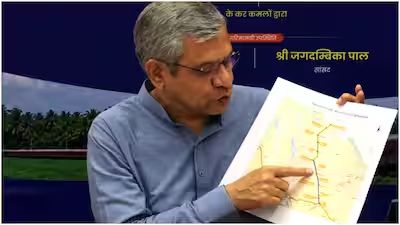
Union Railway Minister Ashwini Vaishnaw outlined plans for a proposed high-speed bullet train corridor connecting Delhi, Uttar Pradesh, and Bihar on August 31, 2026. The network aims to slash travel times, enabling journeys from Delhi to Lucknow in roughly two hours and to Patna in 4.5 hours.
Backed by official ministry statements, the government has detailed ambitious high-speed rail blueprints designed to slash travel times across northern metropolitan corridors.
Accelerating nationwide infrastructure development and long-distance transit capabilities, the Ministry of Railways has detailed expansive plans for high-speed rail integration. According to official announcements made by Union Railway Minister Ashwini Vaishnaw on August 31, 2026, a proposed bullet train project aims to seamlessly connect the national capital with major commercial and religious hubs across Uttar Pradesh and Bihar.
The extensive corridor framework is engineered to dramatically shrink inter-state transit windows, bringing cities like Lucknow and Patna within striking distance of New Delhi.
Evaluating Project Timelines and Segment-Wise Projections
Designing a high-speed rail corridor across high-density terrain requires meticulous engineering and precise alignment mapping. According to official disclosures and ministerial statements, projected travel benchmarks along the route include:
Delhi to Agra: The 200-kilometer stretch will take an estimated 58 minutes.
Delhi to Kanpur: The 455-kilometer route will require approximately 1 hour and 50 minutes.
Delhi to Lucknow: The 495-kilometer journey will be cut down to just 2 hours and 12 minutes.
Delhi to Prayagraj: The 750-kilometer transit will take roughly 3 hours.
Delhi to Varanasi: The 945-kilometer connection will be bridged in 3 hours and 33 minutes.
Delhi to Patna: The 1,170-kilometer corridor will take approximately 4.5 hours.
Why It Matters
The practical implications of establishing high-speed rail networks across the Delhi-UP-Bihar belt extend deeply into regional economics, tourism, and daily mobility. For business travelers and daily commuters, cutting transit times between major state capitals to under a few hours enhances commercial productivity and trade efficiency. For religious tourism hubs like Varanasi, Agra, and Prayagraj, ultra-fast rail connectivity ensures smoother tourist inflows, supporting localized hospitality and economic growth.
Key Facts at a Glance
Project Scope: Proposed high-speed bullet train corridor connecting Delhi, Uttar Pradesh, and Bihar.
Delhi-Lucknow Transit: Reduced to 2 hours and 12 minutes over 495 kilometers.
Delhi-Patna Transit: Reduced to approximately 4.5 hours over 1,170 kilometers.
Intermediary Stops: Projected to cover Agra, Kanpur, Prayagraj, and Varanasi.
FAQ Section
Which cities will be connected by the proposed bullet train project?
The proposed high-speed rail network connects New Delhi to Agra, Kanpur, Lucknow, Prayagraj, Varanasi, and Patna.
How long will it take to travel from Delhi to Lucknow on the bullet train?
According to Railway Minister Ashwini Vaishnaw, the 495-kilometer journey between Delhi and Lucknow will take approximately 2 hours and 12 minutes.
What is the projected travel time between Delhi and Patna?
The proposed high-speed corridor aims to reduce travel time between New Delhi and Patna to about 4.5 hours over a distance of 1,170 kilometers.
Where can official updates regarding Indian railway infrastructure projects be tracked?
Official project disclosures, policy rollouts, and budgetary allocations are published regularly on the Ministry of Railways Official Portal and the Press Information Bureau (PIB) Website.
Source: Press Information Bureau (PIB), Asian News International (ANI), India.com, TNP News