Shalu Agarwal founded Rosada in Kolkata in 2013, naming it after the French word for pink. Growing from ₹48 lakh in FY22 to ₹6.48 crore in FY25, the brand secured a three-Shark deal on Shark Tank India Season 5, nearly doubled revenue post-Shark Tank, and on June 2 2026, announced an undisclosed strategic investment from Shilpa Shetty Kundra.
A Kolkata Home, a Love for Design, and a Gap in India's Children's Market
- Shalu Agarwal founded Rosada in Kolkata in 2013 with a founding insight that was both personal and precise. India's children's accessories market was dominated by generic, mass-produced offerings that looked identical and felt interchangeable. Parents who wanted something beautiful, personal, and genuinely crafted for their child had almost nowhere to turn.
- Shalu focused on blending creativity, customisation, and practicality into a premium lifestyle brand for babies and kids. What began as a small homegrown business gradually evolved into Rosada Unicorn Private Limited, a 100% Make-in-India brand specialising in handmade, personalised products that combined expert craftsmanship with the warmth and imagination of childhood. The dedicated e-commerce website launched in 2020, opening Rosada to parents across India for the first time.
- The founding philosophy is captured directly on the Rosada website: "The sole objective of the brand is to create high quality simple day to day products and groom them with eyes of an expert and emotions of a child."
- Bhupesh Agarwal, Shalu's husband, joined the business full-time in January 2022, a move that proved transformative. His entry accelerated operations, streamlined manufacturing, and contributed significantly to scaling revenue and distribution reach. The business is bootstrapped, with Shalu holding 90% equity and Bhupesh holding 10%, reflecting the founding contribution of both partners.
In-House Manufacturing, Personalisation, and a 31% Repeat Customer Rate
- The boldest structural decision Rosada made was to build in-house manufacturing capabilities in Kolkata rather than outsourcing production. This gave the brand something most lifestyle D2C companies sacrifice in pursuit of scale: complete control over product quality, personalisation execution, pricing structures, and operating margins.
- Every Rosada product is handmade and customised to order. The product portfolio spans personalised backpacks, school bags, tote bags, name hangings, bedding sets, travel kits, pouches, décor items, and baby bedding. The signature tote bag, priced between ₹1,090 and ₹1,390, is the brand's best-selling product. The Lazy Zoo diaper backpack, designed to be lightweight and water-resistant, serves the growing segment of new parents seeking premium, functional baby gear. Average order value stands at ₹1,910.
- The personalisation model created something that generic kids' brands spend years trying to build: emotional attachment. When a parent orders a bag with their child's name embroidered on it, the product becomes a possession rather than a purchase. That emotional investment produced a 31% repeat customer rate, one of the strongest signals of genuine brand loyalty in India's D2C space.
- Approximately 95% of Rosada's revenue comes through its own website, with a digital community of 135,000 Instagram followers backed by a monthly marketing spend of approximately ₹16 lakh that delivers a return on ad spend exceeding five times. In June 2025, the brand entered offline retail through Hamleys, India's most iconic children's lifestyle destination, marking its first physical retail expansion.
- Celebrity validation arrived entirely organically. Kareena Kapoor Khan, Mira Kapoor, Neha Dhupia, Soundarya Rajinikanth, the Ambani family, and Nidhi Bansal, wife of Lenskart founder Peyush Bansal, all became Rosada customers, making the brand a trusted name among India's most discerning parents before it ever appeared on a national platform.
The Shark Tank Moment Three Sharks, One Powerful Negotiation, and a Near-Doubling of Revenue
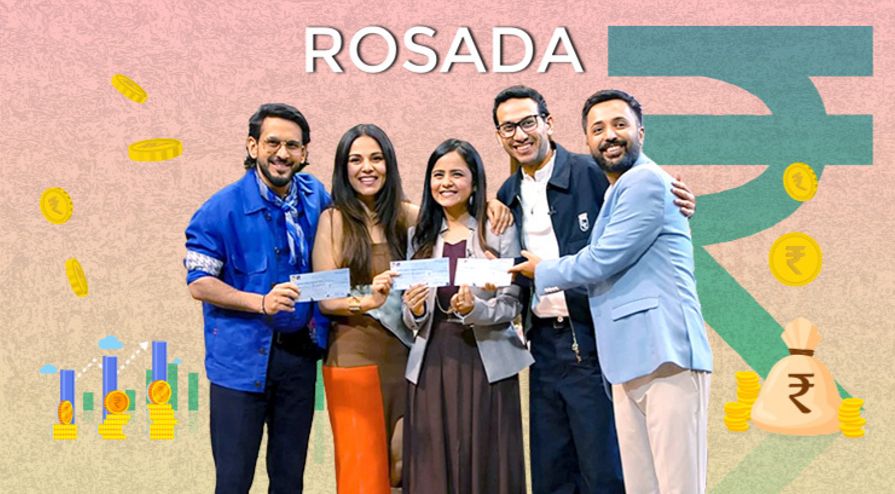
- Rosada appeared on Shark Tank India Season 5 Episode 31, which aired on February 16, 2026. Shalu and Bhupesh entered seeking ₹1.25 crore for 4% equity at a ₹31.25 crore valuation. They brought personalised bags for each Shark's children, a gesture that captured the brand's philosophy immediately.
- Namita Thapar, Ritesh Agarwal, and Aman Gupta jointly invested ₹1.25 crore for 5% equity plus a 2% royalty until the invested amount was recovered, valuing Rosada at ₹25 crore. Aman Gupta's memorable line during negotiations, "Tera game over kar dunga," became one of the episode's most talked-about moments.
- Post-Shark Tank, Rosada's revenue nearly doubled, validating both the product and the founders' conviction.
From Customer to Co-Believer: Shilpa Shetty Invests
- On June 2, 2026, Rosada announced a defining new chapter. Shilpa Shetty Kundra, who had been a Rosada customer long before becoming an investor, announced an undisclosed strategic investment in the brand. The association marks Rosada's first external funding round beyond the Shark Tank deal, and represents one of the most powerful validations a D2C brand can receive: a celebrity who loved the product enough to back it with capital.
- "What drew me to Rosada was straightforward: the product spoke for itself. The design sensibility, the quality of materials, the attention to detail, it is the kind of brand you instantly recognise as different. As someone who has experienced it as a parent first, I am backing this with full conviction," Shilpa Shetty Kundra said.
- Shalu Agarwal responded: "Having Shilpa Shetty Kundra come on board is a defining moment and strengthens our confidence to move forward with a much larger vision. This is India's moment for a homegrown kids' lifestyle brand to go big, and Rosada intends to be exactly that."
- The fresh capital will be deployed toward geographical expansion, product portfolio broadening, and strategic hires across design, marketing, and operations.
Scale and Real-World Impact
- Rosada was founded in 2013 and incorporated as Rosada Unicorn Private Limited in Kolkata, West Bengal. Revenue grew from ₹48 lakh in FY 21-22 to ₹1.23 crore in FY 22-23, rising to ₹6.48 crore in FY 24-25, representing 13.5x growth in three years, with a projected ₹13 crore in FY 25-26. Revenue nearly doubled post-Shark Tank. The brand serves children aged zero to 12 with a 100% in-house manufacturing facility in Kolkata. Instagram community stands at 135,000 followers. Average order value is ₹1,910 with a 31% repeat customer rate and 5x-plus ROAS. The brand entered Hamleys offline retail in June 2025. Total funding raised includes ₹1.25 crore from Namita Thapar, Ritesh Agarwal, and Aman Gupta on Shark Tank India Season 5, followed by the undisclosed strategic investment from Shilpa Shetty Kundra in June 2026.
The Most Defensible Brands Are Built on Emotions That Mass Production Cannot Replicate
- The sharpest lesson from Rosada's journey is this: in any category dominated by cheap, generic alternatives, the brand that makes its product feel personal earns a loyalty that no amount of price competition can erode.
- Shalu Agarwal built Rosada on one foundational understanding: parents do not just want products for their children. They want something that carries their child's name, their family's story, and the feeling that someone made this with care specifically for them.
- When a customer loves your product enough to invest in your company, you have built something that goes beyond business. You have built belief.
- Shilpa Shetty was a Rosada customer. Then she became a co-believer.
- That journey, from customer to investor, is the most powerful endorsement any brand can receive. And it is the natural destination for every brand built the way Rosada was: with hands, with heart, and with the unshakeable conviction that the most personal products always win.
Sources: Inc42, Indian Startup News, Apparel Resources, ImagesBOF, StartupArticle, Shark Tank Audits, Rosada Official Website