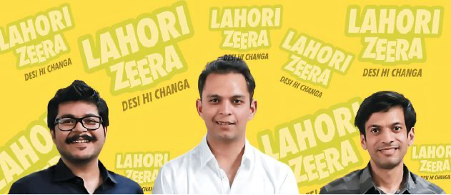
In 2016, three cousins from Punjab, Saurabh Munjal, Nikhil Doda, and Saurabh Bhutna, mixed cumin, rock salt, and lemon in a home kitchen and tasted something extraordinary. Today, Lahori Zeera is a ₹2,800 crore brand, present across 18 states, 5 lakh retail outlets, and on a clear path to ₹1,000 crore in annual revenue.
Walk into any kirana store in northern India and you will find it, a modest bottle, priced at ₹10, sitting quietly between Coca-Cola and Pepsi.
It is fizzy. It is spiced. It tastes unmistakably Indian. And it was born on a family kitchen counter in Punjab, with no investors, no marketing budget, and no business plan — just three cousins, a handful of spices, and an instinct that the world was ready for something real.
The idea of a jeera soda was not new. But the space lacked an organised leader in the northM India's largest soft drink belt. Lahori stepped in and filled that void. What followed was one of the most quietly remarkable brand-building stories in Indian consumer history.
The Origin Story — A Kitchen Experiment That Tasted Like Childhood
-
Saurabh Munjal, Nikhil Doda, and Saurabh Bhutna were cousins raised in a region of Punjab where food is a celebration. The trio had always been drawn to the bold, spiced flavours that defined their childhood — whether street-side shikanji served in steel tumblers or goli soda bursting with jeera and kala namak. These were more than drinks; they were rituals of summer afternoons.
-
In 2016, while reminiscing about the local jeeras they enjoyed as children, Nikhil Doda recreated one in his kitchen. With no prior experience in food and beverages, he used basic ingredients like cumin, black salt, and lemon. The drink immediately took all three of them back to their childhoods, bringing back memories of the tangy, fizzy goli soda and Banta they used to drink on the street.
-
When Saurabh Munjal and his cousin Saurabh Bhutna tried Nikhil's Zeera beverage, they agreed immediately that it might be suitable for commercial sale. The trio saw a massive industry that had remained unchanged for years — a space waiting to be redefined. Ethnic Indian beverages, in particular, stood out as a largely untapped category, one that major brands had not focused on.
-
The trio decided to bring it to market, founding Archian Foods Pvt. Ltd. in Fatehgarh, Punjab, in 2017. Their flagship product was Lahori Zeera — named after the primary ingredient that had inspired everything: Lahori Namak, the rock salt that is as deeply rooted in Indian culinary tradition as the flavour itself.
The Defining Turn — Five Years, Zero Advertising, Pure Product
-
Most consumer startups launch with a marketing campaign. Lahori Zeera launched with a product — and trusted the product entirely.
-
In May 2017, without any grand launch event or PR buzz, Lahori Zeera quietly entered the market. No celebrity faces, no billboards — just a fizzy, spiced drink in a modest bottle priced at ₹10. Before the first bottle even rolled out of their plant, the founders had already begun building trust with shopkeepers across Chandigarh and Ludhiana — sampling, gathering feedback, and locking in pre-orders.
-
They did not offer a range of products. Just one. Lahori Zeera. A single SKU. And the ambition to make it the go-to drink for the masses. "At the beginning, we had no money to give products on credit and no money for advertisements," Nikhil shared. "For the first five years, there was no advertising."
-
The discipline this required was extraordinary. In an era when most startups chase visibility before viability, the Lahori founders chose the opposite path — deepen distribution, perfect the product, and let the drink speak for itself. It did. From ministers unknowingly serving Lahori Zeera at house parties to kids at traffic lights sipping it with glee, the feedback came from all corners. "Someone sent me a picture of our bottle on a puja table next to sweets," Saurabh smiled. "That's when I knew — this is more than just a drink."
The Strategic Genius — ₹10, One SKU, and the Kirana Army
-
The boldest strategic decision Lahori Zeera ever made was also its simplest: price the bottle at ₹10.
-
At ₹10 for 250ml, Lahori Zeera democratised access to hygienic, flavorful, spiced soda for people across roadside eateries, railway stalls, local kirana shops, and rural bazaars. The drink's price point turned it into a daily refreshment rather than a luxury or indulgence. Lahori Zeera was almost 40% cheaper than big brands such as Coke and Pepsi, which offered 300ml for ₹20.
-
This low-margin strategy demanded operational discipline from the beginning — but it paved the way for habit-driven consumption. And habits, once formed at ₹10, are extraordinarily durable.
-
The second pillar of the strategy was distribution — and the founders built it with military precision. Instead of seeking external capital, the founders borrowed money from their families. "Our families pooled in the money. They said, 'Use it if it helps, return it if it works,'" said Saurabh. They visited more than 30 bottling plants to understand operations before building their own. Nearly all of Lahori's distributors came from a beverage background, averaging 10–12 years in the trade. This was not a startup placing bets — it was a team building a machine, partner by partner, shelf by shelf.
-
The founding team also divided responsibilities clearly along their strengths: Nikhil took charge of product development and logistics, Saurabh Munjal focused on production and operations, while the third partner steered marketing, legal, and commercial strategy. This clarity of roles, from day one, gave the company the structural integrity most early-stage startups spend years trying to find.
Scale, Numbers & National Impact
-
Every figure below is drawn from publicly verified, credible sources.
-
In FY24, Lahori Zeera achieved a revenue of ₹312 crore, reflecting a 47.2% increase from ₹212 crore in FY23. The company's profits tripled to ₹22.5 crore in FY24 from ₹7.6 crore the previous year. The brand is now targeting ₹1,000 crore in revenue — a goal its growth trajectory makes entirely credible.
-
Lahori Zeera raised ₹200 crore in a Series B round led by Motilal Oswal, taking its valuation to ₹2,800 crore. The company has raised a total of $46 million across three funding rounds, with investors including Verlinvest and Motilal Oswal.
-
By mid-2025, Lahori Zeera's products were available in 18 states across over 500,000 retail outlets, supported by a network of 2,000-plus experienced distributors.
-
What began with a small team of just 20 people has now expanded to over 1,800 members and contractual employees. The company currently operates with a production capacity of 50 lakh bottles per day across two facilities in Punjab and Gujarat, and is working to double capacity to 100 lakh bottles daily. This expansion includes a new state-of-the-art facility in Lucknow, along with three more co-packing facilities set for launch.
-
The company started by producing 96,000 bottles per day and scaled up to 1.2 million bottles daily by 2022. From 96,000 to 50 lakh — that is the arc of what disciplined execution, zero early advertising, and a ₹10 price point can build in under a decade.
-
Indian regional and value beverage brands including Lahori Zeera have doubled their combined market share to approximately 15% in 2025, up from roughly 7% earlier — while Coca-Cola and PepsiCo's combined grip has dipped from 93% to nearly 85%. The shift is real, measurable, and accelerating.
The Business Lesson — Make It Indian. Price It for Everyone. Trust the Product.
-
The sharpest lesson from Lahori Zeera's journey is one that cuts across every category of consumer business: authenticity at the right price point is an undefeatable competitive moat.
-
Coca-Cola and Pepsi had decades of brand recall, billion-dollar marketing budgets, and global distribution infrastructure. Lahori Zeera had rock salt, cumin, lemon — and the lived memory of every Indian who had grown up drinking goli soda on a summer afternoon. It chose to own that emotional territory, price itself for the masses, and build the distribution network that would carry it to every shelf in the country.
-
"Profitability shouldn't be a question. Commerce, by definition, is about buying low and selling high," said CEO Saurabh Munjal. This philosophy — simple, grounded, and deeply practical — is what separated Lahori from the wave of D2C beverage startups that burned cash chasing premium positioning and lost the mass market in the process.
-
The second lesson is about the power of family capital and founder alignment. The three cousins had grown up together. They trusted one another completely. Their roles were divided cleanly. And when the time came to raise money, they had already built a profitable, self-sustaining business — which meant investors came to them, rather than the other way around.
The Bigger Picture — Desi Is the New Global
-
"Our vision has always been clear — to make 'desi' the new cool," said Nikhil Doda. The question Saurabh Munjal has asked publicly is the one that drives everything: "Why can't a global beverage brand come from India?"
-
It is the right question for this moment. India's non-alcoholic beverage market is among the fastest-growing in the world. The average Indian consumes about 12 litres of soft beverages per year — compared to 79 litres in China and over 350 litres in the United States. The headroom is immense. The appetite is real. And the brand that wins the next decade will be the one that tastes like India, is priced for India, and is distributed across every corner of India.
-
Lahori Zeera, built on a kitchen counter in Punjab by three cousins with borrowed family money and zero advertising budget, is already that brand.
-
They started with a spice. They built a ₹2,800 crore company. And they did it by doing the most radical thing possible in a market dominated by global giants — they made something that tasted like home.
Sources: Tranx, 30 Stades, Verlinvest, Startuppedia.in, A Junior VC, Laffaz Media,